
Germany · taz · · 4h
Dance festival Uferstudios Berlin: Between the continents
Deutsch (original) · Auto-translated to English
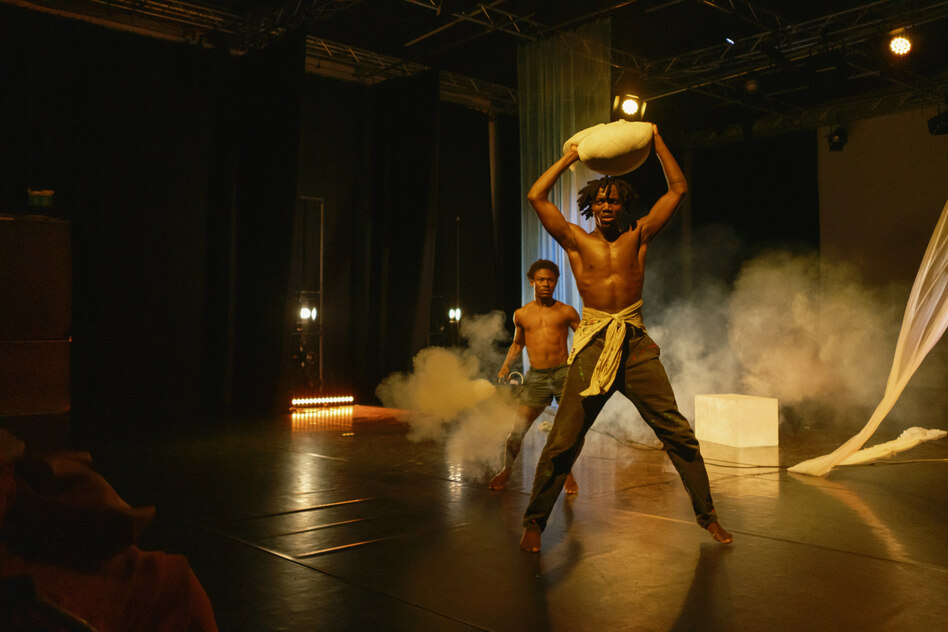
Clouds of smoke drift across the stage; at first they can only be seen as shadows on the back wall of the dimly lit stage area. Noises that sometimes sound like thunder, sometimes like volleys of gunfire, create an acoustic layer over the event. You can also see a person lying on the ground. Completely covered, he looks more like a mummy than a living creature. A second person comes in, also completely covered. His silhouette is magnified by a bundle balanced on his head.
A little later she will gasp into a microphone and make wailing sounds. The two Tanzanian dancers Tadhi Alawi and Samwel Japhet create an atmospherically very strong beginning in “The Net We Carry – Wavu Tuliobeba” on the opening evening of the dance platform “Kuyum” in the Uferstudios. The platform has been around since 2021. "I studied in Berlin at the HZT, the Inter-University Center for Dance, and realized that there was no real platform for contemporary African dance in the city. And then I simply founded one myself," says Felix Dompreh, born in Ghana but has been in Berlin for ten years.
His aim is to show works and promote practices that combine African dance traditions with contemporary dance techniques. Dompreh mentions, among others, Bamaya - a dance that originally accompanied the search for water, especially in northern Ghana - and Agbadza - initially a war dance that is now often performed at weddings, funerals and parties.
In “The Net We Carry” you can also see some rhythmic moments that refer to the foundation of traditional dances. Alawi and Japhet always associate these movement patterns with very archaic and existential-seeming motifs, such as trembling and vibration of the entire body. Injuries and trauma seem to grow out of their bodies. And in the finale their movements are actually linked to large-scale projections of images of street battles.
The second production on opening day, “Between The Oceans,” traveled between different continents. Raphael Moussa Hillebrand and Tiffani Achilleas, who are already known in Berlin from numerous productions, including at the HAU, the Ballhaus Naunynstrasse and the Berlin Festival, trace the migrant paths of their ancestors, alternating between spoken monologue and movement interludes.
Hillebrand, for example, traveled to Mali – and discovered that he was addressed as “white” for the first time in his life. Achilleas is also read in Sri Lanka as a woman from the Global North. Both find themselves surprisingly at home in the Afro-Brazilian dance and music scene in Salvador de Bahia. They gain particular prestige because – in contrast to many Afro-Brazilians – they were able to have their own experiences on the continent of origin of the descendants of the formerly enslaved.
Afro-Brazilians usually lack the resources for such trips, and the continent haunts their minds as a myth and also in widespread Orisha practices. “Between The Oceans” now brings the continents together again, not primarily through accusations of colonialism, but rather with a joy in discovering common roots and cultural practices. Hillebrand, an ex-hip-hopper who also rose to prominence in Berlin through the small party “Die Urbane”, which is currently running for the House of Representatives, primarily uses street-tested moves and combines them with dance forms from Africa and the African diaspora on other continents.
“It is important to us that traditional dance forms are included in the pieces, but that the pieces are also structured dramaturgically in such a way that our audience can follow them,” says curator Dompreh, describing the approach. Close collaboration in development is therefore also a characteristic of the platform. In addition to a show program of eleven productions in total, there is also an extensive workshop program.
“We simply want to make contemporary African dance known to a wider audience and, above all, promote recognition of both traditional and contemporary African dance,” says Dompreh as a goal. This year’s edition of the festival certainly achieved that. Due to the dancing quality and atmospheric density, “The Net We Carry” would definitely enrich “Tanz im August” next summer.
Read the full story at the source
Source: taz