
Germany · taz · · 3h
Alliance Sahra Wagenknecht: Big mouth, not enough behind it
Deutsch (original) · Auto-translated to English
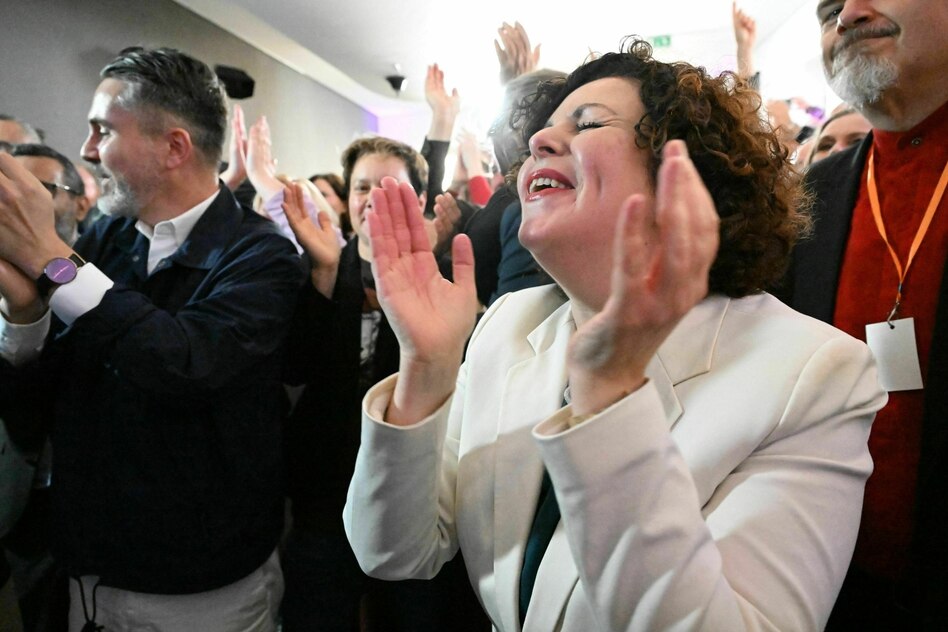
The top candidates of the BSW in Berlin and Mecklenburg-Western Pomerania agreed: After the successful Saxony-Anhalt election, they felt “tailwind”, “confirmation” and “a lot of support” on the streets everywhere. There was just something wrong with the polls. At least with those who did not see them at least 5 percent for this Sunday's elections.
Machinations, manipulation, mainstream media: “There is a hell of a lot of lying,” said party founder Sahra Wagenknecht. The exciting question was whether the round of attacks on the right-wing extremist AfD that opened after the election in Saxony-Anhalt two weeks ago attracted or deterred potential voters.
Initial projections saw the resolutely anti-Western Angry Citizens Party hovering around the 5 percent hurdle in both Berlin and Mecklenburg-Western Pomerania on Sunday evening. At the time of going to press, it was unclear whether there would be enough to enter the state parliaments, as was the case in Saxony-Anhalt two weeks earlier.
The federal chairmen Amira Mohamed Ali and Fabio De Masi emphasized at the BSW election party in Schwerin that they had fought against the wind. He now has a “broad inner grin,” said De Masi. The top candidate for Berlin, Alexander King, was also optimistic because “we are now at least scratching the 5 percent hurdle,” said King.
"After the three state elections in Berlin, Mecklenburg-Western Pomerania and Saxony-Anhalt, many questions arise that go beyond state politics. Is something currently shifting in the German party landscape? We'll discuss this live and in the stream in the Bundestalk in the taz canteen in Berlin tomorrow evening. You can register here.
The initial situation in Berlin and Mecklenburg-Western Pomerania was quite different. While in the capital it seemed irrelevant from the start for stable majorities whether the Wagenknecht party sat in the House of Representatives or not, in Mecklenburg-Western Pomerania there was a threat of chaos in Magdeburg due to the entry of the BSW. At the time of going to press, it was not clear whether these BSW hopes had been fulfilled - despite SPD Prime Minister Manuela Schwesig's efforts to catch up.
To ensure the success of her project, Wagenknecht went from market place to market place to complain about “those up there” in extensive speeches. And that there is “even more idiocy” in the current federal government than under the previous traffic light government, and that was already idiotic. She didn't dwell on the depths of state politics.
Wagenknecht had other dreams. With a view to Mecklenburg-Western Pomerania, in view of the weak CDU values, she repeatedly and close to megalomania explained: Anyone who votes for BSW can overthrow Chancellor Friedrich Merz; If the CDU is thrown out of the Schwerin state parliament and the BSW comes in, Merz will not be able to stay in office.
Even without its “traveling preacher,” the BSW focused primarily on its federal and European political evergreens at its public events in both countries: peace with Russia instead of a dictatorship of opinion, cheap gas imports instead of pension cuts, combustion cars instead of weapons for Ukraine. In short: Merz has to go, von der Leyen has to go, and Zelenskyj has to go anyway.
Individual candidates also had special requirements. “Germany must leave NATO,” said the prominent ex-leftist Sevim Dağdelen – number 4 on the BSW state list in Berlin – making her priorities clear.
The BSW leaders brushed aside the objection that such decisions are not made in state parliaments. There are Federal Council initiatives for this. There is a catch: only state governments can introduce or join Federal Council initiatives. So it would have been difficult. Finally, Wagenknecht had now issued an unambiguous order to the states: “We don’t want to participate in government.”
For Berlin, she justified her desire to co-govern with the fact that, apart from state parliamentarian Alexander King, who defected from the Left to the BSW, all other candidates lack “a certain parliamentary experience”. Which was very mean regarding the candidate Dağdelen. Wagenknecht's confidant sat in the Bundestag for 20 years.
Read the full story at the source
Source: taz