
Germany · taz · · 1h
Elections in Berlin and MV: A people's party is staring into the abyss
Deutsch (original) · Auto-translated to English
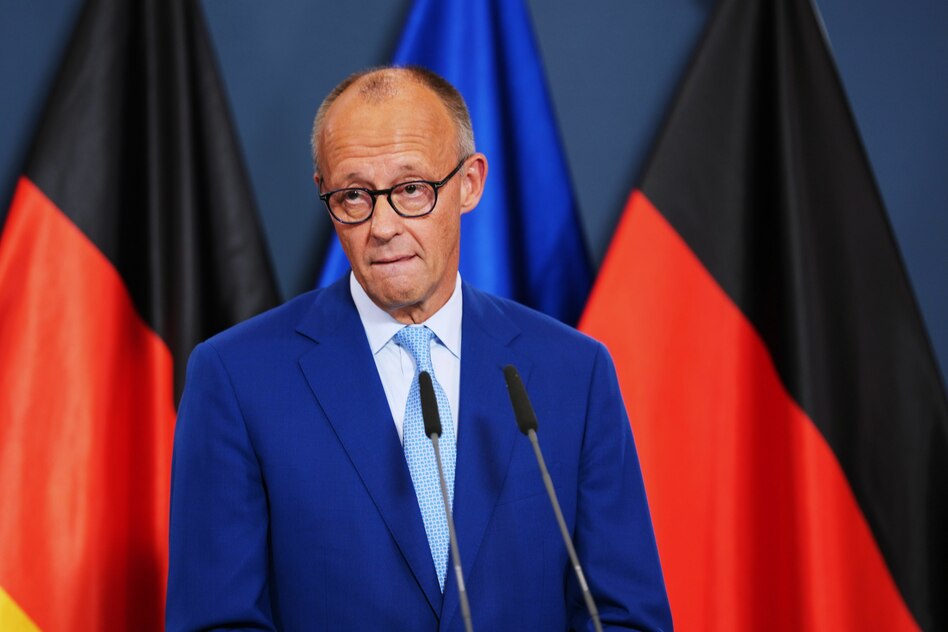
Friedrich Merz has set a new speed record. Never before had a Federal Chancellor appeared before the press so quickly after state elections. In general, it is quite unusual for him to comment on the outcome of state elections on an election evening. That was the case in 2005, when the then SPD Chancellor Gerhard Schröder, together with SPD leader Franz Müntefering, announced new elections after losing the state elections in North Rhine-Westphalia.
Merz did not want to announce something similarly dramatic. The Chancellor announces that he wants to remain steadfast and push through the reforms - as Chancellor and as party leader. “The reforms have to come now,” said Merz, adding that he takes responsibility for this.
Although his appearance was announced at short notice, Merz had prepared himself and came up with an almost poetic justification: the reforms were the remedy against the authoritarian poison that was penetrating ever deeper into society with the fascination of authoritarianism. “What needs to be done now requires backbone, steadfastness and patience,” said Merz, and he will have both.
The Chancellor is trying to flee forward. Merz didn't allow any questions, but questions remain unanswered.
The election results in Mecklenburg-Western Pomerania in particular are dramatically bad. According to the first projection, the Christian Democrats only achieved a result of just over 5 percent in the regional state and have to worry about entry. Merz himself called the result “a disaster.”
It is not only the worst result for the party in Mecklenburg-Western Pomerania, which was the Prime Minister here until 1998. It is also the lowest result that the CDU has ever achieved in a state election. Top candidate Daniel Peters spoke of “a difficult hour”.
However, if the CDU fails to enter the state parliament, which was not yet certain at the time of going to press, it would also be the first time that the party fails to pass the 5 percent hurdle in a state election. The CDU is looking into the abyss.
"After the three state elections in Berlin, Mecklenburg-Western Pomerania and Saxony-Anhalt, many questions arise that go beyond state politics. Is something currently shifting in the German party landscape? We'll discuss this live and in the stream in the Bundestalk in the taz canteen in Berlin tomorrow evening. You can register here.
This greatest possible accident would probably reignite the discussion about replacing the Chancellor, which has just been laboriously suppressed, and Merz's appeal is unlikely to change that.
In Berlin, where the Christian Democrats ended up with 20 percent according to projections, they will clearly have to admit defeat to the Left Party.
According to the first forecast at 6 p.m., it is very, very quiet in the ballroom on the third floor of the Berlin state parliament. The first election goal was to be ahead of the Left Party, in which top candidate Stefan Evers sees extremists at work. The federal party leadership around Friedrich Merz had also hoped for an election victory based on percentages.
As the Left Party's purple bar rises higher and higher, someone says: "I think I'll go." Another asks the person next to him whether he had already sold his condominium before it was taken away from him - an allusion to the left's expropriation plans.
The poor performance of the Christian Democrats did not come as a complete surprise. An unambitious election campaign in the northeast and there, as in the capital, two top candidates with no real appeal and an extremely unpopular CDU Chancellor did not provide any tailwind. In Mecklenburg-Western Pomerania, only one percent of CDU voters thought Merz was helpful in the election campaign. The fuel discount and fuel price cap that was hastily announced on Friday could no longer change the mood.
In Mecklenburg-Western Pomerania, the local top candidate Peters never had the chance to slip into the role of challenger to incumbent Manuela Schwesig. In the head-to-head race between the SPD and AfD, the CDU was simply not needed. In surveys conducted by the Elections Research Group, 78 percent of their own supporters stated that they preferred Schwesig as Prime Minister.
Even before the election Sunday, the Mecklenburg-Western Pomerania CDU threw in the towel, decided not to conclude the election campaign and wanted to largely decide on the election results among themselves and out of the public eye. Only after the media complained did the party quickly change its sulk plans and invite people to the Schlebusch dance school in Schwerin.
It would be mathematically possible to be chosen as a partner to form a government if the party remained in the state parliament. However, the SPD could give preference to other partners, namely the Greens and the Left, because the majority and the overlap would be larger.
In Berlin, Finance Senator Evers was substituted as the top candidate at short notice against Governing Mayor Kai Wegner, who finally stumbled in July over false allegations about his behavior during the Berlin power outage that lasted several days at the beginning of the year.
Evers can no longer even hope for a CDU-led government with the Greens and SPD. According to the initial forecast, such a Kenya coalition was one of two possible alliances beyond the AfD.
Evers appears composed as he makes his way through the waiting party members and journalists. Staccato applause accompanies Evers. He admits defeat on stage: he congratulates the strongest force, the Left Party – “that’s right.” Evers speaks of a “respectable success”, but also says that the result makes him humble. “We are coming from an extraordinarily good result that we achieved in the 2023 election and have lost significantly today.” This is “no reason to be happy”.
Hard questions now arise for the federal CDU: How will it position itself in the coalition with the SPD, and how ambitiously can it actually implement its own reform ideas? The SPD is drawing new self-confidence from the election results in Mecklenburg-Western Pomerania and has a strengthened top woman in Schwesig, who has persistently criticized the reform course and especially the end of the so-called pension at 63.
However, a battered and highly insecure CDU will not be prepared to make any further concessions. The tone in the coalition is unlikely to become more conciliatory after these elections.
Read the full story at the source
Source: taz