
Politics · Novara Media · · 2h
How Zohran Mamdani Helped Germany’s Left Party Win in Berlin
English (original) · Read in Deutsch ⇄
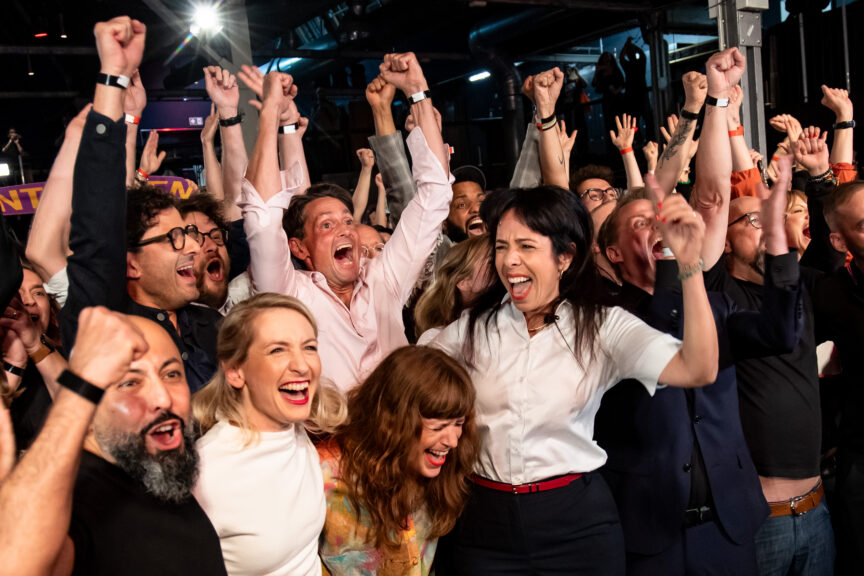
In Berlin’s state elections, Germany’s most leftwing party Die Linke has won a significant victory – the biggest in its recent history. It could also mean that the city gets its first mayor from the party since the fall of the Berlin wall.
That’s partly due to the apparently infinite influence of New York City mayor Zohran Mamdani, whose team helped supercharge the German left with the infectious positivity he’s world famous for. But it’s also down to policy – and in particular a long-standing pledge to expropriate housing from the private sector for public supply in a city where rents have soared by 70% in the last decade.
Die Linke’s Elif Eralp, a human rights advocate sporting a ‘rent cap’ necklace, may well become Berlin’s first anti-capitalist mayor. The daughter of Turkish immigrants, she led the party to a clear victory in Berlin’s Sunday election, taking 26% of the vote – several points over what the polls predicted, by running on a platform squarely targeted at Berliners’ cost of living.
It all came with a little help from some friends. According to the Washington Post, in the weeks leading up to the race, Die Linke sent a delegation to New York to meet with advisors to Mamdani. “The success of a democratic socialist in New York, the heartland of capitalism, is a huge achievement,” Eralp said last week, “We’ve exchanged a lot of ideas.”
Die Linke, which has more than doubled its membership since 2024, was an early adopter of some of Mamdani’s techniques, not least of all a massive ground game and lashings of social media flare in last year’s federal election. In Berlin, they took another leaf from his policy rule book: keep it simple and keep it real.
Simple and real the campaign was, with a laser focus on Berlin’s mounting housing crisis.
Throw a stone in Europe, and you’ll hit a major city in a housing emergency. Crippling rents, gobbling Pac-Man-like one steadily increasing chunk of your paycheck after another, are increasingly the complaint not just of the under-30s, but many of those knocking up against midlife. And Berlin, a city where 84% of the population rent, and more than half from private landlords, is no exception.
The monthly extortion that is the city’s rental market has been blamed for any number of social ills. Last year, Berlin’s birth rate dropped by 5% on 2024. At the same time, some 160,000 people (a growing trend) are thought to have left the city, many for cheaper housing elsewhere. Ten percent of Berliners live in housing poverty.
It’s a problem that’s been long-brewing. A 2021 referendum saw Berlin’s residents vote in favour of the city’s government seizing privately-owned flats from large corporate landlords. While it wasn’t binding, what it proposed appeared legal, with Germany’s 1949 constitution – the Basic Law – giving the state the right to bring private property into public ownership in exchange for appropriate compensation to former owners.
Late last year, a law drafted by political supporters inched the referendum towards a concrete reality. Enacting that law and forcibly buying back 220,000 flats from multinationals like Vonovia at around 60% of market value was a major plank in Die Linke’s pitch. Another was rent caps. And that – no duh – seems to have worked.
The result puts Die Linke far ahead of their nearest challenger, the centre-right Christian Democrats (CDU). That’s the party of Germany’s beleaguered chancellor Friedrich Merz. But in order to govern, it’ll need to enter a three-way coalition.
Treachery aside, it’ll include the German Greens, who came fourth in this election also on a commitment to push the property law through. Die Linke will need the support of the centre-left too, in the form of the market-friendly Social Democrats (SPD), whose collapse in support has pushed them to a distant fifth. They previously ran the city in coalition with the CDU. Surprise, surprise, the party’s lead candidate in the city has already said he’s against expropriation.
I predict Sturm und Drang ahead.
Germany’s far-right party, Alternativ für Deutschland (AfD) also did better than expected in Berlin on16% of the vote, with its leader bitterly claiming that Die Linke wants to shoot the rich. It also won – though very narrowly – another state election on Sunday. In north-eastern Germany’s Mecklenburg-Western Pomerania, it grew its voteshare by a stonking 21%. It won’t have any direct power, though, with close runner-up the SPD, the Greens and Die Linke likely able to govern in coalition.
All this spells more trouble for Merz, with his party all but wiped out in the state. Combined with the AfD’s victory in Saxony Anhalt just two weeks ago, the chancellor looks increasingly ill-equipped to deal with a growing crisis. Meaning the sharks in Merz’s own party are circling, perhaps not before time.
Read the full story at the source
Source: Novara Media