
Politics · taz · · 1h
Left wins House of Representatives election: Berlin turns red
Deutsch (original) · Auto-translated to English
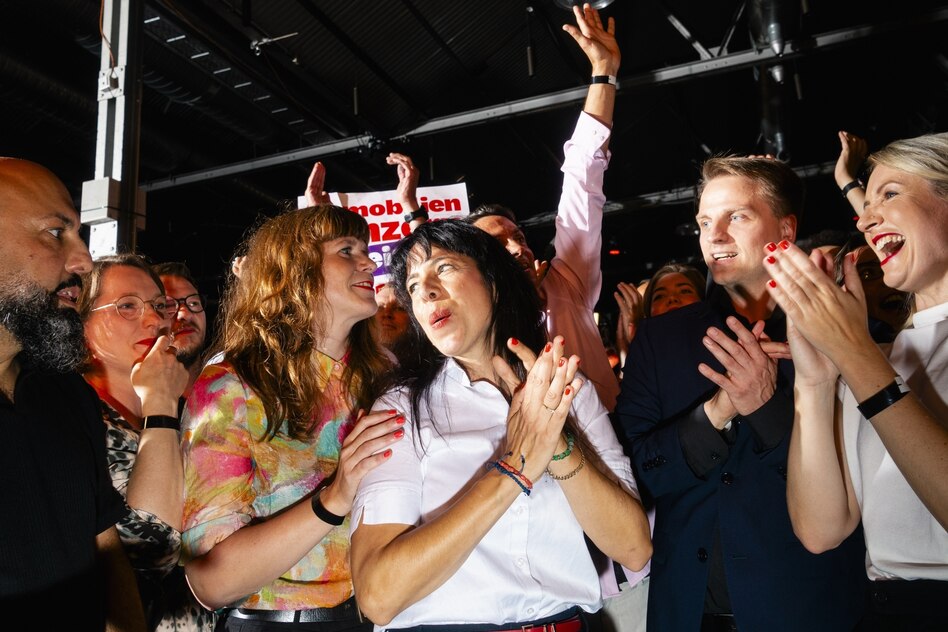
Elif Eralp is the radiant winner of the Berlin House of Representatives election. At 25.5 percent, the Left's lead over the CDU, which ends up at around 20 percent, is clear - and larger than predicted. At the central election party in the Kreuzberg festival hall, the comrades lie in each other's arms, shouts of "Elif! Elif" echo through the hall.
Just ten minutes after the first forecast, Eralp takes the stage. She says: “From today on we will change our Berlin together and make it a better place.” In the city, “love and justice won over hate.” She is interrupted by shouts of “Alerta, Alerta, Antifascista” from her supporters. Because everyone here knows: The Left's success also helped keep the AfD in check. “This signal goes out into the world,” shouts Eralp.
In her 20-minute speech, Eralp then thanks everyone who supported her and made this result possible: her family in Turkey, as well as everyone who supported her with election calls, both people from the cultural sector and the trade unions.
The Left's strategy worked completely in this election campaign: Although MP Eralp was unknown to most voters, her party agreed a year ago to make her the top candidate and from then on staged a duel between Eralp and the CDU, acting as if the SPD and the Greens - hitherto at a similar level in the polls - didn't even exist.
Eralp against Evers - the CDU's top candidate - was recently shown on all channels: in a duel on several private TV channels, on the covers of national newspapers and also in countless viral web videos. At the Left's end of the election campaign on Friday in front of the Red Town Hall, Eralp was accompanied by more journalists than the state party has probably ever experienced. While a possible CDU victory only promised “business as usual”, the expectation of a left-wing victory caused emotions to run high. The top candidate promised: “We will write history that will not only be heard in Germany.”
"After the three state elections in Berlin, Mecklenburg-Western Pomerania and Saxony-Anhalt, many questions arise that go beyond state politics. Is something currently shifting in the German party landscape? We'll discuss this live and in the stream in the Bundestalk in the taz canteen in Berlin tomorrow evening. You can register here.
With the staged duel, the Left has now overtaken the other two parties of the center-left bloc in Sunday's election: it has clearly left the Greens behind with around 15 percent, and has even outclassed the SPD, which still has 12 percent. And yet: Without the two parties as partners, Eralp will not be the next governing mayor of Berlin.
25.5 percent of the vote: This is a historic high for the Left in Berlin. In 2001, the PDS under Gregor Gysi got 22.6 percent as a result of the banking scandal, but this was only enough for third place.
First place in the capital is a turning point and of great symbolic importance - also as a response to the growing right. The Left also wins a state election for the first time with the help of West Berlin districts. Their strongholds are spread across the city.
It was only two years ago that the party was weakened by the dispute over Sahra Wagenknecht and was also moving towards the 5 percent limit in Berlin. But since then things have been looking up, even with new momentum after the federal election. 10,000 people joined in Berlin; No party has such a presence in the capital, with tenant meetings, door-to-door conversations, garbage collections and on social networks. The party knocked on a quarter of a million doors, Berlin party leader Maximilian Schirmer announced at the end of the election campaign - “no party has ever achieved this in a state election.”
But that alone does not explain why the Left was able to repeat and even expand on its success in the federal election, in which it was also ahead in the city. A big factor is the candidate herself, who was able to stand out from her competition simply because she is not a man named Stefan or Steffen. Eralp didn't even have to highlight her migration background, but in a city where 42 percent of the residents have an immigration background, many of whom are of Turkish origin, that's a big deal. One of their messages was that “it is not intended that any of us will be able to do this.��� And after the election in Saxony-Anhalt, Eralp confidently declared itself the “answer to the AfD”.
At the same time, Eralp not only made no mistakes in the election campaign, but also became increasingly confident. Her speeches no longer sounded like they had been memorized; she authentically conveyed that she knew the big problems Berliners faced from her own life, for example that she herself was looking for an apartment as a mother. As a hands-on candidate with the goal of “embracing politics,” she came ever closer to the oft-quoted comparison with New York Mayor Zohran Mamdani, even if the big personal hype in the city failed to materialize.
The only disturbing noise in recent weeks has been the unwillingness of parts of their party not to overextend Palestine solidarity into anti-Semitism, especially after a rapper praised the “Initifada” at a Neukölln Left election campaign event. Eralp himself, who had been active in anti-racist work for a long time, credibly conveyed his stance against anti-Semitism and racism, but did not have to talk about any other topic so often.
She herself received support through an election call from survivors and relatives of victims of right-wing attacks. Not a call for the left, but one for Eralp. The extent to which the defiant parts of the party have damaged the party will perhaps only become clear in future exploratory or coalition talks.
The Left not only scored points with its candidate, but also in terms of content, with its focus on rents, garbage and local transport. Eralp's golden "rent cap" chain was more than a gag, but rather an expression of the fact that the party had succeeded in being the most credible offer for the city's abused tenants. Rent checks and heating cost checks gave practical help to tens of thousands, as did meetings in large housing estates against inactive or brazen corporations. In addition, there is a range of rent policy measures that are in the drawer - and the promise to finally push forward the socialization of the large real estate groups.
The implementation of the successful referendum in 2021 is likely to be the biggest stumbling block in talks for a left-wing alliance. SPD leading candidate Steffen Krach rejected the plan in advance. But Berliners did not reward this attitude of the SPD.
Read the full story at the source
Source: taz