
Germany · taz · · 1h
Ban on stumbling blocks in Heidenau: Saxon mayor does not respond to criticism
Deutsch (original) · Auto-translated to English
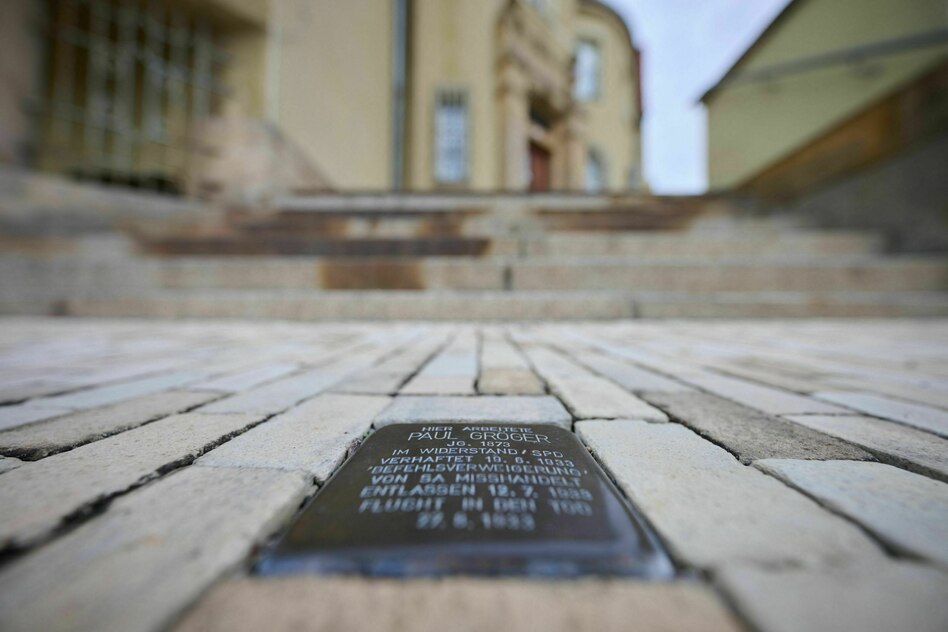
The decision against stumbling blocks in the Heidenau city council pushes the memory of victims of National Socialism out of everyday life. This is the criticism of the International Auschwitz Committee, the Jewish communities in Saxony and Federal Minister Karin Prien (CDU), among others. But does that change anything? Even when asked, Mayor Conny Oertel (independent) does not respond to the reactions. “The city of Heidenau does not generally close itself off from commemoration,” is all she answers.
A week ago, the city council decided to reject all applications for new stumbling blocks in the future. The initiative was supported by CDU and AfD members. The city councilors justified the idea by saying that people ignore the stumbling blocks and thus the names of the Nazi victims. This is not “dignified remembering”. Instead, a “memorial area” should be created in the northern cemetery, dedicated to the victims of “war, terror, dictators, expulsion and especially National Socialism in Heidenau”.
The stumbling blocks go back to the artist Gunter Demnig. They are small brass plaques embossed with the names of victims of the German Nazi dictatorship. There are now more than 116,000 stumbling blocks in more than 30 countries, mostly in front of the last voluntarily chosen place of residence or place of work of the victims. So far, five stones in Heidenau commemorate the SPD mayor Paul Gröger and the Jewish Reiner family.
The Alternative Culture and Education Center (Akubiz) applied for an application in February 2025 for two additional stones to commemorate the couple Fritz and Martha Goldstein, who were deported because of anti-Semitism. Anne Nietschke from the association's board says: "We have asked several times, but have not received any response so far." According to Mayor Oertel, the stones will be rejected in accordance with the new decision.
In a statement on Wednesday morning, she again criticized the fact that a “media distorted image” of the city was being spread. The previous stumbling blocks would not be removed, she assured. Although there will be no new stumbling blocks for the victims of National Socialism in the city, there will be a memorial area “for the victims of war, terror, dictators, expulsion and especially of National Socialism”.
It is not yet clear whether the area will be built in the northern cemetery, where there is currently a memorial stone for the victims of National Socialism. Which “dictators” are we talking about exactly? There are no concrete plans for this yet either.
But it is precisely this alternative suggestion that Shoah survivor Charlotte Knobloch believes is not sufficient. She says herself: “I was never a fan of the concept of stumbling blocks.” But decentralized commemoration, which “permeates and shapes” the public space not in one place but rather in a distributed manner, is, according to Knobloch, crucial “for a real culture of remembrance.”
Removing places of remembrance from the cityscape, as is now happening in Heidenau, is “in any case the completely wrong approach,” says Knobloch – and then criticizes the CDU: “I am horrified that a democratic party would give in to supporting such a transparent maneuver by the extremists from the AfD.”
But there is also criticism of the joint decision in Heidenau from the CDU. Tom Unger, General Secretary of the Saxon Union, says, for example: “As a CDU state association, we support the laying of stumbling blocks as a form of commemoration of the heinous crimes of National Socialism.” When discussing living remembrance, it is important “to include the Jewish communities in particular.” Fundamentally excluding any form of commemoration “is the wrong approach,” says Unger. In response to a taz query, the regional association of Jewish communities in Saxony said that they were not included in Heidenau.
The CDU Federal Education Minister Karin Prien describes the city council decision in Heidenau as a “scandal”. She hopes that the city council will reconsider and reverse the decision, Prien told the Evangelical Press Service on Tuesday during a visit to Leipzig. There she demonstratively placed flowers at eight stumbling blocks.
Meanwhile, there is at least a small development in Heidenau. On Wednesday, Mayor Oertel said for the first time, even if only in passing: The city administration is also examining options for a decentralized memorial site.
Read the full story at the source
Source: taz