
Germany · taz · · 43m
Preliminary discussion between the Left, the Greens and the SPD: All or nothing
Deutsch (original) · Auto-translated to English
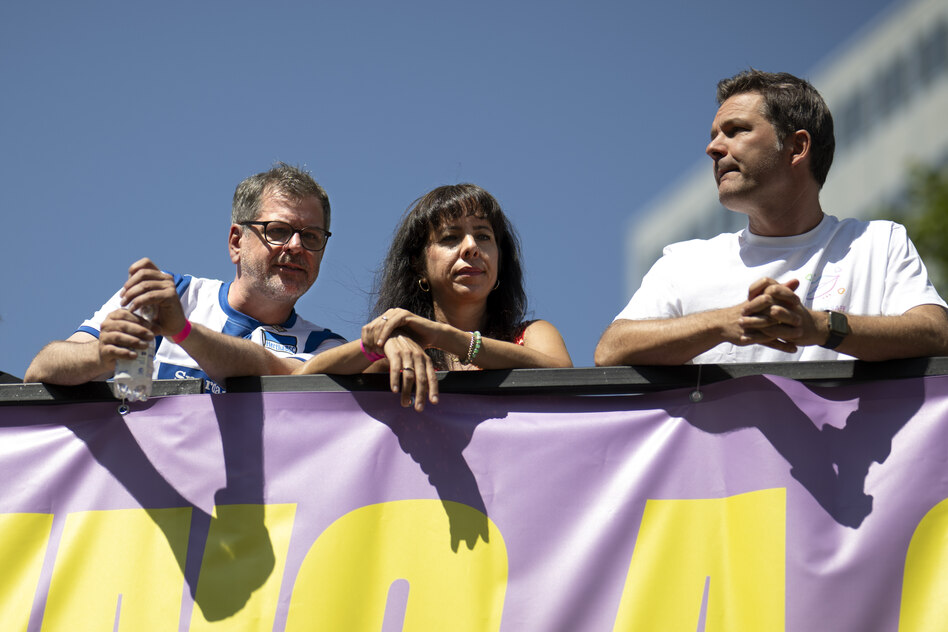
The Left Party, the Greens and the SPD want to meet this Thursday for a mere “preliminary discussion” in order to discuss fundamentals before exploratory discussions and coalition talks. What sounds simple is very important: At this meeting, the Left Party is supposed to present something about how it deals with anti-Semitism that will convince potential coalition partners. “Agreement on this is a basic prerequisite for explorations,” say the Greens and SPD. Which means: Thursday is the day of Hopp or topp, Duck or Trente.
Immediately after the House of Representatives election, Green Party lead candidate Werner Graf called for a “mechanism” from the Left Party in a press conference. It must “put anti-Semitism in its ranks” more than before. Graf did not want to make individual suggestions - that was the responsibility of the Left Party, he answered questions about it.
According to RBB, the parliamentary and state executive committee of the Left Party has now decided that the future parliamentary group in the House of Representatives will stipulate in its statutes that its members take a position against anti-Semitism. A spokeswoman for Graf declined to comment on whether this met his call for a “mechanism.” That's exactly what the conversation on Thursday will be about, she says.
The spokesman for SPD state leader Steffen Krach, the top candidate in the election on September 20th, also referred to the meeting to the taz: “We won’t say anything beforehand.” Over the past few weeks, Krach has repeatedly said that simply signing an anti-Semitism paper without clear sanctions is not enough for him. It was heard from those involved on Wednesday that the conversation could not be completed on Thursday, but might continue on Friday. They said they wanted to give themselves enough time.
The importance of the meeting can also be seen in how intensively leading national media are reporting on a possible left-wing alliance at the state level. On Wednesday, the Frankfurter Allgemeine dedicated the lead of its print edition to the fact, which has long been public knowledge, that the possible future governing mayor Elif Eralp was a member of the Rote Hilfe association.
The Federal Office for the Protection of the Constitution mentions Rote Hilfe e. V. in its most recent report on page 219 in the chapter “Left-Wing Extremism”. It says about the association that it tries “to discredit the security and judicial authorities as well as constitutional democracy through opinion-forming public relations work.” Eralp stated her membership for two previous editions of the state parliament's handbook of representatives (2022 and 2023), of which she has been a member since 2021. This information is not available in the current MP portrait available online. According to the Left Party, Eralp left the club in 2025 before she became the top candidate.
In 2017, the former Juso federal leader Franziska Drohsel stumbled upon a previous Red Aid membership when applying. She was supposed to become a city councilor for the SPD in the Steglitz-Zehlendorf district. But the CDU voted against her in the district assembly; there was no majority for Drohsel. At that point, she had not been a member of Rote Hilfe for almost ten years: she had left the club shortly after she became head of the Juso in 2007. The CDU also justified the non-election by saying that Drohsel was perceived as a “polarizing figure” when she was introduced.
A look back at the 2011 House of Representatives election shows that it makes sense to discuss a major controversial issue in advance and not enter into coalition talks without clarification. At that time, the Greens almost saw themselves in the Red City Hall with federal politician Renate Künast, but ultimately only ended up in third place behind the SPD and CDU.
There was potato soup at the exploratory talks, in which Bettina Jarasch was also involved as the Green Party's state leader at the time, later the top candidate in 2021, 2023 and 2026. The mood is said to have been good and in the end there was apparently nothing against coalition talks between the Social Democrats and the Greens. Prime Minister Klaus Wowereit (SPD) also flirted a bit with the CDU, with whom he would have a larger majority in the House of Representatives. But that could be seen as a tactic to be able to negotiate more with the Greens later.
But the coalition negotiations were over before they had even begun. Because the SPD and the Greens had postponed the explorations until this day, the clarification of the extension of the A100 - the three-kilometer-long section of the motorway that was opened in August 2025. Wowereit definitely wanted this expansion, even if not the entire SPD. The Greens, on the other hand, had clearly decided against it: “There will be no Green signature on a coalition agreement that states that the government will continue to build the A 100,” said their parliamentary group leader at the time, Volker Ratzmann.
Both parties emerged from the explorations with an unclear compromise. Tenor: Efforts should be made to be able to use the money provided by the federal government for other projects, but without completely giving up on further construction. That sounded wrong the moment the SPD and the Greens first formulated it after their explorations.
At 11 a.m. on October 5th, the two negotiating groups sat together in the Red Town Hall - and an hour later it was over. On the same Wednesday, the SPD state executive committee decided to offer the CDU coalition talks. A week later, on October 12th, negotiations between the SPD and CDU began, and around five weeks later the draft coalition agreement was finalized - and five years of red-black politics.
Read the full story at the source
Source: taz