
Germany taz
Playing Chess: In the Legitimacy Crisis
Classic chess was hardly able to take advantage of the pandemic boom and no longer seems up to date. But new attempts depend too much on Magnus Carlsen. more...
Deutsch (original) ·Auto-translated to English
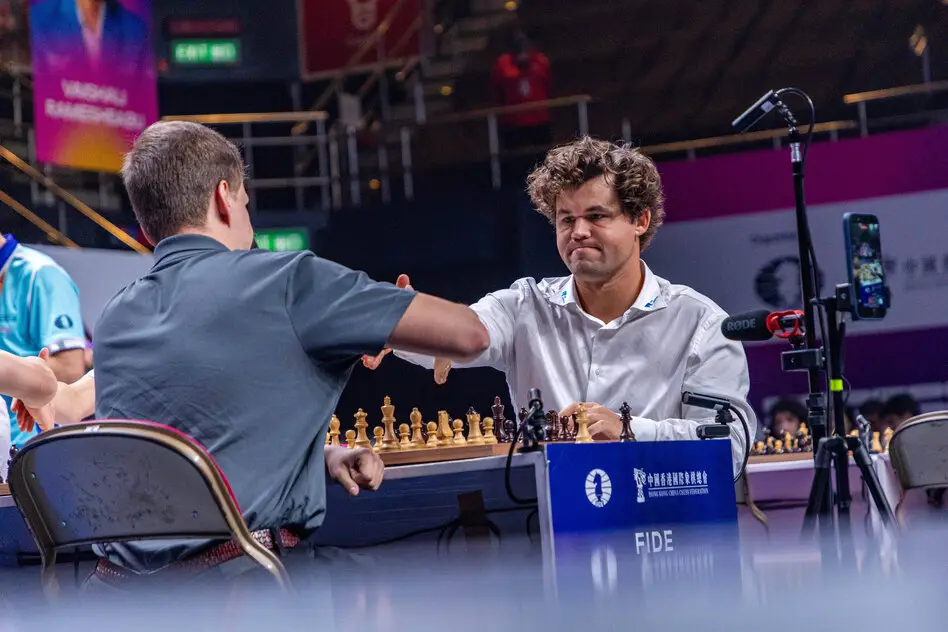
One might think that chess fans would be particularly blessed this November: not only will the fight for the individual world championship take place from the 22nd, where defending champion Gukesh and his challenger Javokir Sindarov will compete against each other in Geneva. No, right before that, from November 10th, the rest of the chess elite will meet to play the final of the Total Chess World Championship - a combination format of different tenses to choose the most complete chess player of the year.
How come two of the most important chess events of the year take place just days apart? In terms of attention economics, isn't it a mistake to send two such prestigious events one after the other?
There is currently a lot of upheaval in the chess world, which is largely due to the fact that the world federation FIDE is significantly weakened. Traditionally, the organization of world chess is Russian-run, but since Russian players only appear sporadically in the extended world elite, the operational basis is missing here. With Russia's attack on Ukraine, not only did many second and third-tier players leave the country, the sanctions also affected high-ranking FIDE officials, including the president, Arkady Dvorkovich. Dvorkovich was Vladimir Putin's personal economic advisor until 2012 and later deputy prime minister.
Three people ran for the election of the new president, including two Germans: the erratic billionaire Wadim Rosenstein, the tech manager Jan Eric Buettner and - as a candidate not only of the Kremlin, but also of the increasingly influential Indian association - the Kazakh millionaire Timor Turlov, who ultimately won the election.
The challenges are numerous, as dissatisfaction with the umbrella organization, particularly among top players, is growing. It seems to many that the chess boom as a result of the pandemic and the Netflix series The Queens Gambit has not been sufficiently exploited and that FIDE is slowing down further development in the professional field more than promoting it. For example, the (at best amateurishly produced) YouTube streams of important FIDE events regularly only attract a handful of thousand viewers: these are not numbers that attract sponsors.
The gap left by the world association is being used by various new players in the hope of making chess profitable. One of these numerous players is Jan Eric Buettner, who for this purpose works closely with, among other things, what is still the best chess player of the present day, perhaps even of all time, Magnus Carlsen.
FIDE's driving forces are the Individual World Championship and the Chess Olympiad. Since Magnus Carlsen gave up his world title undefeated in 2022, the title has lost a lot of its aura. It is currently a second-class award, all the more so because the reigning defending champion Gukesh has been in a creative crisis for months and is currently only ranked 26th in the world.
The crisis of legitimacy of classical chess – the undisputed supreme discipline for at least 150 years – is also related to the developments in chess programs. The massive advances in opening theory made by various software require more hard work and come at the expense of players' creativity. Accordingly, it is not only Carlsen who prefers other formats (for example with shorter thinking times), other top players such as world number two Hikaru Nakamura and Alireza Firouzja have also taken a prominent position against classical chess. Also because the long reflection times for viewers are no longer considered contemporary.
Attempts to renew and popularize sport are numerous. One of them is the Total Chess World Championship, which is supported by Norwegian sponsors. In addition to Carlsen, Fabiano Caruana, the two young stars Nodirbek Abdussatorov and Praggnanandhaa as well as the currently best German player, Vincent Keymer, will also compete there. The scheduling shortly before the World Cup duel can also be understood as a declaration of war on FIDE.
However, it is questionable whether the calculation will work to establish new forms of chess more strongly. Because in this whole development a lot depends on the name Magnus Carlsen. His fiercest competitor of the last few decades, Fabiano Caruana, put it relatively dryly: "If Carlsen wins (the event), we will say: That proves that the world championship is superfluous. If he loses, the new winner was just a coincidence." And it is this circumstance above all that takes away a lot of the tension from chess. The result of both tournaments has already been determined in advance. Namely that Magnus Carlsen is the best player in the world, if not of all time.