
Politics · taz · · 1h
Perspectives from Saxony-Anhalt: Everything is possible, but from the left
Deutsch (original) · Auto-translated to English
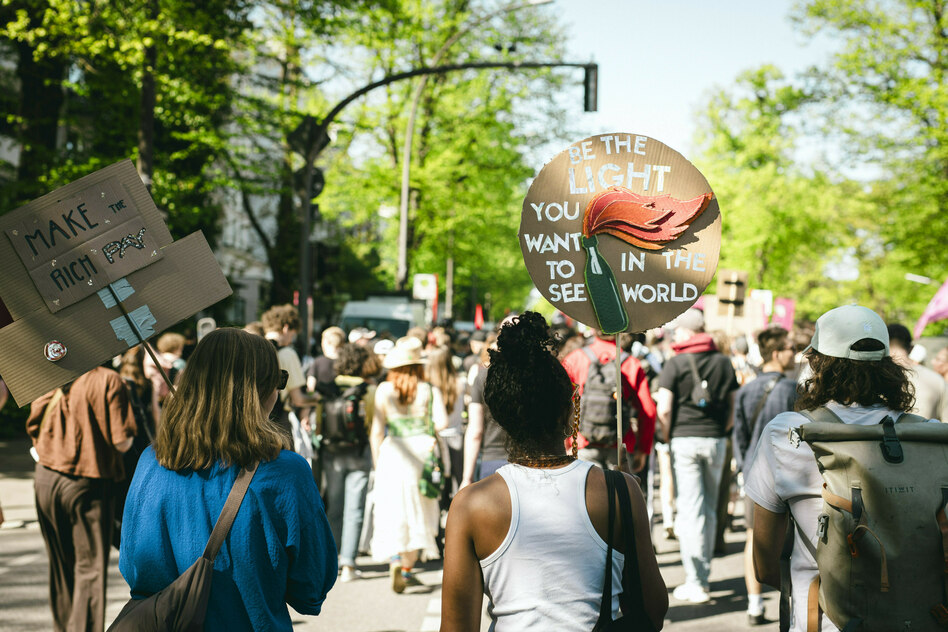
Fascism has been here for a long time, it's just unequally distributed. The singer Achan Malonda said this at an anti-AfD demonstration over two years ago. What she meant: For people like Oury Jalloh, who burned to death in a Dessau police cell, fascism had long been there. And also for the nine people who were shot by a right-wing extremist in Hanau in 2020.
Nevertheless, the AfD election victory in Saxony-Anhalt is a turning point. Because with him, schools, administrations and the police could now officially be subordinate to right-wing extremist politicians. What does this mean for the people who will be directly affected by this policy?
For example, there is Alan Achehab from Halle an der Saale. Achehab is 36, he works as an integration officer in a hospital, has lived in Germany for 30 years and speaks perfect German. He tells me on the phone how he and his five-year-old son were recently harassed on the tram by a white woman because his son was eating a pretzel. “Doing this with you doesn’t teach you any decency?” And finally: “Take the tram straight to your hometown!”
There is a 40-year-old man from Magdeburg who fled Syria to Germany in 2015 and only wants to speak to me anonymously. He does wage work and is politically active. When he saw the election results on Sunday, he was shocked. He has been worried for a long time because the AfD in Saxony-Anhalt is calling for the establishment of “voluntary citizen guards” in its election program.
You are reading a text from our weekly taz newsletter TEAM FUTURE. If you would like more perspectives like this, subscribe to the constructive newsletter on climate, knowledge, utopias. Every Thursday you will receive an email from us with strong thoughts for you and the planet.
🐾 Sign up now for the TEAM FUTURE newsletter – free of charge
In what spirit they could act he heard from an acquaintance who walked past Hasselbachplatz in Magdeburg on election night. A group of people had gathered there to chant together: “Germany for the Germans, foreigners out!”
There is a 33-year-old woman from Saxony, where the AfD is polling at over 30 percent. She is the daughter of Vietnamese contract workers and she also wants to remain anonymous. In the last month alone she has been insulted on the street three times. Every time by men. First with disparaging looks, then with whispers, then quite openly: “Fucking Koreans!”, “You live on our tax money!”, “Fuck off!”
If she had been alone, she might not have objected. But this time her four-year-old daughter was there, tugging on her sleeve and saying, “Mommy, I’m scared.” So she stood in front of them and yelled, “Stop scaring my daughter!”
All attacks took place in public places, at the train stop, in front of the supermarket. Many people stood there. And yet no one said anything. Only after the situations were over did isolated observers approach those affected.
“We are taking our country back,” is how top candidate Ulrich Siegmund has repeatedly described the AfD’s mission in Saxony-Anhalt. AfD voters should feel as if they had been robbed. As if something that was rightfully theirs had been taken away from them.
To describe this “something”, the philosopher Eva von Redecker coined the term phantom possession. The bullying people on the tram or in the square in Magdeburg also tried to defend something that doesn't belong to them - for example the right to decide where non-white people belong.
Historically, overcoming inhumane systems such as slavery or formal colonialism represent progress. But: “What equality means to some after overcoming domination appears to others like an unreasonable amputation,” writes von Redecker.
In the context of capitalism in which food and housing are becoming increasingly expensive, factories are threatened with closures and experiences of loss and fear of failure are part of everyday life, the AfD's offer is attractive. While the liberal promise that anyone can make it with hard work is dashed by reality, the AfD promises that “real” Germans will soon be able to feel like they have property again. At least as a phantom owner.
Indulging in deportation fantasies “until the runway glows,” as Ulrich Siegmund says, does not change the power relations that produce the social and material frustration that many people in Germany feel. It doesn't change the fact that one percent of people in Germany - all millionaires - own over half of the private assets.
For them, the AfD's racism is even a useful tool for maintaining power. Because a working population divided by racism does not turn against the owners. They tear each other apart.
Alan Achehab supports nursing staff from El Salvador in the hospital in Halle so that they are doing well despite the racism in Saxony-Anhalt. He trains colleagues not to respond to the wishes of patients who demand white doctors and nurses.
It takes courageous people like Achehab who stay on site despite the AfD. But their commitment alone will not be enough if democratic politicians have nothing more to offer than maintaining a system whose social and environmental failure is becoming increasingly obvious.
“Everything is possible” was put up by Ulrich Siegmund in Saxony-Anhalt, mobilizing 170,000 non-voters, almost twice as many as all other parties combined. “Everything is possible” would also have to be said from the left in order to go against the AfD’s promise.
The campaign to socialize large real estate groups in Berlin has shown that the time is ripe for fundamental, even radical change. She has achieved what the social scientist Andrej Holm described to me a few weeks ago as a “small social miracle”.
In the fight against displacement and excessive rents, house communities came together across all cultural and social differences. When it came to their own home, the Turkish conservative family, the CDU voter and the anarchist also pulled together, says Holm.
The AfD's racism wants to divide us. Appeals to tolerance and respect will not stop him. To fight him, we have to leave capitalism's “us against each other down here” behind us. And create more places where it becomes a “us together against the profiteers”.
Read the full story at the source →
Source: taz