
Politics · taz · · 2h
123 runoff elections in Lower Saxony: Greens triumph, AfD loses
Deutsch (original) · Auto-translated to English
There were 123 runoff elections in Lower Saxony on Sunday. Two weeks after the local elections, those eligible to vote were called upon to once again provide clarity - namely where none of the district administrator, mayor and mayoral candidates immediately achieved an absolute majority in the first round of voting.
The Greens were able to feel like the winners of the evening: they not only won the town hall in Hanover again, but are now also the mayor of Göttingen. 33-year-old Onyeka Oshionwu won with 62.95 percent over Ehsan Kangarani from the CDU.
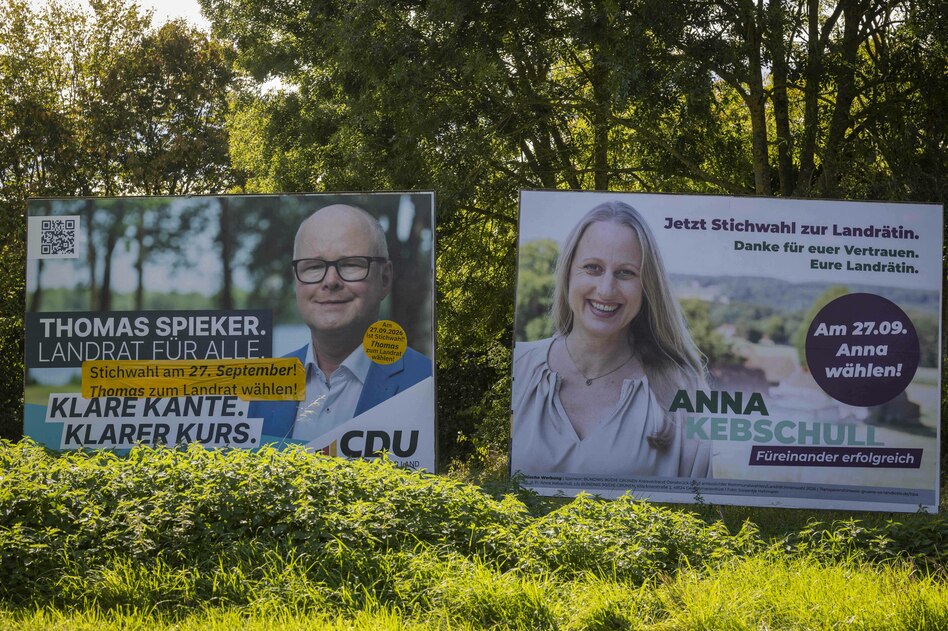
In Lüneburg, Claudia Kalisch defended her mayoralty a little more narrowly; with 52.92 percent, she was ahead of Heiko Meyer (The Independents). Anna Kebschull is starting a second term as district administrator in the Osnabrück district. With 64.7 percent, she clearly left her challenger Thomas Spieker from the CDU behind. Both formally ran as individual candidates and thus received the election recommendations of other parties.
And Anna Kebschull is no longer the first and only Green district administrator in Lower Saxony: In Osterholz, a Green, Kim Fürwentsches, also won. The previous mayor of the municipality of Lilienthal received 58.13 percent of the votes, his competitor Michael Harjes (SPD) 41.87 percent.
This is also a great triumph for the Greens because it allows the party to prove that it is also gaining in importance as a municipal force outside of the traditional strongholds, i.e. the university towns. Green candidates also prevailed in the runoff elections for mayor or joint municipal mayor in several smaller municipalities. The Greens were only in the race in 13 runoff elections - but they won 11 of them.
The result of the AfD was eagerly awaited. There had been a bit of a fuss in advance about the nomination of their candidates because six of their candidates were not even admitted due to doubts about their loyalty to the constitution. Of the 33 candidates who were approved, three made it to the runoff. However, all three had to admit defeat in this round - by a significant margin.
In Salzgitter, which was hit by structural change, the long-time incumbent Frank Klingebiel from the CDU ultimately won with 74.7 percent. The AfD candidate for mayor Patricia Mair only ended up with 25.3 percent - although her party became the strongest faction in the council elections on September 13th with 27.39 percent.
In the mayoral elections in the municipalities of Bockenem (Hildesheim district) and Munster, the AfD candidates received 30.4 and 19.5 percent. In both cases, the opposing candidates were independent, individual candidates.
As far as the SPD and CDU are concerned, the picture is more mixed. The two former people's parties still had the most applicants for top municipal offices in Lower Saxony. However, a general trend cannot be seen from the duels. The SPD achieved success in the Hanover region, in Braunschweig, Delmenhorst, Gifhorn and various districts. The CDU in Osnabrück, Salzgitter, Lingen and many smaller municipalities or districts.
The official bonus often plays a major role; what is known is chosen. Where long-standing incumbents are no longer running, the cards are often reshuffled. Individual applicants are also increasingly playing a role in many communities - i.e. people who are either independent or recommended by several parties or electoral alliances.
The most prominent example of this was the mayoral election in Oldenburg: the independent Jascha Rohr was supported by the Greens and the CDU. He narrowly won with 51.55 percent of the vote against Ulf Prange from the SPD, who actually wanted to take over from the long-time SPD mayor Jürgen Krogmann.
Read the full story at the source
Source: taz