
Politics · taz · · 33m
Debate about Gaza documentary: “Naza” should be shown online for free
Deutsch (original) · Auto-translated to English
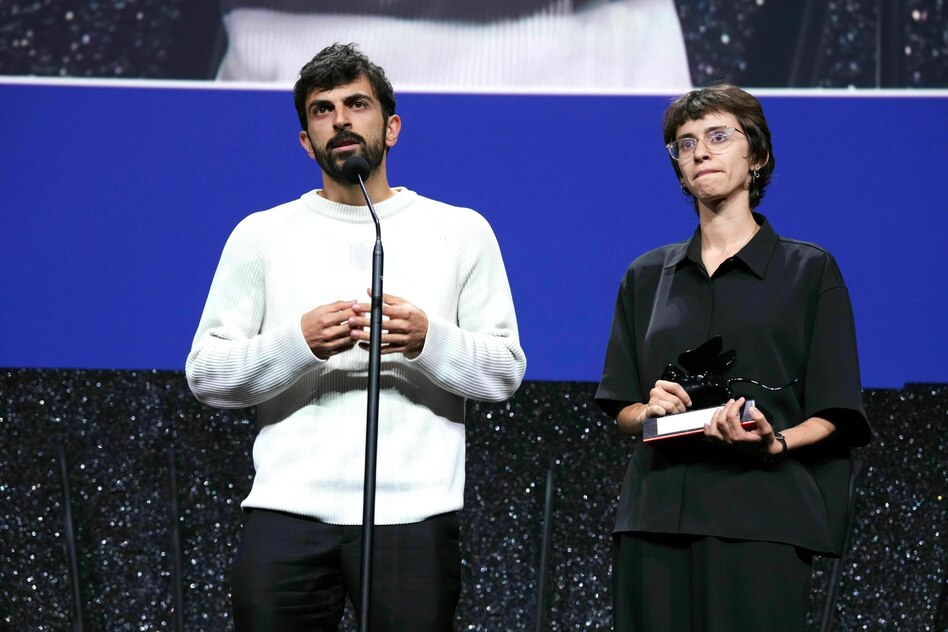
dpa The film was greeted with 25 minutes of applause at its premiere at the Venice Film Festival, and in Israel it is being sharply attacked by the army and government - even though no one has seen it there yet: The Gaza documentary "Naza" by the two Jewish filmmakers Yuval Abraham (31) and Rachel Szor (32) is now coming to German cinemas. The two recently announced that it will be available to watch online for free from November. The film won the Special Jury Prize in Venice.
In their 80-minute-long documentary, the filmmakers focus on one aspect in particular: the system that is supposed to be behind Israel's warfare - in all its efficiency. “Naza” is derived from the Hebrew term “Nezek Agavi,” meaning collateral damage. According to a soldier interviewed in the film, the military abbreviation refers to the estimated number of civilians who could die in an attack.
The anonymous witnesses' statements are intended to describe how targets are selected and how decision-making processes take place before residential buildings are bombed. Some of those interviewed in the film also describe the use of artificial intelligence.
Recorded at night on the rooftops of Tel Aviv, Abraham says he interviews 24 members of the Israeli secret service. Their voices are distorted, their faces unrecognizable in the shadows. The British newspaper The Guardian co-produced the film and previously conducted investigative research into the allegations. She claims to have adhered to all journalistic standards.
A protagonist says that in some Israeli air strikes, 20, 30 or 300 Palestinians were accepted as collateral damage and killed. “Once there was authorization to kill 500 people in an attack on a human target,” the man said. “I can click on a house and see how many people will be damaged if I bomb it.” He takes a piece of paper and sketches. “You look at it like this: Apartment 6, 5th floor, Ahmed and his family will die.”
A day before the awards ceremony on September 12, the Israeli army rejected the allegations and questioned the credibility of the 24 anonymous witnesses. Some statements concern decisions about which members of lower ranks could not have an overview. The army criticized the fact that the film had not been presented to it in advance in order to respond to the allegations.
According to the army, attacks were also called off as soon as the foreseeable civilian damage was disproportionate to the military advantage - as required by international humanitarian law. The systematic acceptance of high civilian casualty rates depicted in the film is not part of Israeli military doctrine. Whether individual attacks exceeded this limit cannot be judged from the army's statements and the film scenes alone.
According to the Hamas-controlled health authority in Gaza, around 74,000 Palestinians have been killed so far during the almost three-year war. The Israeli army no longer doubts the number, but criticizes the authority for not distinguishing between civilians and fighters. Israeli military officials put the number of fighters killed in the Gaza Strip at more than 24,000 in mid-September. This information cannot be independently verified.
Regarding the allegations about the use of artificial intelligence, army spokesman Effi Defrin said that decisions about the selection and approval of attacks were made exclusively by human personnel and not by artificial intelligence.
Culture Minister Miki Zohar from the Likud party described the filmmakers' work as "treason" and called for their citizenship to be revoked. Prime Minister Benjamin Netanyahu announced proposed legislation against people who slandered Israeli soldiers or the state abroad. Although hardly anyone in Israel has seen the film, the two directors and their family have been the target of death threats and right-wing agitation. Right-wing activists gathered in front of director Rachel Szor's parents' house
The Israeli human rights organization B'tselem, however, sided with the filmmakers. Together with other organizations, it opposed threats and possible steps against Abraham, Szor and their sources.
Israeli journalist Nadav Eyal writes on X: Preparing for an air strike on a target is lengthy and complex. Over 100 people are involved in each attack, even before the pilot is deployed. Few, if any, of them would have the full picture.
Amos Harel from the left-liberal newspaper Ha'aretz shares the assessment that Israel has committed war crimes in the Gaza Strip. What happened during some of the fighting was cruel and disturbing enough in itself. It obliges you to look at the situation directly and engage in self-reflection.
Criticism comes from a former Israeli hostage: Omer Shem Tov writes in the Wall Street Journal that the long applause felt like “a hail of knives.” Not because the film shows Palestinian suffering - that is real and deserves to be seen. However, he doesn't feel seen. He spent 505 days in Hamas captivity – “kidnapped, starved and tortured”. “In this story, perhaps I too am ‘Naza,’ collateral damage,” said Shem Tov.
In Arab social media, however, the moral courage of the two filmmakers is highlighted, among other things. The London-based news website Middle East Eye writes that Naza is doing invaluable work at a time when ongoing violence in both the Gaza Strip and the occupied West Bank continues to be accepted as normal.
According to the London-based daily newspaper Al-Arabi Al-Jadid, parts of the Arab debate criticize the fact that the Western public apparently reacts more strongly to Israeli witness statements than to years of Palestinian testimony.
Read the full story at the source
Source: taz