
World Pressenza
‘International Day to End Impunity for Crimes against Journalists’: Will Mere Remembrance Serve the Purpose?
Proclaimed by the United Nations General Assembly in 2013 (Resolution A/RES/68/163), the date commemorating the 2013 assassination of two French journalists in Mali (Ghislaine Dupont and Claude Verlon
English (original) ·Read in Deutsch ⇄

Proclaimed by the United Nations General Assembly in 2013 (Resolution A/RES/68/163), the date commemorating the 2013 assassination of two French journalists in Mali (Ghislaine Dupont and Claude Verlon), 2nd of November, is marked as the ‘International Day to End Impunity for Crimes against Journalists’.
The United Nations, on its Web Portal (www.un.org), writes: “Ending impunity for crimes against journalists is one of the most important and complex challenges of recent times. It is an essential precondition to guarantee freedom of expression and access to information for all citizens”.
Quoting the source, UNESCO (2026) highlights:
- “189 journalists have been killed in the line of duty in 2024-2025, a 20% increase from the previous period.
- 86% of cases of journalists’ killings since 2006 are still unresolved or abandoned.
- Fourteen women journalists were killed in 2024-2025, all but one in conflict zones.
Two-thirds of the journalist killings in 2024-2025 were due to armed conflicts, with 40% of these caused by drones.”
On the International Day to End Impunity for Crimes against Journalists, the Indian Journalists Union (IJU), Affiliated to the International Federation of Journalists (IFJ), has expressed grave concern over the continuing killings, physical attacks, threats, intimidation and persecution of journalists across the world, and particularly in India. The Union called upon governments to ensure that those responsible for crimes against journalists are brought to justice and that effective legal mechanisms are established to guarantee the safety and independence of media professionals.
IJU further stated that journalists continue to pay an unacceptable price for pursuing truth, exposing corruption, questioning those in power, reporting conflicts and human rights violations. From conflict zones to remote rural areas, journalists are being murdered, assaulted, threatened, and silenced. The failure to investigate these crimes and prosecute the perpetrators has created a dangerous culture of impunity that encourages further attacks.
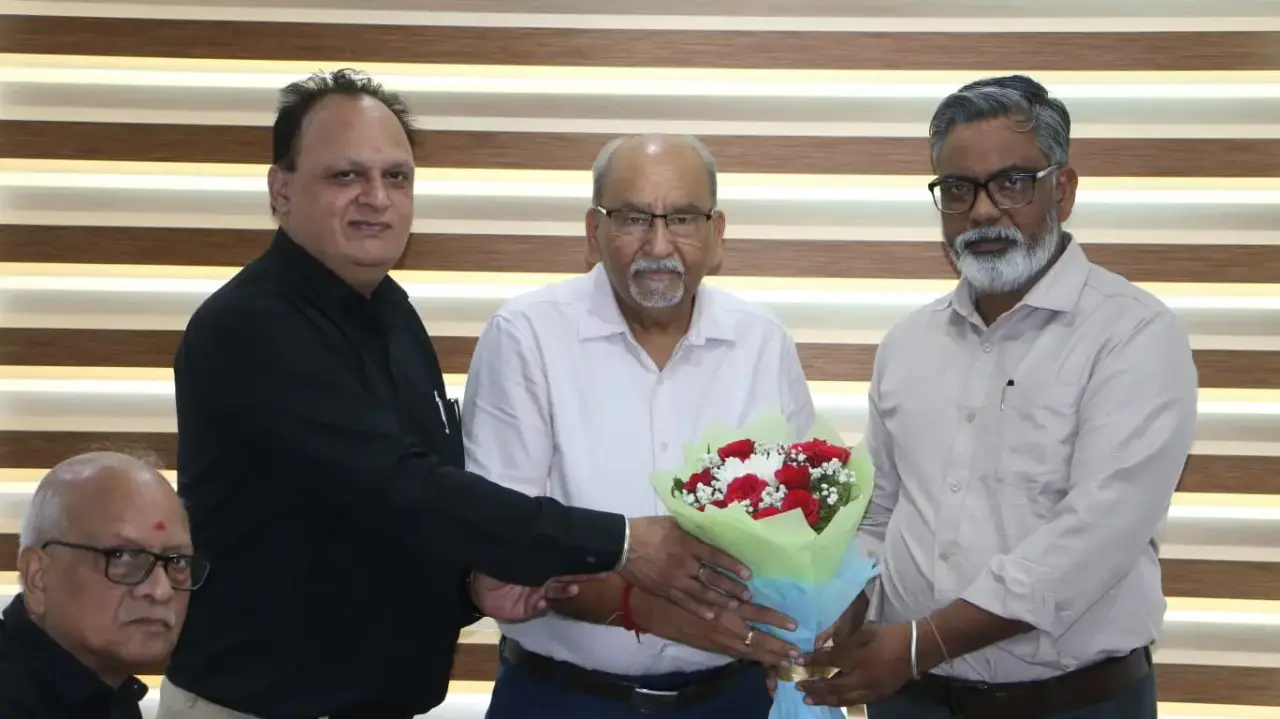
IJU GS AND PCI MEMBER VINOD KOHLI- PHOTO CREDIT CPUJ CHANDIGARH.
IJU President Geetartha Pathak and Vinod Kohli, Secretary General, in a joint statement quoted– “The International Federation of Journalists (IFJ), in its 2025 annual report, documented 128 journalists and media workers killed during the year, including four in India. The figures underline the grave risks faced by media professionals and the urgent need for effective international and national mechanisms to protect them”.
The IJU statement further added– India, the world’s largest democracy, cannot remain complacent about the safety of its journalists. The killings of journalists, particularly those reporting on corruption, illegal activities, organised crime, political violence and abuse of power, have repeatedly exposed the vulnerability of media professionals. In many cases, investigations have failed to identify all those responsible, including the masterminds behind the crimes, while families of murdered journalists continue to wait for justice.
Expressing concern over the condition of journalists in Assam, the IJU added that the situation in Assam is particularly distressing. “According to the Journalists Union of Assam, 25 journalists have been killed or reported missing in the state since 1991, and their families continue to seek justice. The prolonged failure to deliver accountability in these cases is a painful reminder of how impunity can undermine the freedom of the press and the rule of law”.
The IJU stressed that the safety of journalists is not merely a professional concern but an essential requirement for democracy. An attack on a journalist is an attack on the public’s right to know. When journalists are silenced through violence and intimidation, society loses an important safeguard against corruption, injustice and abuse of authority.
The Union has urged the Government of India to move beyond expressions of concern and take concrete legislative, administrative and judicial measures to protect journalists.
The IJU highlighted the major demands:
1. Enact a comprehensive Central Journalist Safety Act: The Government of India must introduce and enact a dedicated national legislation to protect journalists and media workers against physical attacks, threats, intimidation, arbitrary harassment and violence. The law should provide preventive protection, time-bound investigations, accountability, and rehabilitation of victims and their families.
2. Independent and time-bound investigations: All killings and serious attacks on journalists must be investigated through impartial and professionally supervised investigations. Special investigation teams should be constituted wherever necessary to ensure that perpetrators, conspirators, and those who ordered or financed the crimes are brought to justice.
3. Reopen unsolved murder cases: The Union and State governments must review unresolved cases of journalist killings and disappearances, particularly those involving suspected retaliation for professional work. The families of victims deserve truth, justice and closure.
4. National and State-level Journalist Safety Mechanisms: Establish permanent safety committees involving representatives of journalist organisations, police, administration and independent legal experts to assess threats, recommend preventive action and monitor investigations.
5. Protection against threats and intimidation: Police and district administrations must respond promptly to complaints by journalists facing threats. A dedicated journalist safety helpline, emergency response mechanism and witness protection arrangements should be established.
6. Compensation and support for victims’ families: Families of journalists killed in the line of duty must receive adequate compensation, legal assistance and long-term social and financial support. Children and dependents of slain journalists should receive appropriate educational and welfare assistance.
7. Safety of women journalists: Special measures must be adopted to address gender-based violence, online harassment, stalking, sexual intimidation and threats against women journalists, including effective institutional complaint mechanisms.
8. Implementation of international commitments: India should support the adoption of the IFJ-led International Convention on the Safety and Independence of Journalists and strengthen its implementation of the United Nations Plan of Action on the Safety of Journalists and the Issue of Impunity.
The IJU has also called upon the State governments to recognise that protecting journalists is a constitutional and democratic responsibility. Police forces and administrative authorities must ensure that journalists can discharge their professional duties without fear of retaliation, whether their reporting concerns governments, political parties, corporations, criminal networks or powerful vested interests.
Paying tribute to all the journalists who have lost their lives in the pursuit of truth, IJU, during this International Day to End Impunity, remembered the families who continue to fight for justice. IJU reminded them that their sacrifices must not be forgotten, and their cases must not be allowed to disappear from public memory. Justice delayed must not become justice denied. No journalist should have to pay with their life for doing their duty.
The IJU reiterated that press freedom cannot survive where journalists are unsafe, and crimes against them go unpunished. Ending impunity is not optional; it is an obligation of every democratic government. “Investigate every killing. Prosecute every perpetrator. Protect every journalist”.
Now the question arises: Is it sufficient to just fix a commemorative ‘International Day to End Impunity for Crimes against Journalists’, to give freedom to the journalists and give them a safe environment to bring out the truth and raise the depressed, feeble voice of the public? Demands highlighted by IJU indicate that there is still a large gap between paper assurances and the real situation on the ground. Will the governments let this aggrieved voice enter their ears?