
Germany · Perspektive Online · · 2h
The findings of the election results from Berlin and Mecklenburg-Western Pomerania
Deutsch (original) · Auto-translated to English

The Left is winning primarily thanks to young voters in Berlin. The CDU and SPD lose in both federal states due to the unpopularity of the federal government. The election results are putting Chancellor Merz in distress.
The election results of the state elections in Mecklenburg-Western Pomerania and Berlin clearly show one thing: dissatisfaction with the federal government. InMecklenburg-Western PomeraniaIt gives the AfD 32 of 71 seats in the state parliament. The SPD loses its majority with only 29 seats. InBerlinOn the other hand, the Left Party won 47 of the 159 seats and is therefore clearly ahead of the CDU (34 seats) and AfD (29 seats).
The AfD was able to mobilize primarily non-voters in Berlin and Mecklenburg-Western Pomerania, as well as most recently in Saxony-Anhalt. However, in Berlin the Left Party picked up more non-voters in absolute numbers. The Left was also clearly able to convince young voters and people with low incomes. The election campaigns of the CDU and SPD, however, were not successful.
“The Woman Against Blue”
The election of the 9th state parliament of Mecklenburg-Western Pomerania seemed to be preceded by theElection in Saxony-Anhaltto have been overshadowed. This is what political scientist Jan Müller from the University of Rostock said in oneElection campaign analysisat tagesschau24. But in the last two weeks one thing was particularly noticeable in the election campaign: “the escalation towards Holm and Schwesig or Schwesig against the AfD”. Ultimately, this election campaign strategy didn't really work for the SPD. Although Prime Minister Schwesig won the direct mandate against Holm, the AfD still emerged successfully from the elections.
Parallel to the election, misinformation also spread on social networks throughout the day. Videos with ballot papers without the AfD listed were circulating on Facebook and X. In them, a male voice claims to be a pensioner from Rostock and to be voting by post this year. He says the AFD was missing from the ballot papers he received.
However, the ballot papers shown are fake, confirms theMecklenburg-Western Pomerania State Returning Authoritythe news agency dpa. State returning officer Christian Boden said: The forgeries were “really well done” and were based on the sample ballot papers.
State election in Saxony-Anhalt: How did the AfD win and how does it want to govern?
New coalitions are needed
The provisional official oneElection resultalso reflects the escalation towards the SPD and AfD. With a voter turnout of 78.1 percent, the AfD received 38.2 percent of the vote. The SPD is just behind with 35.5 percent, followed by the Left Party with a huge gap and only 6.5 percent of the second votes.
The Greens also made it into the state parliament with 5.7 percent. After 28 years, the SPD is no longer the strongest force in Mecklenburg-Western Pomerania. The CDU and BSW narrowly missed out on entering the state parliament with only 4.9 percent and 4.8 percent of the vote. This is the first time since 1949 that the CDU has not been represented in a (West) German parliament. It only became clear late in the evening that the CDU would no longer be represented in the state parliament. In initial projections, the party was still well over 5 percent.
This would mean that a three-party alliance would be necessary for a coalition for the first time in Mecklenburg-Western Pomerania. As of now, a coalition of the SPD, the Left Party and the Greens is most likely. In this case, Prime Minister Schwesig could continue to govern. A minority government or an alliance between the SPD and CDU was also conceivable before the CDU left. Collaboration with the AfD or tolerating it would only have been possible if the BSW had made it into the state parliament. All other parties had previously ruled out a coalition with the AfD.
Left celebrates historic election victory
In Berlin, the provisional official drawsResultthe election of the 20th House of Representatives provides a clearer picture. With 75 percent voter turnout, the Left Party is clearly ahead with 25.7 percent, followed by the CDU with 18.8 percent. With 16.3 percent, the AfD achieved its best result to date in a Berlin House of Representatives election. With its victory in Berlin, the Left Party emerged as the strongest force in a state election for the second time in its history. She last won in Thuringia in 2019 with top candidate Bodo Ramelow.
The result in Berlin is thanks to the voters, said top candidate Elif Eralp. They had shown that they had “hope for a better, affordable Berlin”. Thestatisticson voter migration show: The Left was able to win votes from both the Greens and the SPD. However, most of the new votes come from previous non-voters.
Looking at the election polls, it is also clear that the Left Party was particularly successful among young people. In the age ranges between 16 and 24 and 25 and 34, 43 and 49 percent of Berlin voters voted for the Left. Support for the AfD is increasing among voters aged 45 and over. Over the age of 70, the CDU is clearly the strongest force.
TheDistribution of votesbetween Berlin's inner and outer districts, as well as between East and West, show clear trends in voting. The west of Berlin voted primarily for the CDU, while the center gave votes to the left. In the outskirts of the east, the AfD was elected with a clear majority. For a long time, the Left Party was the strongest force in the eastern outskirts. But it is now more likely to convince voters where the Greens previously dominated. In the urban center of Berlin.
Left is clearly the strongest force in Berlin – AfD ahead of SPD in Mecklenburg-Western Pomerania
Will Eralp become mayor?
The left's election victory is clearer than polls predicted in advance. And this despite the fact that there was a constant media fire of anti-Semitism allegations against the party from NIUS to Tagesschau. Eralp showed this in one after the election victoryinterviewwith the Tagesschau clearly back: “It is very clear to us that we stand for the protection of Jewish life, as well as for the protection of Palestinian, Muslim and queer life.”
What was particularly convincing in the Left's election program was the demand for the socialization of large housing companies. It remains to be seen whether this issue will complicate coalition talks. The most likely scenario here would be a red-green-red coalition. This is also supported by himGreen Party leader Felix Banaszakout of. Mathematically, a CDU-led coalition with the Greens and SPD would also be possible.
The Greens are in line with the Left on the issue of socialization. SPD leading candidate Steffen Krach has so far clearly spoken out against it. Alsodemands the SPDas a condition for a coalition to distance itself from anti-Zionist positions within the left.
The leadership of the Left Party is currently clearly in favor of a government coalition under Elif Eralp as the governing mayor. But there are also voices within the party that speak out against a red-green-red coalition. Especially the left wing of the party and the left-wing youthwarnedBefore “co-managing the misery with the SPD and the Greens”. It remains to be seen whether and how the positions of the Left and its coalition partners will come together. Before that, the party members of the Left must also agree to a possible coalition agreement.
CDU loses due to dissatisfaction
For the CDU, however, the results of both elections represent a clear loss of voters. In Mecklenburg-Western Pomerania it lost 8.4 percentage points and in Berlin 9.5. The AfD in particular benefits from this, as it was able to win several thousand votes. She wins in Mecklenburg-Western Pomeraniaaccording to preliminary dataAdded 30,000 former Union voters.
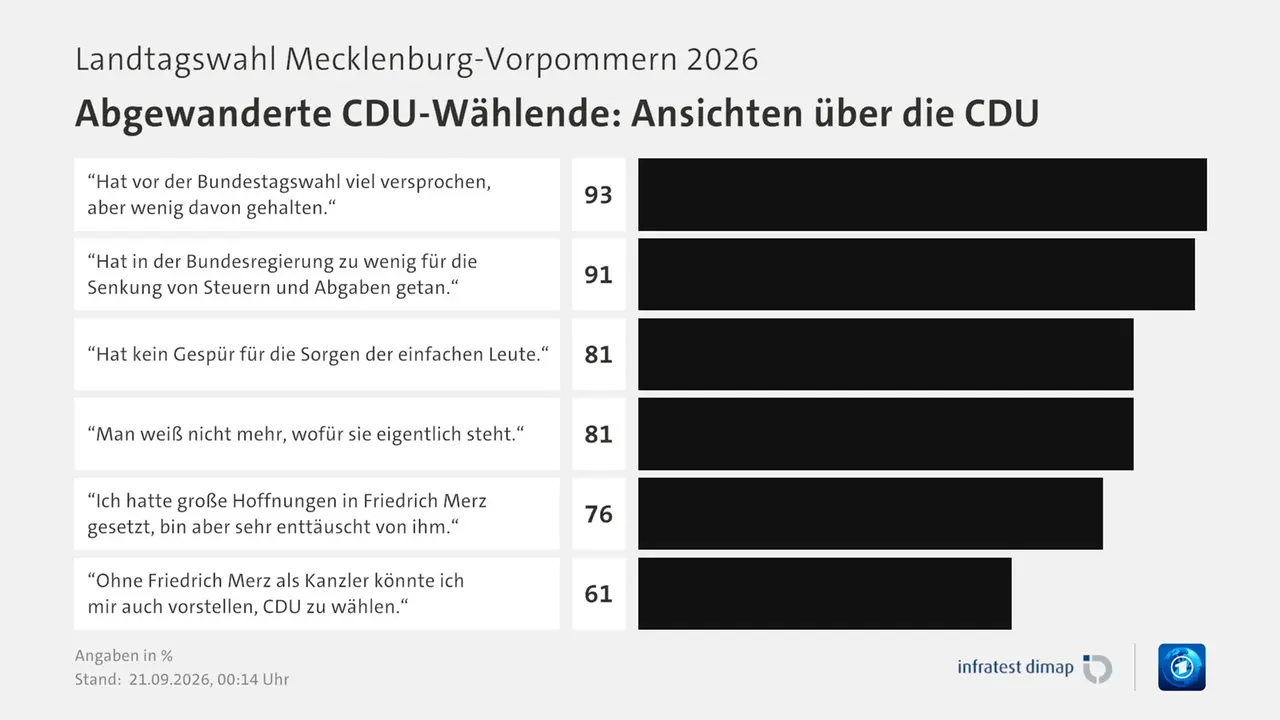
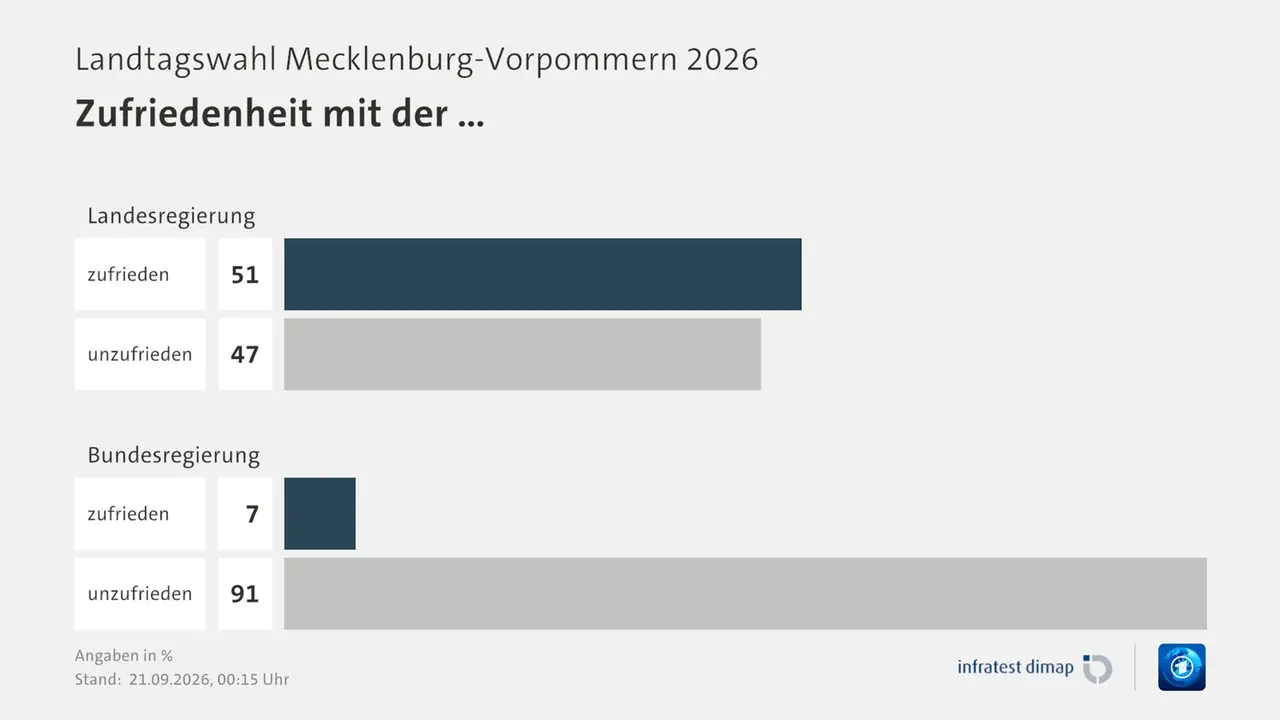
According to surveys by Infratest dimap, this exodus can primarily be attributed to dissatisfaction with the CDU-led federal government and Chancellor Friedrich Merz. So gave61 percentof the emigrated CDU voters from Mecklenburg-Western Pomerania that they would probably vote for the CDU without Friedrich Merz as chancellor. The respondents were dissatisfied with the federal government91 percentand was therefore decisive for voting behavior instead of state politics.
Berlin's governing mayor Kai Wegner (CDU) also sensed this dissatisfaction during the election campaign. “It was all about the federal government and a lot about Friedrich Merz,”he told ARD. This trend continues on the evening of the election. Shortly after the 6 p.m. forecast, the Chancellor leaves with onestatementto the public. In it he not only comments on his party's election results in the state elections.
Will Merz still fall?
Merz speaks primarily about the reforms that supposedly continue to come. He also talks about the stress and uncertainty that will come with it. He also emphasizes that he wants to implement these reforms as Chancellor. In the run-up to Merz's appearance, some observers expected an announcement of Merz's resignation or an end to the existing federal government.
The voices thathis resignationdemands became steadily louder as the election evening progressed. Precisely because it only became clear late in the evening that the CDU would not be returning to the Mecklenburg-Western Pomerania state parliament. The appeasement that Merz tried to provide early on with his statement probably did not have the desired effect.
As Chancellor, it has also been unusual to publish a high-profile statement so soon after the forecasts for state elections. It is even more unusual that the CDU Prime Ministers are only informed about the planned statement at short notice. Influential party circles – including the CDU prime ministers – are already discussing the possibilities of an orderly transfer of power. This was reported by Die Zeit on September 12th under the headline “Operation Chancellor Overthrow“.
Even on the day after the CDU lost two state elections, there is widespread discussion, both inside and outside the CDU.Media reportsabout a “secret meeting” of top CDU politicians without Friedrich Merz. The results of this meeting are not yet public.
The end of the previous popular parties
The election results in both countries make one thing very clear: the CDU and especially the federal government are causing dissatisfaction and seem unrealistic to voters. The federal government's reforms are not seen as an upswing, but rather as a burden. Rather, the Infratest dimap surveys show that people's biggest concerns are probably not understood and implemented by the CDU. Both inMecklenburg-Western Pomeraniaas well asBerlinThe issue of social security was a decisive factor in voting behavior.
The current popular parties CDU and SPD are particularly suffering from citizens' low approval of the federal government. They have consistently lost support in Saxony-Anhalt, Berlin and Mecklenburg-Western Pomerania. In their place is the AfD and, at least in Berlin, the Left Party. What consequences this will have beyond the three federal states remains to be seen.
The postThe findings of the election results from Berlin and Mecklenburg-Western Pomeraniaappeared firstperspective.
Read the full story at the source
Source: Perspektive Online