
Germany · labournet.de · · 1h
Nursing crisis without wage increase: (Again) foreigners in! So into care.
Deutsch (original) · Auto-translated to English

dossier
“…The recruitment of foreign nursing staff as a solution to a nursing shortage, understood as a lack of staff, has - one will not be surprised - a long history in our country and goes far back to a time in which Germany saw itself as anything other than what it had long been: a country of immigration. The figure of the “guest worker” was transferred to many areas, including healthcare. (…) Spahn should also know by now that this approach does not represent a real solution to the blatant shortage of nursing staff, because a realistically achievable import of workers will only result in a very manageable relief effect. (…) By the way - the fact that it is the working conditions that have a significant influence on whether a) there will be enough young people for nursing and b) whether and for how long the nursing staff stay in the job is certainly not a new finding…”Article from April 2, 2018 by and at Stefan Sell  . See also our dossier:Migrant women in care: “Nobody monitors the working conditions” in private householdsand here for international recruitment/poaching:
- Immigration of skilled workers: Nursing association demands speed at work and stay agency

"Germany urgently needs nurses, but skilled workers who want to immigrate have a hard time. A Catholic social association is now calling for reforms.
More and more people in Germany are dependent on care. The industry's need for personnel is correspondingly huge. But although many trained nursing staff from other countries would like to come to Germany, the federal government is doing little to pave the way for them. On Thursday, the Association of Catholic Elderly Care made clear demands to politicians in a press conference. Association managing director Andreas Wedeking emphasized: “Every fifth nursing professional now has a foreign background.” But tens of thousands more try unsuccessfully to come to Germany every year, because even after the skilled immigration law is reformed in 2024, the hurdles remain high. In order to change that, Wedeking particularly called for an effective work and stay agency that should centralize, standardize and digitalize visa procedures, recognition of professional qualifications and arrival assistance. Such a work and stay agency is actually planned by the federal government, but the responsible Ministry of Labor and Social Affairs of Bärbel Bas (SPD) is currently taking its time with implementation. (…) The costs should also fall, both for the recruited carers and for the providers. The latter now spend large sums of money to support those recruited on their way through the bureaucratic processes. And anyone who spends months in the accrual process will largely be unable to work for that long. The costs that arise for the supporting facilities would be directly reflected in what residents, relatives and insurance companies have to pay for a place in the nursing home.The nursing association is also calling for a positive list for professional qualifications from certain countries, which would then be recognized without further verification. (…) In addition to the bureaucratic hurdles, there are also problems affecting society as a whole that are particularly difficult for newly arrived skilled workers. These included the ongoing housing crisis and poor transport connections in rural areas. The federal government must create concrete improvements here – not just for the immigrant nurses, but also for them.” Article by Frederik Eikmanns from September 15, 2026 in the taz online, see also:
- Elderly care criticized: Authorities are slowing down foreign carers
“Germany needs international nursing staff, but makes starting a career complicated with different recognitions, visa deadlines and responsibilities. The elderly care association had an unusually radical idea: simplify procedures…”Article by Nils Sandrisser from September 16, 2026 in Migazin
- Elderly care criticized: Authorities are slowing down foreign carers
- [“There is no welcoming culture here”] False promises: Racism makes it more difficult to arrive in the healthcare system
“Germany urgently needs staff for clinics and practices. But people like Hugo Mosquera report qualifications that are difficult to recognize, racist exclusion and working conditions that quickly drive away many international skilled workers.
Hugo Mosquera is sitting in a café in Berlin, his shift as a medical assistant in a practice has just ended. “As a black person, I have to work three times as hard here in Germany to be perceived as much as everyone else,” says the native Colombian. (…) Mosquera still remembers the advertising by placement agencies for jobs in the German health sector. Private agencies sometimes look for specialists on behalf of clinics abroad, take care of German courses and organize flights. Mosquera remembers that they were promised quick job entry, a high quality of life and good wages. Today he says: “You conveyed a ‘German dream’ that doesn’t exist.”
There is a risk of rapid burnout
Paula, who actually has a different name but wants to remain anonymous for professional reasons, also criticizes this. The doctor grew up in Colombia, later studied physiotherapy in Spain, came to Germany and completed a medical degree at the Charité. “Many skilled workers are recruited under false promises,” she says…”Contribution by Malte Seiwerth from August 5th, 2026 in Migazin - “The Black Nurse” among others: Nursing staff report racist discrimination and bullying – both by patients and colleagues
“Due to the shortage of skilled workers, the need for international nurses in the health system is particularly high. But now nurses are reporting racial discrimination – both from patients and colleagues. (…)
Joshua was born in Germany, but is often mistaken for African by patients. "They think that because I'm black, I come from Africa and the care there isn't very good. And whether I can even speak German," says the nurse.
This is a racist prejudice, says Monique Ritter, professor of social work at Landshut University. Together with Serhat Yalcin from HAW Kiel, Ritter is researching the topic of racism, particularly in the area of geriatric care.
Racism in the nursing sector is increasing
More and more nursing staff are currently reporting systematic experiences of discrimination, as shown by a study by the German Center for Integration and Migration Research. According to Monique Ritter, this also has to do with the intensification of debates regarding migration. Because the boundaries of what can be said are currently shifting, the feeling arises: “that people are allowed to express what is supposedly legitimate.”
At the same time, Ritter and Yalcin want to use their research to make it clear that there is a connection between racism and precarious working conditions. There are fewer union structures in nursing. So no one who cares about the needs of the employees. This promotes racism - According to Serhat Yalcin, this is about: "that we view nursing staff not just as owners of labor, but as people with their own stories."
Anyone who doesn't take the topic seriously will lose skilled workers
The shortage of skilled workers in geriatric care is serious, but racial discrimination is contributing to migrant nursing staff leaving the industry…”Contribution by Ferdinand Meyen from July 1st, 2026 in BR24(“Racism in nursing: This is what those affected and science say”) – see more about racism in nursing here below, unfortunately again and again… - [You have to do everything yourself...] Agreement with India: Federal government wants to train nursing staff abroad
“Germany cannot take care of itself and needs skilled workers from abroad. So far, all state recruitment efforts have failed. Now nurses are to be trained abroad. Patient Protection Foundation warns against excessive expectations.
The federal government wants to recruit nursing staff from India. As the Federal Ministry of Health announced on Tuesday, a corresponding diagnosis was made during the visit of Federal Chancellor Friedrich Merz (CDU) to IndiaLetter of intent signed. It provides for common standards for the training of nursing staff. Federal Health Minister Nina Warken (CDU) explained that in this way, “lengthy and bureaucratic recognition procedures could be avoided in the future and well-trained specialists could be integrated more quickly into the German labor market”. (…) The training of nursing staff in India should include German lessons up to B2 level, as well as courses that prepare people for working and living in Germany. According to information, the courses are free for trainees…”Report from January 14, 2026 in Migazin (“Agreement with India: Federal Government wants to train nurses abroad”) - Racism or welcome in nursing? Perspectives on the arrival and stay of nursing staff from third countries
- Welcome to nursing? Perspectives on the arrival and stay of nursing staff from third countries in Baden-Württemberg
“Germany is facing a dramatic increase in the need for care due to the aging population. It is increasingly focusing on recruiting international nursing staff. The aim of this project was to use Baden-Württemberg as an example to shed light on how nursing staff from third countries arrive in Germany, what hurdles they face and what conditions promote their social integration. Based on a triangulated research design, the study makes it clear that recruitment alone is not enough to retain international nursing staff in the long term and to ensure sustainable nursing care. It also makes an important contribution to understanding the social integration of international nursing staff: It emphasizes that social integration is a complex process that must and can be actively shaped and supported…”DeZIM Project Report 18 from November 2025  by Yula, Ezra; Rischke, Ramona; Yanaşmayan, Zeynep; Käferstein, Melinda at the German Center for Integration and Migration Research (DeZIM), also hear:
 - Racism in nursing: Situation of international nursing staff
Contribution by Luise Sammann from November 14, 2025 on Deutschlandfunk 
- Welcome to nursing? Perspectives on the arrival and stay of nursing staff from third countries in Baden-Württemberg
- Migration, care work and social media. A country comparison between India and Mexico
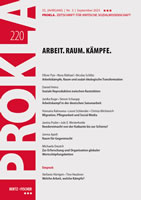 “The shortage of nursing staff has affected German recruitment efforts in non-European countries and new, transnational scope for action for those interested in migratingNursing staff result. These use digital platforms to navigate a complex migration infrastructure. Our study is dedicated to the research gap of social media in care migration using the examples of Mexico and India. The dominance of self-organized vloggers is noticeable alongside the advertising of influencers for placement agencies and the absence of state recruitment. We analyze the exchange of information in the area of tension between neoliberal subjectification for the target labor market and solidarity-based community building…”Articles by Homaira Rahnoma, Leoni Schlender and Christa Wichterich in thePROCLAUS 220 from September 2025: work. Space. Fights. - as always - and yet always consciously - we recommend the entire magazine!
 - Import – Export: Germany wants to further increase the immigration of Indian skilled workers and nursing staff and deport economically undesirable Indians to a greater extent
"The Federal Republic has so far achieved only a mixed result when it comes to recruiting Indian skilled workers and nursing staff to cover Germany's workforce needs. This emerges from current analyses, including a study by the Berlin Science and Politics Foundation (SWP). According to this, Germany is increasingly dependent on third countries such as India to cover its workforce needs in the areas of mathematics, computer science, natural sciences and technology (MINT subjects) as well as in nursing. Despite certain successes, however, the proportion of Indian IT specialists, who are in high demand in Germany, is falling; In addition, the Federal Republic receives a high number of applications from Indian students, but hardly any from India's leading universities. Berlin also complains about a lack of acceptance of economically undesirable Indian asylum seekers by New Delhi. The recruitment of nursing staff has been significantly increased in recent years, especially from the southern Indian state of Kerala. This has its origins in the 1960s and contributes to a serious shortage of nursing staff in India. recommends at least four nurses and midwives per 1,000 inhabitants. However, a recent study estimates that there are only 0.6 nurses and midwives available per 1,000 inhabitants; there is a shortage of around 4.3 million nurses. This is because of the total 3.26 million nurses trained in India, only 1.4 million actually work in their profession.Training to become a nurse in India is quite expensive with an average of 7,000 to 9,300 euros for the entire training program, although these costs cannot be recouped through gainful employment in India. The minimum wage for a nurse in the state of Kerala was around 195 euros per month in 2017; However, nurses are reportedly paid just €58 per month and face exploitative working conditions. The low salaries combined with miserable working conditions mean that the majority of qualified nurses do not want to practice their profession or emigrate to European countries, where they are also exposed to precarious working conditions and long shifts. In order to get to Europe, many even have to take on large debts with placement agencies, to which they are therefore chained for a long time. Report from August 28, 2025 by and at German-Foreign-Policy.com(“Import of labor from India”) - [The exploitation caravan moves on] Shortage of staff in nursing: Wadephul is campaigning for more skilled workers in Indonesia
“There is a shortage of skilled workers in the healthcare sector in Germany. In Indonesia, the Federal Foreign Minister is finding out how the language barrier in particular can be reduced. Foreign Minister Johann Wadephul is campaigning for more skilled workers from Indonesia in view of the shortage of personnel in the health sector in Germany. In the capital Jakarta, the CDU politician found out about the relevant training in the Indonesian healthcare system, which is coupled with German courses. Accompanied by the Indonesian Minister of Health Budi Gunadi Sadikin and the director of the Goethe-Institut Indonesia, Constanze Michel, he was shown a state technical college for health professions. (…) Given the shortage of nursing staff, Germany is interested in recruiting skilled workers from Indonesia in this area, among other things. The federal government sees great potential here, especially since half of the population is younger than 30 years old. With more than 284 million inhabitants, Indonesia is the fourth most populous country in the world after India, China and the USA and also the country with the largest Muslim population in the world. At the meeting with Wadephul the day before, Indonesian Foreign Minister Sugiono said that 329 Indonesian nurses had gone to Germany so far. Jakarta hopes to expand this program to the hospitality sector, supported by German-funded language courses.
So far, the migration of skilled workers to Germany has been at a low level with a total of around 1,000 visas per year. The reasons given by the federal government include a low level of training, language requirements and problems with the recognition of professional qualifications. In addition to German-Indonesian initiatives to recruit skilled workers, especially in the nursing sector, there are also similar efforts in the hotel and restaurant industry…”Article from August 21, 2025 in Migazin - Expertise wasted: Nursing staff from abroad have to wait around 500 days for their qualifications to be recognized. You can't deal with them like that
"Nursing emergency, nursing emergency, nursing emergency! That's the mantra these days. Behind it there is a drama for which there is no hint of catharsis. There is a shortage of places in nursing facilities and nursing staff; according to the German Economic Institute, there are currently 130,000 skilled workers. By 2049 there could be more than twice as many. The consequences have long since unfolded brutally: nursing staff are reporting long-term sickness due to burnout, leaving their jobs or retiring earlier. These Conditions will worsen and in turn have further consequences: sooner or later, more people who care for relatives at home end up in a clinic because of overwork. Last but not least, the declining quality in care facilities increases the dissatisfaction on all sides. Now it is not the case that there are no strategies and initiatives against it since 2013, for example So far, several thousand skilled workers from the Philippines, Indonesia, Tunisia, India, Vietnam and Jordan have been brought to Germany with mixed success: employers are largely satisfied, but the foreign nursing staff are often not, because their integration is often difficult and they often do not feel welcome here.When the Federal Association of Private Providers of Social Services complains that skilled workers from abroad have to wait up to 500 days for their qualifications to be recognized, migrant skilled workers will probably feel confirmed: They want our expertise, but they let us do unskilled work. If the new federal government wants to score points, it must change this quickly - and, first and foremost, revise its migration policy. The care industry is not the only one with such conditions, childcare is the next desolate sector.” Comment by Simone Schmollack from May 2, 2025 in the taz onlineand to that:
- Presumption of competence: Social association criticizes the speed of recognition of international nursing staff
"... The Federal Association of Private Providers of Social Services (bpa) is calling on the new federal government to change course in the recognition of foreign nursing staff. Up until now, it has often taken many months before the urgently needed immigrants are allowed to work in accordance with their qualifications, writes President Bernd Meurer in a guest article for the specialist service "epd social". He promoted the so-called “presumption of competence”. If this principle were introduced, additional specialists could quickly be deployed to care for those in need of care. The idea behind it: With the presumption of competence, international nursing staff with at least three years of training or study and the necessary language skills could immediately be employed as specialists in homes and nursing services. Recognition and any necessary adjustment measures would then only take place after starting work. (…) According to Meurer, an estimated 11,000 trained international nursing staff in Germany are waiting for formal recognition. They would have completed three years of training or even a degree and had the necessary language skills. “Nevertheless, they are not allowed to be employed as skilled workers for months – an incredible 500 days on average,” criticized the head of the employers’ association, which claims to have around 14,000 members. (…) The bpa proposed the presumption of competence together with the Association of Replacement Funds (vdek). This would reduce bureaucratic requirements and quickly bring in additional specialists to care for those in need of care. This reform “doesn’t cost a euro of tax money,” Meurer advertised.” Report from June 2, 2025 in MiGAZIN
- Presumption of competence: Social association criticizes the speed of recognition of international nursing staff
- Experiences of racism by specialists: “I don’t want to be cared for by a black person” – racism also experienced by a colleague“The care system is urgently dependent on them, but international professionals are often treated with hostility because of their religion, origin or skin color. A trainee talks about her experiences with racism. (…)
Most are grateful that she is there. But not all. Her origins and her skin color repeatedly lead to negative reactions. Often subtle, sometimes very direct. Once, she says, a patient even refused care. “When I came into the room he said: ‘I don’t want to be cared for by a black woman’.”
Racism also experienced by a colleague
Shocked, she consulted her then practice manager. He said she had to accept it that way. Does she have to? Cyndi Kamga says she can live with rejection - but not with a lack of respect and hindrance to her work. She says she knows how to classify xenophobic reactions in elderly residents or dementia patients. A different historical influence or the illness often played a role. It becomes difficult when racism comes from colleagues. The trainee has also had to experience this. "A colleague said she didn't want to go with me on the ward. That I should just walk away from her. That was the worst," says Kamga. These are extreme individual cases, emphasizes Kamga. However, subliminally, she regularly senses racism or discrimination in her everyday work life. (…)
Cyndi Kamga receives support and support at her nursing school. Around 90 percent of the classmates come from abroad. Almost everyone has had to deal with racism in everyday work. In class, they exchange experiences, learn to set boundaries and resolve conflicts. Headmaster Ewelina Bies attributes this partly to the difficult conditions in nursing. "Stress, a lack of staff and time pressure contribute to the problem. A trainee from abroad is then perceived as a burden because he may not understand everything straight away." Politically, more urgently needs to be done for foreign skilled workers, says Bies. At least: According to their observations, the fear of xenophobia in Germany has not yet had an impact on the number of applicants. And dropouts from training are also rare. However, experiences of racism have an impact on the psyche of the trainees, making it more difficult for them to arrive, learn and integrate, says Bies…”Contribution by Laura Cloppenburg, SWR, from March 23, 2025 at tagesschau.de(Text and video) – we know other information about the lack of consequences of racism on “acquisition”, see below, among other things. Too racist: Filipino nurses don’t want to go to Germany. See also:
- Nursing students from abroad: Open your eyes and close your ears when it comes to racism
“Caring for patients, consultations with doctors, nursing documentation: In order to prepare foreign nursing trainees for their work in Germany, there is a special professional language course in Neustadt. A teacher helps them overcome hurdles - but there is also racism…”Article by Alexander Lang from March 23, 2025 in Migazin
- Nursing students from abroad: Open your eyes and close your ears when it comes to racism
- From guest workers to compulsory service: The desperate fight for nursing staff
"... The German healthcare system is not only lacking money, but primarily staff. While money can be raised through consistent contribution increases, it has now been noticed that more and more nursing staff no longer want to endure the strain of family-hostile shift work, even with better pay. Federal Germany is faced with the considerable problem when it comes to training doctors that this training is a state matter. Since the states do not want to give up their skills, financing the study places for doctors also remains the responsibility of the states. The federal government is not involved For understandable reasons, it was not possible to finance training courses over which he had no influence. For a certain time, the wage gap with other countries, mainly in Eastern Europe and Asia, could be used and people who had to leave the country again for a limited period of time were wanted. They wanted to avoid the problem with guest workers who soon felt at home in Germany, stayed here and then brought their families to Germany spent the best time of their lives in Germany without family connection, but this led to problems in their home countries and some countries have now made it more difficult for their skilled workers to migrate to Germany. The best-known example is probably Albania, which no longer wants to accept that skilled workers are trained and then they leave and are no longer available to their own healthcare system (…)
If there is a lack of qualified personnel in Germany and people from other regions are increasingly treated with hostility, other solutions must be found. With the current political climate increasingly looking back to when Germany was supposedly doing much better, Chancellor candidate Friedrich Merz is now bringing up a general obligation to serve. It is no coincidence that the name is reminiscent of the labor service of times past. This service obligation is intended to win people over to the democratic society. In his considerations, Merz places "a new military conscription and a parallel compulsory service in a larger context: Germany and Europe are experiencing the end of a short period of history in which it was believed that there was only peace, democracy and a market economy." Currently, both the Basic Law and the European Human Rights Commission prohibit the regulation of compulsory work. International lawyer Ferdinand Weber is presented on the CDU website with the statement that commitment to society and the community could be a way to introduce a general obligation to work if there is the necessary majority in the Bundestag. 700,000 young people would have to be addressed and convinced to accept this work requirement. Once the necessary infrastructure has been built and it becomes apparent that the falling birth rates cannot provide for young volunteers to the extent envisaged, one could also think about inspiring other groups, such as agile pensioners, to serve the community.” Contribution by Christoph Jehle from January 20, 2025 in Telepolis - Petition and broad protest against the threatened deportation of 10 Colombian nursing staff beyond Lower Saxony (because “urgently needed”)
- Threatened nursing home in Lower Saxony: 8 of the 9 nursing assistants from Colombia receive “training tolerance” as supposedly the only solution to deportation and the nursing shortage
“Where there is a will, there is a way: the Colombian employees of a nursing home who are threatened with deportation should stay in Germany. This should be made possible with the “training tolerance”. To do this, employees must now begin training. (…) Eight of the nine nursing assistants are to be trained in-house to become nursing specialists or nursing assistants in the coming years. A man is also being trained to become a chef. For a woman who has already studied nursing in her Colombian homeland, the aim is to have her studies recognized as training. According to Wohlmacher, the plan has been coordinated with Federal Health Minister Karl Lauterbach (SPD). Last Wednesday in Berlin he accepted a petition with more than 83,000 signatures collected. The signatories had demanded a right of residence for the Colombians. Wohlmacher reported that all documents from the ten affected people will be available to the Hardship Commission of the State of Lower Saxony by December 20th. The “training toleration” is intended to prevent the ten employees from being deported before their cases have been examined by the hardship commission. “That buys us time first.”Report from December 17th, 2024 in Migazin(“Solution found: Colombian nurses receive “training toleration””) - [petition]Stop the deportation of the nurses in the Wilstedt house! Save the homes of our mothers, fathers & spouses with dementia!
“We urgently need your help! The Lower Saxony government plans to deport a third of the nursing staff at the Haus Wilstedt nursing home to Colombia. The day after tomorrow, November 16th, there is a threat of the first deportation! For our 48 mothers, fathers and spouses suffering from dementia, the Christmas season is also in danger of becoming a nightmare: their home is at risk of extinction! Care replacement? Unthinkable in times of care collapse. The home management makes it clear: That would be the end for Haus Wilstedt. Germany's authorities' nonsense leaves us stunned: Because the nurses' asylum applications were rejected - despite the acute threat from paramilitary organizations - they are not allowed to stay through the so-called "skilled immigration".This means: While homes and hospitals in our country are groaning under the nursing shortage, we are simply deporting experienced nursing staff for bureaucratic reasons. So that the same number of nursing staff may be recruited from abroad by our politicians shortly afterwards. Nobody believes us!…”Petition from Anne Weiss on innn.itto the Lower Saxony Ministry of Social Affairs, Lower Saxony Hardship Commission, Mayor Wilstedt Traugott Riedesel, Nancy Faeser, Federal Minister of the Interior, Hubertus Heil (Federal Labor Minister), Federal Minister of Health Prof. Dr. Karl Lauterbach – in the original version the petition was called “Entire nursing home threatened by deportations – Save your home!” , which was criticized by us on Bluesky, among others - even if not because of us: Thanks for the renaming! - Deportation policy threatens complete nursing home closure
“The state of Lower Saxony wants urgently needed nursing staff in the midst of the nursing shortagedeport: Now there is a complete home for people with serious dementiaPeople threatened with closure…”Press release from November 12th, 2024 from Haus Wilstedt Pfleges GmbH - Protest against the threatened deportation of urgently needed nursing staff
Open letter from relatives and staff from November 12, 2024 - Home closure due to deportation of nursing staff?
“…The Lower Saxony Refugee Council supports the protest and offers the affected nursing staff advice and help in individual cases. Below we are sending a letter from the relatives initiative and staff at Haus Wilstedt…”Report from November 14, 2024at the Lower Saxony Refugee Council including a press review - Nursing assistants are threatened with deportation – the home in Wilstedt is threatened with closure
"Because their asylum applications were rejected, ten nursing assistants at a home in Wilstedt (Rotenburg district) are threatened with deportation to Colombia. The house would then have to close, warns the home management. However, the return feared by the home management this week appears to be off the table. "According to our information, no deportations of Colombian citizens from Lower Saxony are planned for tomorrow," said a spokesman for the Lower Saxony Ministry of the Interior on Wednesday. The ministry thereby contradicted the representations of the nursing home management, which had addressed the public on Tuesday: (…) If the ten nursing assistants were deported to Colombia, the home would, according to its own information, lose a third of its nursing staff, and the “Wilstedt House” would be threatened with closure. (…) If this happens, the relatives fear that the 48 residents with dementia will be distributed to facilities far away. Every serious change in the lives of people with dementia is a big problem for them, the letter continues. “They may have to be admitted to a closed psychiatric ward in order to regulate behavioral problems with medication.” But the residents wouldn’t belong there. (…) According to the home management, the Colombian nurses have submitted asylum applications and provided sufficient reasons for them. For example, a nurse fled from demands for protection money from her family. Another nurse fled from the liberation army, which had already killed a family member.In addition, the employees lived in rented apartments, were involved professionally and in clubs, and their children went to school, the nursing home said. However, according to the open letter, the asylum applications were rejected on the grounds that Colombia is considered a safe country of origin. (…) “It is absolutely incomprehensible why people who are so well integrated, pay taxes here and support the social system should be deported,” says facility manager Tino Wohlmacher. Because of the nursing shortage, he doesn't expect to find new staff. Wohlmacher believes that his nurses from Colombia make a “valuable contribution” to society. “The state government and federal ministers are called upon to intervene quickly and help.” NDR report on Hallo Niedersachsen from November 14, 2024 - And previously on November 13th:
- Threatened nursing home in Lower Saxony: 8 of the 9 nursing assistants from Colombia receive “training tolerance” as supposedly the only solution to deportation and the nursing shortage
- [Germany absurd] If on Thursday, November 14th. Ten Colombian nursing staff are deported, a home in Wilstedt has to be closed
“Ten Colombian nurses are to be deported by Thursday. This means that a home for dementia patients in Wilstedt would lose a third of its carers. Colleagues and relatives are worried. Without the nursing staff from Colombia, the home in the Rotenburg district would have to close, the Wilstedt house announced on Tuesday. The staff and relatives of the residents are therefore writing a letter to state and federal politicians. (…) According to their employer, the Colombian nurses submitted asylum applications and gave sufficient reasons for them. For example, a nurse fled from her family's demands for protection money. In addition, the employees lived in rented apartments, were involved professionally and in clubs and their children went to school, explained facility manager Tino Wohlmacher. Nevertheless, the applications for asylum were rejected. For Wohlmacher, the deportations of his employees are incomprehensible. Because of the nursing shortage, he doesn't expect to find new staff…”NDR report from November 12th, 2024(“Deportation of carers: Home in Wilstedt is threatened with closure”) with many links to the nursing crisis – see also recently:
- Foreigners in!? Since 2022, employment growth in nursing has been driven exclusively by foreign employees
Post from October 19, 2024 by and at Stefan Sell
- Foreigners in!? Since 2022, employment growth in nursing has been driven exclusively by foreign employees
- Internationalization of nursing: “Employment growth in nursing is now driven exclusively by foreign employees”
“Germany's hospitals and care facilities are struggling with an acute shortage of staff. Since the need for skilled workers cannot be met with German staff, companies are also recruiting nursing staff from other countries. A current IAB research report now provides an overview of the development of foreign employees in nursing professions and shows what contribution they make to meeting acute needs. The editorial team of the IAB Forum spoke to the authors of the study. (…)
Doris Wiethölter: They have become an integral part of the care sector. One in six nurses in Germany now has a foreign nationality. Their share has grown continuously over the last ten years. Since 2022, employment growth in nursing has been driven exclusively by foreign employees. The number of German nursing staff, however, is declining…”Interviews by Christiane Keitel from October 15, 2024 in the IAB Forum, see:
- Carstensen, Jeanette; Seibert, Holger; Wiethölter, Doris (2024): IInternationalization of nursing - nursing staff with foreign nationality and their contribution to securing skilled workers . Research Report No. 22 in Open Access
- The proportion of foreign employees in nursing is increasing significantly
“More people work in nursing. The increase is due to foreign skilled workers - mostly from non-EU countries. Health Minister Lauterbach expresses his thanks: "We need you. We need your work. We are proud of you." (…) In the previous year, more foreign nursing staff from non-EU countries than from the EU worked in Germany. Within the EU, nursing staff come primarily from Poland, Croatia and Romania. Nationals from Turkey and Serbia form a large group among nursing staff from third countries. From countries with recruitment agreements, a particularly large number of nursing staff come from Bosnia-Herzegovina, the Philippines, India, Tunisia and Vietnam…”Report from October 17, 202 in Migazin– the thanks from Lauterbach are so important…
- Carstensen, Jeanette; Seibert, Holger; Wiethölter, Doris (2024): IInternationalization of nursing - nursing staff with foreign nationality and their contribution to securing skilled workers
- All the begging was no use: The recruitment program was suspended due to a lack of nursing staff in Brazil
“In Brazil, the Foreign Minister and the Labor Minister were full of hope that they would be able to recruit nursing staff. Now disappointment is setting in. The recruitment program was suspended due to a shortage of nursing staff in Brazil. Patient protection is criticized.
The Federal Employment Agency (BA) has theRecruitment of Brazilian nursesexposed to Germany. Reason: According to the Federal Ministry of Labor, Brazil's government had expressed concerns. At the start of the BA hadprogram the recruitment ofup to 700 nursing staff per year considered possible. After a change of government in Brazil, the Brazilian side had doubts about the surplus of nursing staff it had originally communicated. Foreign Minister Baerbock (Greens) and Labor Minister Heil (SPD) had the increased numberCooperation with nursing staff in June 2023 initiated during a trip to Brazil. After the suspension of an agreement, the German Patient Protection Foundation is calling for the program to be suspendedcriticized from the start , the review by the Federal Audit Office. “Hubertus Heil and Annalena Baerbock have raised great expectations by flying to Brazil,” said board member Eugen Brysch to the German Press Agency in Berlin. In Brysch's opinion, the German nursing shortage should definitely be solved “by recruiting foreign skilled workers”. “But apart from wasting millions of taxpayers’ money, nothing has been gained.”
Foreign nursing professionals wanted to take on tasks in this country other than basic human care, which they are generally only allowed to do in this country. “After all, those recruited are responsible for other activities at home,” explained Brysch. "The statement that Brazil has a surplus of workers is also not true. The Federal Audit Office is called upon to review the federal government's political recruitment practices.”…”Report from June 3, 2024 in Migazin(“Brazilian Nursing Recruitment Suspended”) – see previous stories on recruitment in Brazil here below - Perfidious system: rip-off of foreign nursing staff?
“Highly qualified nurses from India are urgently needed in Germany. A nursing entrepreneur from Lower Saxony also brought Indian nursing staff to Germany and employed them in his nursing homes. But in the end they would have to pay dearly for it. As soon as they arrived in Germany, they were supposed to sign “acknowledgments of guilt with subordination clauses” at a German notary. And thus acknowledge that they owed the entrepreneur tens of thousands of euros. Their debt would only be forgiven if they worked for his company for at least two or three years. According to research by Panorama 3, this procedure with notarized acknowledgments of debt is apparently a method for this entrepreneur from Lower Saxony to retain Indian nursing staff.”Video of the contribution in the program Panorama 3 on April 23, 2024 on NDR 
- Germany's nursing staff: Imported, exploited, forgotten
“…It was only realized late that raising the wage level in nursing in Germany could also be a way to bring nursing staff into the country. However, it soon became clear that the wage increase was in practice associated with a reduction in working hours.
The temporary employment agency as a refuge for nursing staff
The work organization of nursing in hospitals does not appear to be structured in a very employee-friendly manner. Many nurses now prefer to be employed by a temporary employment agency rather than being employed permanently at the hospital. Perhaps it would be fairer to adopt processes from countries like India than to poach employees. (…)
Xenophobia: A Growing Obstacle for Healthcare Professionals
"While German politics in the area of medical care has been following the motto of bringing in foreigners for decades, the public is increasingly calling for foreigners to be taken out. If regions in Germany now develop into "no-go areas" for foreign workers, medical care in Germany will collapse comparatively quickly.”Contribution by Christoph Jehle from February 15, 2024 in Telepolis - Too racist: Filipino nurses don't want to go to Germany
“The Philippines specifically trains a large number of nursing staff who are then supposed to work abroad. But only a few want to go to the Federal Republic; their reputation has now been seriously damaged.
Jason Heinen has been in trouble a lot lately. For example, a good two weeks ago, when the entrepreneur held an information event in front of 120 nursing staff who could basically imagine moving to Germany for a job. But those interested wanted to know surprisingly little about working conditions, contract law or the punctuality of salary payments. “70 percent of the questions were about racism“says Heinen. “I then of course try to portray Germany as positively as possible.” But that is becoming increasingly difficult. (…) Such impressions apparently have real consequences even far away from Germany. Entrepreneur Heinen, for example, reports: “We have an interested person drop out every day.” Concern about being treated badly in Germany is increasing rapidly. "We can meet the needs that hospitals and other institutions report to us. We are recruiting even more." But how long can this be afforded if the reputational damage that Germany is currently suffering continues to grow? “If it continues like this, soon no one will want to go to Germany anymore,” believes Heinen. (…) What else do people hear about Germany in the Philippines? For example, the compatriots often don't feel comfortable there. At least that's what intercultural consultant Grace Lugert-Jose, who specializes in the integration of foreign nursing professionals, reports. In 2023 she conducted a survey among 224 Filipinos and Filipinas working in Germany. Result: “The majority of Filipino nurses working here would not recommend working in Germany to their colleagues.” Two thirds have experienced discrimination or racism. “The newly arrived nursing staff often work in teams with a poor working atmosphere "Where bullying is already the order of the day," says Lugert-Jose. "Then, of course, as the new ones with a mostly reserved demeanor and insecurities in the German language, they become victims of bullying." The finding seems to fit with a survey by the EU Agency for Fundamental Rights: In Germany, 65 percent of respondents with African roots said they had experienced racism - the second highest figure behind Austria…”Article by Felix Lill from February 15, 2024 in the FR online - “When Germany can no longer care for itself”: German Nursing Council against racism and right-wing radicalism
“…According to new calculations, the need for additional nursing staff could rise to up to 690,000 by 2049 due to increasing aging alone. That would be an increase of around a third compared to 2019, the Federal Statistical Office announced on Wednesday in Wiesbaden. By the middle of the century, around 2.15 million people would need care. (…)After the forecast was announced, the German Patient Protection Foundation criticized the generalization of nursing staff. Its board member Eugen Brysch told the German Press Agency: "To lump all nursing professions together when it comes to future care needs is a mistake. After all, the conditions and requirements in hospitals are different than in nursing homes or outpatient care services."He also warned the federal and state governments that they should not afford any further flops when recruiting foreign nursing staff. "In ten years, only 7,700 new employees were counted. Instead of continuing to burn millions of euros, the recognition and promotion of professional qualifications must take place more quickly." Germany is currently advertising specificallynurses in Vietnamandin Latin America . However, surveys show that job discrimination also makes it more difficult to recruit nursing staff from abroad. Anyone who still comes to Germanywants to leave the country again due to negative experiences at work .
With a view to a secret meeting of right-wing radicals, AfD politicians and CDU members in Potsdam, where remigration plans were discussed, the German Nursing Council expressed concern. Association president, Christine Vogler, said on Wednesday in Berlin that direct attacks on the German constitution and the inviolable dignity of human beings were also an attack on the nurses' code. Right-wing extremist beliefs are incompatible with the nursing profession…”Report from January 24th, 2024 in Migazin(“Nurses against racism”) – see:
- Nursing profession against right-wing radicalism. Compliance with human rights is a cornerstone of the professional understanding of nursing
““The AfD's right-wing radical statements have long since become unacceptable. Their provocations and polemics aim to undermine our democracy, divide our society and despise the basic values of the majority of the population in Germany. The German Nursing Council and the nursing profession are shocked that such statements can be made not only behind closed doors, but also in public without having any consequences," says Christine Vogler, President of the German Nursing Council e.V. (DPR)…”Press release from January 24, 2024
- Nursing profession against right-wing radicalism. Compliance with human rights is a cornerstone of the professional understanding of nursing
- Mexico is investing in the training of nursing specialists and German capital is benefiting from it – also the “exodus of Filipino nursing staff”
- [Mexico] Unequally distributed profits – recruitment agreements to combat the nursing shortage
"Gerardo Aguirre was full of anticipation when he got on the plane in March 2020 to work as a nurse at the University Hospital of Bonn. He was one of the first nurses to come to Germany through a recruitment agreement with Mexico. But his joy didn't last long. Bureaucracy, racism and the stress on the ward shattered his illusions, and a year later he returned to Chihuahua. Although he has a good job there, he is currently looking for job offers in Germany again. (…) The reception at the airport was nice, he remembers. The shock came on the first day of work in the premature baby ward. His ward manager assigned him an employee who was supposed to explain everything to him, but he was so stressed that Gerardo never saw him. He didn't blame his colleague because the problem lies in the structures: "It's not as if the people don't want to help you. It's just not possible because the workload is so high that they ignore everything else." The next shock came when his station manager handed him the roster: "Five days early shift, one day off, eight days night shift, one day off, and then late shift. That wasn't in my contract, but my boss said there was simply no staff, everyone had to do overtime." Gerardo wasn't used to this; in Mexico he had always had fixed working hours. At some point, he says, he could no longer stand seeing his colleagues cry every day. “Even on my worst day in Mexico, I wasn’t as exhausted and angry as I was every single day in Germany,” says Gerardo when asked about the workload.(…) It is often said that the most difficult thing for the recruited nursing staff is the German language. In order to overcome language barriers, it would take time and good support. But that is impossible if the wards continually exceed their staffing limits due to a shortage of nursing staff. Gerardo was also frustrated by the slow bureaucracy and being yelled at in offices where he had to get his professional certification done. These experiences are not unique, explains Higinio Fernández Sánchez, who earned his doctorate on health worker migration at the University of Alberta. Nevertheless, Germany is currently a fashion country for nursing staff. (…) There are also many nursing staff in Mexico who would never dream of emigrating. The whole team in the intensive care unit at the public hospital in Chihuahua, for example. Here, one nurse has to look after two patients, a care ratio that nurses in Germany can often only dream of. Everyone has fixed working hours, overtime is rare and the atmosphere in the team is good, they say. The problem: These permanent positions are rare. It is particularly difficult for qualified nurses to get one of the highly coveted positions, because hospitals often hire people with vocational training rather than with a degree - a major cost saving, explains Higinio Fernández Sánchez. In recent years, employment relationships subject to social security contributions have increasingly been replaced by precarious representation contracts - which can be terminated at any time and without pension rights. With the payment crisis of the 1980s, a neoliberalization of the healthcare system began in Mexico that was even more brutal than in Germany.(…) Recruitment programs today are particularly attractive to those who cannot find a job in Mexico despite - or because of - their good education. So is the triple win narrative that Germany uses to promote its recruitment programs true? Accordingly, the recruitment is a three-fold benefit: for Germany, which gains nursing staff, for the partner country, which gets rid of its surplus skilled workers and thus relieves pressure on its labor market, and for the nursing staff themselves, for whom higher income and valuable experience await them. Higinio Fernández Sánchez points out how unevenly the profits are distributed: “Mexico invests in the training of nursing specialists, and Germany benefits from this because it does not have to invest in training itself.” Ultimately, Germany is skimming off the profit for which Mexican taxpayers laid the foundation. To bring a little more balance, Higinio Fernández Sánchez joins the World Association of Nurses' call: "Richer countries should provide financial support for nursing training and health systems in countries from which they recruit staff..." Contribution by Mirjana Jandik to the Latin America news pool on December 26, 2023 - Germany is bringing in nursing staff from the Philippines – how do you cope with the exodus there?
“To cushion the emergency, Germany is recruiting Filipino nurses. The result: they are missing from their homeland. We visited a family in Manila whose mother works in Oldenburg. (…) The Philippines has been filling this need for decades; it is one of the main export countries for nurses in the world; There is an extensive system of private recruiting agencies that often poach young women and men at the training centers, as well as bilateral political agreements that are intended to make it easier for skilled workers to go abroad. Since 2013, nurses from the Philippines, among others, have been brought to Germany as part of the German “Triple Win” program. According to the Philippine Ministry of Migration, there are currently 12,600 Filipino migrant workers living in Germany, most of them with jobs in nursing. (…) But filling the care gap in one place in the world can mean opening up a new gap somewhere else. At home, in the hospital wards and doctor's offices in Asia, and with the children and husbands who remain behind. In 2021, more than half of nurses worked abroad, according to the Philippine Department of Health. Local hospitals, it was said, would therefore have to reduce their beds; they would no longer be able to maintain the prescribed ratio between nursing staff and patients. There is talk of an “exodus of Filipino nursing staff”. So how big can the Philippines really benefit if the country exports its skilled workers? How fair can such an exchange be?At the Batangas Medical Center, the region's largest public hospital, a two-and-a-half hour drive south of the capital Manila, Mark John Thomas D. Buquiz is the nursing director. (…) Buquiz says: “I have seen hundreds of colleagues quit, especially the well-trained ones.” He also says: “I am the one who has to sign the sick notes of the nurses here every day. A thick pile every morning. Everyone is at their limit.«…”Report by Maria Stöhr and Bernice Beltran (photos) from December 26, 2023 in Spiegel online
- [Mexico] Unequally distributed profits – recruitment agreements to combat the nursing shortage
- [Mexico] Recruitment agreement to combat the nursing shortage – Is this the German Dream?
“Gerardo Aguirre was full of anticipation when he got on the plane in March 2020 to work as a nurse at the University Hospital of Bonn. He was one of the first nursing staff to come to Germany through a recruitment agreement with Mexico. But his joy didn't last long. Bureaucracy, racism and the stress at the station shattered his illusions, and a year later he returned to Chihuahua. Although he has a good job there, he is currently looking for job offers in Germany again.You can find the Mexican nurse Herbert Victoriano mentioned in the post on the Instagram channelenfermero.en.alemania…”Audio of Mirjana Jandik's contribution from December 12, 2023 at the News Pool Latin America - Nursing recruitment should become more ethical – except for the Federal Employment Agency
“The immigration of doctors, but also of trained nursing staff, is certainly desirable in rich industrialized countries. The World Health Organization, for example, has clear guidelines about which countries health professionals should not be recruited from. A corresponding list currently includes 55 countries with particularly few of these skilled workers in relation to the total population. Now the Federal Ministry of Labor wants to change the employment regulations that regulate the recruitment of health workers. According to a draft bill, private actors in the 55 countries would be prohibited from doing this, but the Federal Employment Agency should be given this opportunity. This is rightly criticized by aid organizations as inconsistent. The recruitment of skilled workers, no matter how urgently they are needed in Germany, must not take place at the expense of people whose health there is already only a minimum of resources compared to Germany. This principle must not be undermined with any special permission.”Comment by Ulrike Henning from November 19, 2023 in ND online(“Poaching skilled workers: Same rules for everyone”), see also:
- Nigeria: Recruitment of doctors and nurses undermines health system
“A nurse in Nigeria's capital Abuja reports that on the night shift, two of them now have to do the work that previously had six trained nurses available. One reason is the poaching of doctors and nurses by imperialist countries. The World Health Organization (WHO) first published a list of countries from which health professionals should not be actively recruited due to severe shortages in 2020. Nigeria is one of 37 African countries on this list. The WHO appeal does not stop the brain drain. Brain drain is a perfidious method of plundering developing countries by imperialists. Not only raw materials and arable land are stolen from them, but also their trained specialists. Germany maintains three migration advice centers in Nigeria, which are now focusing on recruiting health care professionals. Other migrants from Nigeria are being rigorously deported. With disgusting hypocrisy, the German Development Ministry (BMZ) describes this approach as a “partnership for labor and training migration“.”Short message from November 21st, 2023 in the Rote-Fahne-NewsRead the full story at the source
Source: labournet.de
- Nigeria: Recruitment of doctors and nurses undermines health system