
Germany · labournet.de · · 1h
“Eradicate the Left”: The new ultra-right President Abelardo de la Espriella is a threat (not only) to human rights and peace policy in Colombia
Deutsch (original) · Auto-translated to English
dossier
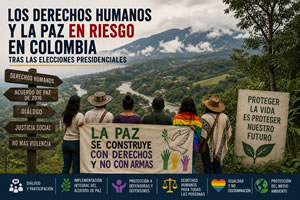
“A group of 21 international human rights organizations, including the International Office for Human Rights in Colombia (Oidahco), warns about the upcoming policies of the ultra-right-wing elected President Abelardo de la Espriella. They fear a possible reduction in human rights, setbacks in the implementation of the 2016 peace agreement and peace policy, and an erosion of the rights of women and LGBTIQ+ people. (…) His “immediate plan” envisages rolling back the sphere of influence of armed groups through extensive military operations in the first 90 days of his government. (…) The signatory human rights networks therefore call on the European Union and its Member States, as well as Switzerland, Norway and the United Kingdom, to persuade the future government of De la Espriella to respect the Colombian State's obligations under the 2016 peace agreement…”Article by Pablo Schröder from June 26, 2026 in Amerika21and more on the topic:
- President in Colombia questions the autonomy of universities by allowing police access to universities

"Colombian President Abelardo de la Espriella has announced that the police will be allowed to enter public universities when terrorist acts, vandalism or violence occur. Such an operation should be legal even if, in the government's opinion, such acts are being prepared. The measure should be accompanied by a nationwide protocol that distinguishes peaceful protests from acts that the government considers to be dangerous or that disrupt public order in an exceptional way. (...)
The announcement has raised doubts among university management. The Rector of the Universidad Nacional, José Ismael Peña, clarified that autonomy does not mean that the university is outside the law. If a crime is committed, the police can intervene without the permission of the university management. His concern is more about the effects of a blanket police operation. According to him, those who commit acts of violence could mingle with students and take advantage of the structural conditions of the university campuses. However, he emphasized: “We have 25,000 people here every day and it can be counterproductive if a police tank drives onto campus because it can injure many other people.” At the core of the matter is the question of what university autonomy means. Article 69 of the Colombian Constitution recognizes it as an institutional guarantee. This does not mean that universities are outside the law or are areas of immunity. Public universities are part of the state, but are not subject to the hierarchical management of the government. Their autonomy is intended to protect the independence of teaching, research and critical thinking from political power. (…)
Colombia has historical reasons to be skeptical. In 1954, police entered the Universidad Nacional campus. Student Uriel Gutiérrez Restrepo was killed during the operation. The following day, soldiers from the Batallón Colombia shot at demonstrators, killing eleven people, including ten students. In 1971, another confrontation at the Universidad del Valle ended with the deaths of 15 people, according to the university. In 1984, a protest was followed by an deployment of security forces at the Universidad Nacional, which also culminated in excessive violence. The lawyer Camilo Blanco believes that De la Espriella starts from the legally correct conclusion that autonomy is not above the constitution, but draws a wrong conclusion from it. According to Blanco, “This does not mean that public universities are at the discretion of the security forces or that a presidential order can replace constitutional guarantees.” Contribution by Sven Hanfstängl Reuss from September 16, 2026 in Amerika21 (“President in Colombia questions autonomy of universities”)
 - Colombia: Heated atmosphere as De la Espriella takes office - counter-demonstrations in Bogotá, Cali and Barranquilla
"Contrary to tradition, this time the new head of state did not take office in the congress in Bogotá, but in Cali. (...) Numerous heads of state from Central and Latin America were expected at the event in the third largest city in Colombia after Bogotá and Medellín. These included the two presidents Javier Milei (Argentina) and José Antonio Kast (Chile), who are considered to be right-wing extremists, as well as other heads of state belonging to the right-wing camp such as Rodrigo Paz (Bolivia), Daniel Noboa (Ecuador), Santiago Peña (Paraguay), José Raúl Mulino (Panama), Laura Fernández (Costa Rica), Luis Abinader (Dominican Republic) and Nasry Asfura (Honduras), Spain was also represented by King Felipe VI on the US side, the Trump administration's main contact for Latin America. According to the Medellín newspaper “El Colombiano”, FIFA President Gianni Infantino was also among the guests at the event. (…)
However, some prominent faces were also missing from the event, including current President Gustavo Petro. The presidential candidate of the “Pacto Histórico”, Iván Cepeda, was also not present. Other members of the left-wing political bloc also stayed away from the event and called for demonstrations in Bogotá, Cali and Barranquilla on Friday (August 7). As the portal “La Silla Vacía” reported, Cepeda explained that these mobilizations were “a peaceful expression of civil disobedience and popular sovereignty.” President Petro, who was still in office, had been less forgiving in the previous days. At a press conference on Monday evening in front of local and foreign media representatives at the Casa de Nariño in Bogotá, he maintained his claim that the elections were manipulated. (…)
Instead of calming the situation, Petro also warned of a possible “civil war” in the country due to the rejection of this and other alleged plans by the future government. “It is very clear what a civil war in Colombia could look like,” the president said. (…) De la Espriella also reacted to these statements. In a live broadcast on his social networks, the future Colombian president attacked Petro and also Cepeda, declaring: “For the first time, an outgoing president and his defeated candidate have chosen, without any reason, not to recognize the victory of democracy at the ballot box and to declare a so-called civil disobedience against the government that I represent and that was elected by almost 13 million Colombians who, despite all the resistance of the Establishments – both legal and illegal – decided for me.” (…)
In this context, De la Espriella reiterated that he is the “President of all Colombians” and that he will “implement, with the force of the Constitution and the law, what Colombians have decided to do, which is to elect me.” He also called for people to “stop normalizing the wrong, the illegal and the distorted.” Let's call a spade a spade and face them as they are. This so-called civil disobedience is nothing but a euphemism to destabilize democracy and I will not allow that.” Article from la diaria translated by Jette Minks on August 8, 2026 in the Latin America news pool, see also: - Four years of realpolitik: Gustavo Petro was the first leftist to rule Colombia for four years and had to contend with the country's powerful oligarchy. A review of his time in office
"The polemic surrounding the entry of the future head of state Abelardo de la Espriella into the presidency this Friday, August 7th, shows how big the change that Colombia is facing will be. (...) [Gustavo Petro] was the first left-wing president in the history of the country to promise at the beginning of his term in office: "From today onwards, Colombia will change." (...) At the end of the left-wing interlude, the question must be asked what the Petro government was really able to achieve. How much change there was in the self-proclaimed "government of change" (...) Petro does not come from the economic elite that traditionally has a firm grip on Colombia. The son of a small farming family, he joined the urban guerrilla "Movimiento 19 de Abril" (April 19th Movement, M-19) at the age of 17, was imprisoned and tortured by the army after the "M-19" made peace with the state After the adoption of a new constitution in 1991, he first became a member of the lower house of Congress, and in 2006 he was elected to the Senate. In 2011, Petro won the mayoralty of Bogotá, from which he was removed again in 2015 after a media campaign. While Petro failed in the runoff election in 2018, he secured the position four years later with the new formation Pacto Histórico (Historical Pact). Victory. The poverty uprising in 2021, which was called a “general strike” in Colombia, played a large part in this. For months, hundreds of thousands took to the streets against social injustice and state violence. The uprising was a reaction to a planned tax reform with which the Duque government wanted to pass on the costs of the corona pandemic to the poorest.The police took brutal action against the protests and around 100 people were killed by emergency services. The vast majority of protesters were young, marginalized, often female; many of them voted for the Pacto Histórico candidate a year later. Indigenous and Afro-Colombian communities also supported Petro's candidacy. (…) Despite some radical rhetoric, Petro did not promise to change the situation. Rather, his government program was in line with left-wing social democrats in the region such as Luiz Inácio Lula da Silva in Brazil or Gabriel Boric in Chile. In addition, Petro made environmental protection a hobbyhorse of his government. Under his presidency, Colombia should develop into a “world power of life” and new concessions for oil and mining projects should be stopped. He wanted to resolve the decades-old armed conflict through negotiations with various armed groups, including guerrilla organizations, paramilitaries and groups active in organized crime. That was enough to frighten the country's oligarchy. (…) Petro had made “total peace” a flagship of his government. Dialogue and offers of negotiation, combined with combating poverty, inequality and social injustice as causes of political violence, were at the center of the approach. Both the decidedly political groups such as the largest guerrilla “Ejército de Liberación Nacional” (National Liberation Army, ELN), with more than 6,000 members, as well as groups primarily active in organized crime such as the “Clan del Golfo” or locally operating gangs should be included.(…) Four years later, the results are sobering. There was never a breakthrough with the ELN; The talks have been on hold for months. The EMC split into a faction willing to negotiate, the “General Staff of Blocks and Fronts” (EMBF), and a faction that continues to wage war in the Cauca department. The talks with the “Segunda Marquetalia”, which had previously joined forces with other groups, also failed; the alliance collapsed. The dialogue with the “Clan del Golfo” – the most powerful organized crime group with almost 10,000 members and a widespread presence in the country – only ended in July when it was broken off. Petro had previously signed a decree that lifted the suspension of the extradition orders of key clan leaders to the United States. The move was justified by a lack of “sincerity” in the dialogue. However, the Petro government was able to record occasional successes; She reached agreements especially with local gangs. Nevertheless, the overall picture is negative. (…) The poor security situation became a key burden for the Petro government. (...) De la Espriella's election victory can also be read as a reaction to the failure of "total peace..." (...) The fact that the election was extremely close despite international interference and the regional trend - the winner received just around 250,000 more votes ahead of the Pacto Histórico candidate Iván Cepeda - gives hope. Petro's government project meant material improvements for millions of Colombians. Even more important for many the experience that for the first time in decades they had the feeling of being heard and taken seriously by politicians.This can lead to self-confidence. The experience of the election victory of the “Historic Pact” in 2022 has shown that the right can also be pushed out of the presidential palace in Colombia.” Article by Frederic Schnatterer in the Junge Welt from August 7, 2026 - Using the example of Abelardo de la Espriella: Local hypermasculinity and global extreme right
"The rise of the extreme right cannot be understood solely based on their programs or election results. It is also about certain forms of subjectivity, authority and power with which it goes hand in hand. The example of Abelardo de la Espriella shows the emergence of a nationalist-focused hypermasculinity as a political instrument that links patriarchy, militarism, nationalism and raw material exploitation in the midst of the current global rise of the extreme right. (…) Abelardo de la Espriella is not just a guy. He represents a right-wing extremist masculinity, a transnational trend that convinces with symbols, gestures and promises of order and preaches national salvation. The most important values are security and family, authority is the solution to social conflicts, the pillars of his idea of salvation are militarized security, the traditional heterosexual family and an extractivist-focused economy. They dominate in all questions about gender, ethnicity, class and nation. The leading figure must be warrior, hero, father and messiah in one person, hence the military salute, the look to the horizon, the constant presence of his wife and daughters and the prophetic tone of his speeches.The image of masculinity displayed by de la Espriella is completed by a specially designed accessory from men's clothing (hats with his name), his performances as a tenor and his self-chosen nickname "El Tigre": De la Espriella sees himself as a solitary, elegant predator who does not negotiate his place in the pecking order, but asserts it and is prepared to kill for it. (…) Even if these things concern the surface, they are not a minor matter, but part of a political strategy that mobilizes emotions: recognizable symbols are established and the image of a leader who embodies a certain idea of the nation is conveyed. Essential aspects are de la Espriella's "whiteness", which combines authority, success and national belonging with historically entrenched racial and class privileges and challenges the rights of people with different identities, and his unwavering commitment to heteronormativity, which manifests itself in the rejection of the rights of people with different sexual orientations and gender identities and in the constant proof of his masculinity. Strength wins over empathy, authority over negotiation and hierarchy over equality. (…) Our aim with this text is not to demonize an individual, but rather to understand a political and cultural machine. When security becomes an ideology and diversity becomes a threat, democratic options are no longer an option.Critically reading and confronting these forms of power is essential to advocating for a more equal, pluralistic and just future for Colombia.” Post from July 7, 2026 in the Latin America news pool, see also:
- How AI benefits the New Right
“A tiger in a suit and tie smashes a train marked “same as always” with one punch. The same tiger appears at a presidential debate, but his opponent does not appear. After winning the first round of the Colombian presidential election, the tiger appears on the Colombia national football team's jersey and in a photo with the players. That tiger is Abelardo de la Espriella, the new president of Colombia and a well-known lawyer for the country's paramilitaries. Unlike what you see on social networks during the election campaign, his campaign did not try to replace reality with deepfakes - that is, audio, videos or images generated or manipulated by AI to appear real - but rather used artificial intelligence to further simplify his messages and generate angrier emotions, including rejection of the left. (…) The use of digital platforms in election campaigns is nothing new. This has already been seen with the New Right in the USA, Brazil, Argentina and recently in Peru. In a recent study by the Peruvian portal Ojo Público, digital rights expert Juan Carlos Lara showed that these ecosystems can create “streams of artificial support” that increase the impression of the candidates’ popularity on the networks, even though the political support does not correspond to reality.(…) After pornographic deepfakes of female candidates in the Brazilian municipal elections were distributed in 2024, Brazil's Supreme Electoral Tribunal TSE published a resolution banning the distribution of AI-generated content in the 72 hours before election day and 24 hours after. The decision will also come into force this year in view of the Brazilian presidential elections in October. (…) The same thing happened in the 2025 Argentine parliamentary elections. After reports of fake videos, the electoral court ordered such artificially generated content to be deleted from Platform X. But Elon Musk's platform did not follow this decision. Elections will also take place in Paraguay in October. César Rossel, a judge at the Supreme Electoral Court, said his body could not regulate the use of artificial intelligence in election campaigns because there were no laws on the matter. A month ago, opposition senator Celeste Amarilla proposed regulating artificial content after she herself fell victim to a deepfake. But it is unclear how and to what extent this proposal can be implemented. All that remains is to analyze, debate and try things out until mechanisms that really work are found. Investigative journalist Leonardo Mangialavori proposes a “media literacy campaign as a sustainable policy”. If you learn to identify influence campaigns and artificial content, Mangialavori says, you can combat the feeling that "everything is fake anyway," the feeling of endless and paralyzing doubt - or the relativization of laws that say everyone is right.Therefore, we must create and defend our own certainties.” Contribution by Josue Congo from July 9, 2026 at the News Pool Latin America
- How AI benefits the New Right
- Protests after runoff elections in several cities in Colombia
“…Already on election evening, people gathered in various parts of Bogotá, including around the Corferias exhibition center, where the official count took place, as well as in the Usme and Kennedy districts. On Monday, June 22, a protest march led by student groups marched from the National University to Plaza de Bolívar. The participants protested primarily against alleged election fraud, the threat of privatization of public education by the new president and the general shift to the right in the country. This caused disruptions in city traffic. The TransMilenio bus system temporarily closed several stations. In a press conference on June 22, Cepeda called for calm and stressed that his political camp was not calling for violent protests.
In Cali, where Cepeda won the majority of votes, clashes broke out on the night of June 22 between demonstrators and Undmo, the successor structure to the former notorious Esmad police unit. Tear gas and water cannons were used, particularly in the east of the city, in the Puerto Resistencia (Resistance Port) district, which is known for its strong protest movement. Undmo units were also deployed in Bogotá. In total, the police registered actions in 82 communities. Bogotá, Cali and Pasto were classified as priorities…”Post by Lilith Mić from June 25th, 2026 in Amerika21 - The international trade union movement stands with the Colombian people in the defense of democracy
“Following the 2026 presidential elections in Colombia on May 31, the international trade union movement reaffirms its commitment to the defense of democracy, popular sovereignty and respect for the popular will expressed at the ballot box. During the first round of elections, which took place on May 31, over 70 trade unionists from Latin America and Europe committed to promoting democracy took part in the international election observation and monitoring mission coordinated by global trade union federations, the Trade Union Confederation of the Americas (TUCA) and Colombian trade union organizations.
The observers were deployed across the country as part of the Unified Command Post (PMU) - Colombia's interagency body to monitor the election in real time. They followed the election process, received complaints and helped ensure the transparency and democratic guarantees of the electoral process. The delegation noted that the electoral process was marred by deep political polarization, disinformation campaigns and reports of vote buying. In general, delegates noted a growing offensive by the far right aimed at weakening democratic institutions and reversing social progress for large parts of Colombian society.
Ahead of the presidential run-off election that will take place on June 21, the international trade union movement reaffirmed its presence and solidarity and expressed its support for the right of the Colombian people to freely decide their future - without pressure, threats or external interference.
Authoritarian rhetoric, political hostilities and attempts to restrict rights are increasing across the region; therefore, the mission viewed the defense of democracy in Colombia as a central part of the defense of democracy throughout Latin America. For this reason, participating organizations, including UNI, expressed concern about signs of foreign interference in the national political debate, particularly by the Trump administration, and expressed alarm at the role played by business and media actors attempting to influence the electoral process through disinformation and attacks on democratic institutions…” EnglishAnnouncement from UNI dated June 25, 2026(machine translated) - “Eradicate leftists”
“Colombia's presumed next president, de la Espriella, an ultra-rightist, maintains good contacts with the extreme right in Europe. He was supported by Trump in the election campaign and wants to subject the country to the USA again…”Report from June 25, 2026 at german-foreign-policy - Colombia: Ultra-right just ahead. The country is threatened with a neoliberal shock program
"The preliminary result is extremely close. After the run-off election for the presidency in Colombia, only around 250,000 votes separate the first-placed Abelardo de la Espriella from Iván Cepeda. (…) In the Caribbean metropolis of Barranquilla, de la Espriella was celebrated by thousands of supporters on election evening. As was the case throughout the campaign, dressed in the jersey of the Colombian national football team and holed up behind bulletproof glass, he exclaimed: "Colombia, here is your tiger!" Now "a new era, a change, the time of the wonderful fatherland" would begin. The time of those "who have fomented violence, terror, drug trafficking and corruption over the years" has come to an end (...) "I am not promising miracles, I will not deceive the people with magic solutions." Instead, "work, self-sacrifice, discipline and perseverance" would be required. The 47-year-old lawyer and businessman, who sees himself as a political outsider staged, promises a shock program for Colombia, like the one used by Argentine President Javier Milei. He wants to drastically cut state spending; in the election campaign he spoke of a reduction of 40 percent. (…) If the result is confirmed, Cepeda announced resistance to likely attacks."We will not allow the social achievements we have achieved to be reversed." Cepeda ended his speech with the words of Chilean President Salvador Allende, who was assassinated in 1973: "History is ours, and it is made by the people." At more than 63 percent, voter turnout was higher than ever before in a runoff election - and more than five percent higher than in the first round. Given the left's enormous mobilization potential, things are likely to be uncomfortable for de la Espriella as president. The Pacto Histórico will be able to play an important role in the opposition. A good half of the country voted for the party on Sunday. Such a consolidation of the left-wing project would have been unthinkable a few years ago. After the preliminary results were announced, young people in particular took to the streets in several cities in Colombia. In the capital Bogotá, they chanted against de la Espriella in front of the public Universidad Nacional. In Cali, the country's third largest city, there were clashes between demonstrators and emergency services. Previously, US flags had been set on fire and police officers used tear gas.” Article by Frederic Schnatterer in the Junge Welt from June 23, 2026 - Human rights and peace in Colombia at risk after the presidential election
“We, Colombian and international civil society organizations, express our deep concern about the situation developing in Colombia following the election of Abelardo de la Espriella as President1. This new political context raises uncertainty about the continuity of progress on human rights, the full implementation of the 2016 peace agreement and peacebuilding measures in the country, and raises concerns about possible regressions in the rights of women and LGBTIQ+ people. (…) We warn of the danger of a resurgence of the armed conflict, which will only lead to a significant increase in the number of victims, displacement, human rights violations and violations of international humanitarian law. We are also concerned that implementation of the 2016 Peace Agreement may be overshadowed, which represents a State commitment and an essential roadmap for structurally addressing the causes of conflict.
Against this background, we urge the international community - in particular the European Union and its Member States, as well as Switzerland, Norway and the United Kingdom - to step up their support and monitoring measures…” span.Press release dated June 22, 2026 from OIDHACO– Oficina Internacional de Derechos Humanos Acción Colombia (machine translated) - Elections in Colombia: The dangers behind the ultra-right candidate – neoliberal restructuring, old patterns of violence and retaliation against the left
In his program, the 47-year-old lawyer and ultra-right presidential candidate Abelardo de la Espriella combines an ultra-neoliberal economic policy à la Javier Milei with an extremely authoritarian security and military agenda. He wants to reduce the state by 40 percent and argues that it has 700,000 employees too many. He plans to abolish the Special Justice System for Peace (JEP), which he describes as a “farce”. His security policy proposals are based on a model of harsh repression: ten large high-security prisons à la Nayib Bukele, some of which are privately managed and controlled by reservists, as well as the end of peace dialogues in favor of military escalation and the legalization of gun ownership for civilians. The program is complemented by an intensification of the fossil fuel economy with fracking as well as more oil contracts and a reorientation of foreign policy with Colombia's withdrawal from international human rights bodies such as the UN and a close security policy alliance with the USA and Israel. His project corresponds to the interests of the international fossil fuel economy and the ultra-neoliberal doctrines à la Milei. He is not an “outsider,” as he likes to call himself, but represents the continuity of the violent rule of Colombian elites, who in the past, and in some regions even today, have made use of paramilitary and mafia structures. In the past he has indicated clear sympathies for the paramilitary project of the then Autodefensas Unidas de Colombia (AUC).About the AUC chief known as “Ernesto Báez,” whose substructure was responsible for over a hundred massacres, over 4,000 murders and more than 1,700 cases of enforced disappearances, De la Espriella said in 2008 that he was “the romantic” of the AUC. (…) These biographical connections are also reflected in his rhetoric. De la Espriella channels counterinsurgency sentiments deeply rooted in Colombia's elites. So he sees “no need to refute opponents, but to destroy enemies,” as the political scientist Sebastián Ronderos and the sociologist Cristian Olaya describe it. (…) In the same style, the ultra-right politician said in a radio interview in July 2025: “You, the gentlemen of the left, should know that in me you will always have a bitter enemy who will do everything in his power to eviscerate you.” He added: “This plague must be eradicated.” (…)In a country where the paramilitaries have a history of literally disemboweling ordinary people from the organized population, dismembering them with chainsaws and playing football with their heads, De la Espriella's words ring alarm bells among social movements and progressive forces. Even in the run-up to the elections, ultra-right forces are spreading a threatening mood. After the first round of voting, lecturers and students at several public universities received mass email threats with the subject: “The good times are over for the communists.”In the name of De la Espriella's Defensores de la Patria (Defenders of the Fatherland) platform, the “ideological training centers for communists” are warned. The authors announce that they will “not rest” until they have “exterminated everyone who thinks in Marxist terms and advocates ideological nonsense.” (…) The broad social base behind the left-wing presidential candidate Cepeda and his vice-presidential candidate Aída Quilcué, on the other hand, relies on the continuation of the progressive project. Cepeda himself called for breaking with the “vicious circle of fear, hatred, selfishness, violence and political decay” that “prevents people, young people, social groups, women and all those who do not have armed or mafia structures at their disposal, from freely participating in public life.” It is the political consequence of the organized population that is the “antidote to hopelessness, fear and violence.” Contribution by Hans Weber from June 20, 2026 at Amerika21
See also:
- Abelardo de la Espriella also has press freedom in his sights in Colombia
- And we remind you of the dossier:Smear campaign before the presidential election: Companies in Colombia coerce employees to vote against Gustavo Petro - unsuccessfully
The post“Eradicate the Left”: The new ultra-right President Abelardo de la Espriella is a threat (not only) to human rights and peace policy in Colombiaappeared firstLabourNet Germany.
Read the full story at the source
Source: labournet.de