
Labour · labournet.de · · 57m
Watermelon Harvesting in the USA: Harvesters and H-2A visas concentrate power with farmers and take it away from self-organized work teams
Deutsch (original) · Auto-translated to English
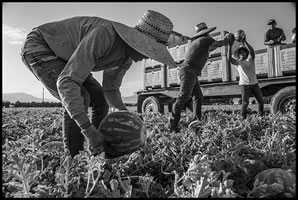
“…Harvesting watermelons is brutal, hard labor performed in extreme heat, but is so well coordinated that it almost seems like a dance. (…) They almost run as they walk along the rows. Over the course of a day, they switch positions so that each worker ends up taking turns taking on the heavier and lighter tasks. They work so quickly that they never stay in one place for more than a day, two at most. Until recently, this type of physical labor gave workers the ability to negotiate and enforce better protections. But the increasing provision of visas for temporary agricultural workers, combined with an increasingly mechanized harvesting process, has brought major changes for these workers…” EnglishPhoto report by David Bacon on September 17, 2026 in Barn Raiser  and more from it:
- Further from the (very worth seeing and at the same time informative!) English.Photo report by David Bacon on September 17, 2026 in Barn Raiser (“A New System of Labor Threats Farmworker Power”, machine translated): “…The group I met at the height of the summer heat was working at the southern end of the San Joaquin Valley, not far from Arvin. At 5:30 a.m. that morning, as the sun rose, workers' cars were already lining the valley's roads and highways, right next to field after field. Even before dawn, people streamed out of their vehicles and into the rows and vines. By starting work early, they were able to complete seven or eight hours of work before the heat reached its peak. (…)
As I headed out into the field to take the photos, I knew I didn't have to ask a supervisor for permission. The watermelon teams work without a foreman, so all I needed was their permission to photograph them. These workers take pride in their ability and willingness to carry out this difficult work in the scorching heat, day after day. They were excited to show a white guy with a camera what they could do.
I've been photographing teams like this for decades. You don't have much time to take photos in the middle of a field. People work and don't want to stop, especially when, like the melon throwers, they work in piecework. If you want to take pictures of people at work, you have to do it in passing. You learn to walk backwards, look, talk and take photos at the same time - all at once. That alone gives you respect. (…)
One particular work group travels together for months, moving from fields near the Mexican border north through California, Oregon and Washington as increasing heat ripens the fruit. During the winter, most watermelon workers live in the border towns of Mexicali and Calexico in the Imperial Valley and in the twin cities of San Luis in Arizona and San Luis Río Colorado in Sonora. A few live in the Coachella Valley, an hour north of the border. They travel during the harvest season and only see their families again when the harvest is over and they return home.
Some teams work as a collective and return to the same fields and growers year after year, negotiating directly with the grower. In previous years, teams' negotiation method and their control over the pace of work gave them a lot of bargaining power and led to better pay. Watermelon Workgroups are paid as a group, $150 per trailer. The trailer in this field held 16 full containers, totaling about 500 watermelons. They split the money evenly, which came to about $20 per person per follower. You can load 7-8 trailers before it gets too hot for this heavy physical work.
Other farm workers have also used their labor groups to gain better wages through control of work. Salad carvers had similar power and were organized into so-called “ground crews” of 30 to 40 workers, divided into groups of three: two cut, one packed the boxes. They were able to control the amount of lettuce they cut per day and slowed down or even took a break to force an increase in piece wages. In previous decades, Filipino teams of grape harvesters also negotiated with producers as a group under the leadership of their own team leader. TheWine strike of 1965began when those teams went on strike, first at Coachella and then at Delano.
Today, however, this traditional way of working and negotiating is increasingly disappearing. The Filipino workforce is now a thing of the past. Ground workers are also becoming increasingly rare, and lettuce is now harvested by workers behind a lettuce harvester who control the pace of work, making collective action difficult. The “Lechugeros” are no longer among the best paid agricultural workers as they used to be.
To find out whether the same process was also changing the work of melon harvesters, I drove through the San Joaquin Valley looking for work crews, particularly those recruited through the H-2A visa program. This program allows employers to bring in workers from abroad who are forced to work in exploitative conditions for up to ten months and then leave the country. Eventually I found several. Often the foremen were young men who themselves participated in the H-2A program. (…)
As they moved across the field, they cut the melons from the vines and threw them onto a conveyor belt that led to a platform pulled by a tractor. There, other workers packed the melons into boxes. This system replaces the previous process in which workers threw, caught and packaged the melons with their hands. The conveyor belt and the loading device are components of a mechanized system, the “melonator,” which is intended to replace much of the manual labor involved in melon harvesting. Producers, especially the largest companies, do not like the old system. It gives workers too much influence, which they use to push for better wages. Today, some independent teams still harvest and sort watermelons, but this new system of machines and H-2A workers is now almost universally adopted for other types of melons.
Grower Bart Fisher says that once an additional assembly is installed to replace the harvesters themselves, the machine will only need seven people to complete a job that currently requires 30 people from the H-2A crew. He has developed melon varieties that can withstand mechanical harvesting. (…)
About 2 million agricultural workers work in the fields of the United States. In 2025, the Department of Labor issued permits to farmers for 398,258 H-2A workers, representing about one-fifth of the total U.S. agricultural workforce. That's a fourfold increase from the 98,813 in 2012. Almost all of them are young men. Anyone who doesn't work fast enough or protests can be fired and sent back at any time. “We all come from disadvantaged communities in Mexico where there is no work,” explained Eduardo. “It’s easy for the company to take advantage of our plight.”
The UFW filed suit, and in late August, U.S. District Judge Kirk E. Sherriff in Fresno ruled that the federal wage was unlawful because the Department of Labor had not "ensured that the hiring of H-2A workers would not 'adversely affect' the wages of U.S. agricultural workers." However, the potentially illegal wage will remain in effect until the Labor Department sets a new one. Regardless, the ruling is based on the obvious fact that the wage paid to H-2A workers effectively acts as a cap on the wages of all agricultural workers who are at risk of replacement if they are unwilling to work for that wage.(…)
Industrial agriculture is increasingly dependent on the explosive growth of this program, ignoring the costs in job losses for local farmworkers and the burdens on H-2A workers themselves. The pandemic has highlighted these costs. Cynthia Rice, former head of litigation at CRLA, cites workers' isolation and the temporary nature of their stay in the U.S. as key reasons for their vulnerability. “Our agricultural industry is supported by cross-border workers – we need to recognize that,” she says. “But these workers only have a quasi-legal status and are controlled by the producers.” While the watermelon and lettuce cutting teams' self-organization gave them a measure of power to counter grower control, they are now losing it to this exploitative new labor system.”
See also by David Bacon and on the topic:
- Dossier:We are not animals, we are people”: It’s not just farm workers in the USA who work in deadly heat and with little protection
- Dossier:Deportation offensive and/vs labor market (using the example of agriculture) in the USA - and Trump's rascal course
- Photo report by David Bacon from August 2024:California's wealthy wine industry routinely endangers the health of its workers
- Photo report by David Bacon in April 2024:The Human Cost of Strawberry Harvesting. About low wages, high costs of living and strikes by migrant pickers in California
The postWatermelon Harvesting in the USA: Harvesters and H-2A visas concentrate power with farmers and take it away from self-organized work teamsappeared firstLabourNet Germany.
Read the full story at the source
Source: labournet.de