
Politics · Labour Hub · · 2h
Climate action: failed government retrofit scheme is ‘the next Post Office scandal’
English (original) · Read in Deutsch ⇄
The disastrous failure of the government’s ECO4 scheme – which was supposed to retrofit homes with insulation, heat pumps and solar panels – is “the next Post Office scandal”, Imogen Thomas of Fuel Poverty Action warned last week.
“It’s that level of outrageous,” Imogen told the campaign’s Make Green Fair conference in Manchester on Saturday.
Homes wrecked by incompetent or fraudulent contractors are facing their fourth winter without heating. People claiming compensation are given the run-around.
The retrofit measures – that could and should help tackle climate change, while making people’s lives better – have made them worse. And this plays into the hands of opponents of climate action.
“Some people tell us we shouldn’t focus on things being done wrong,” Ruth London of FPA told the conference. “We don’t agree. We are taking this up because we want retrofit to be done right.”
When the ECO4 catastrophe was exposed in Parliament last year, echoes of the Post Office scandal – the victimisation, for years, of more than 900 subpostmasters wrongly accused of theft, to cover up the failings of a Fujitsu computer programme – were unmistakeable.
The House of Commons Public Accounts Committee said the “clear and catastrophic failure” of ECO4 had left 30,000 homes with defects. The National Audit Office and Serious Fraud Office are on the case. (See The troubles with retrofit at the end.)
But campaigners say that the ongoing failure to repair damage, and to pay compensation, is compounding the problem.
“Some people have gone for four winters without heating,” Imogen Thomas said at last week’s conference. “People have had tens of thousands of pounds’ worth of damage done to their homes. Some have suffered being without a roof, because badly-installed solar panels collapsed their roof.
“People have been unable to get insurance policies to pay out. They have been sent round in circles by the government and Trustmark [the agency created by the government supposedly to oversee the schemes].”
Signature fraud, where contractors put fake signatures on documents, has been widely reported, but “there is no access to justice,” Imogen added.
Trustmark’s “Find & Fix” scheme, that is supposed to put badly-done work right, produces too few results, too slowly, campaigners say.
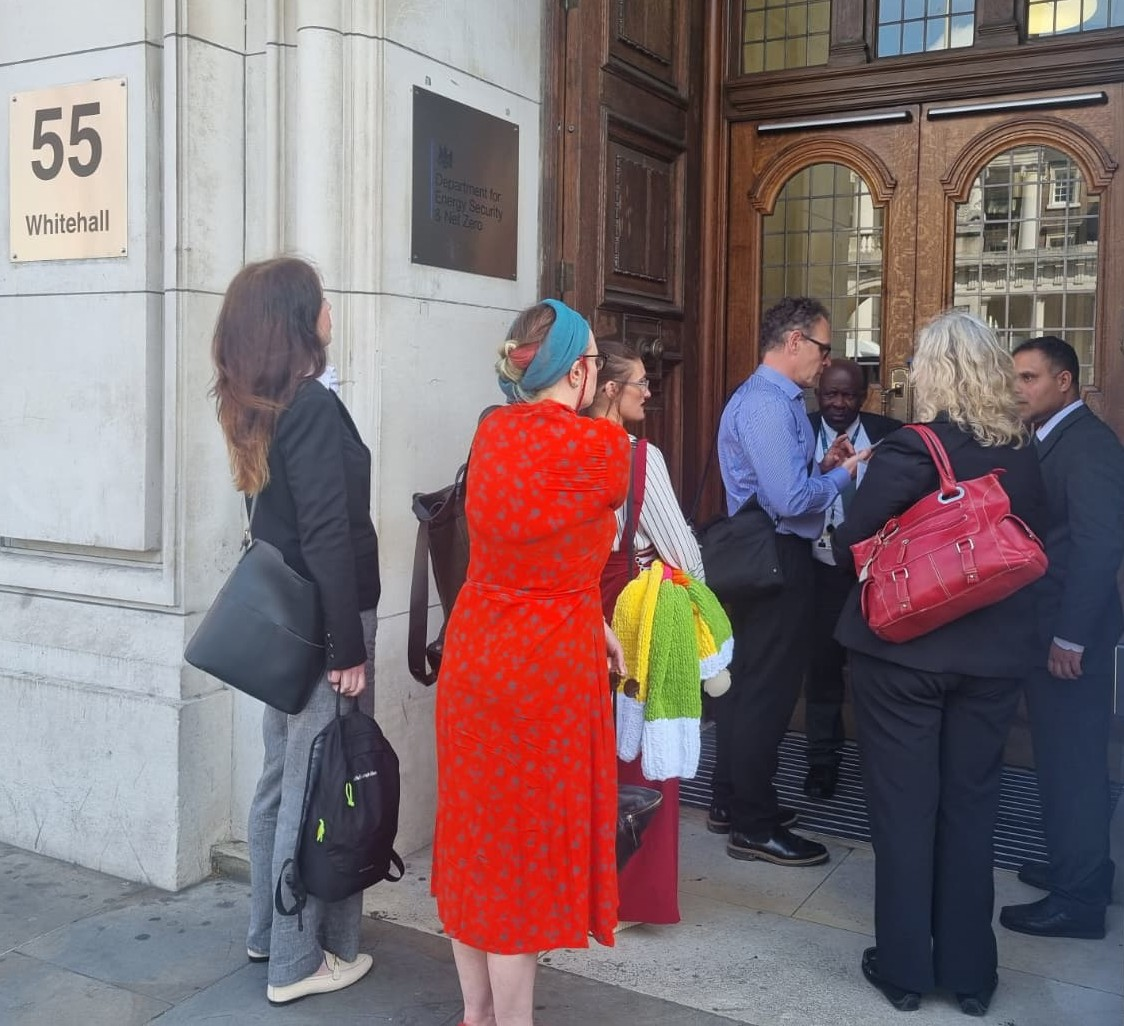
Victims of the scandal are “coming together and organising,” Imogen said. In June, a group of them met with Martin McCluskey, the responsible minister in the Department for Energy Security and Net Zero (DESNZ), and put their demands directly to him.
McCluskey promised that all damaged homes would be fixed, at no cost to victims – but when he addressed the issue in the House of Commons, the principal commitment was to launch a consultation on “how we can simplify the current fragmented landscape” – something campaigners have demanded for years.
The damage done by the ECO4 scandal would be sorted out by TrustMark, the National Energy Foundation and Installation Assurance Authority, McCluskey said.
Jonathan Bean of Fuel Poverty Action said in an interview: “McCluskey has left tens of thousands of ECO4 victims suffering for another year. He doesn’t even know how many homes have been fixed, and his new package of measures excludes most of the victims.”
At the Make Green Fair conference, Imogen Thomas warned that “the people who are contacting each other, setting up meetings with DESNZ and are STILL not seeing remediation” are “the tip of the iceberg.”
Many others who do not have the capacity, or are not well enough, to fight their corner year after year, are being ignored. The scheme was contracted out, often to “completely unregulated cowboys”, who preyed on vulnerable people, going door to door to find those they could make money from.
The conference heard a video message from Katie Barrett, a cell biologist whose home was damaged by ECO4 contractors, and who met with DESNZ officials and with McCluskey.
“Months later, I am still no further in my quest to get the damage to my property fixed. My house is damp and cold – and I am one of many many people in this situation. It’s miserable,” she said.
The complaints procedure has made things so much worse. “We are absolutely ground down by this. It has taken years, and we’re still not there. We’re still living in houses that can’t be redecorated because the insulation needs to be taken out.
“We have sent hundreds of emails, and wasted hours and hours of time trying to get some kind of justice, and to get remediation.”
In a recent social media post, Katie said “residents are being sent around the same loop” in a “failed accountability system.”
Retrofitting of flammable cladding, after the Grenfell disaster, has sometimes been as bad as ECO4 misery, the Make Green Fair conference heard.
Graeme Langton, a resident of the Malus Court council estate in Salford, where flammable cladding was removed, described in a message the multiple problems that ensued. Replacement cladding was installed at snail’s pace, energy bills shot up and equipment did not work.
“The retrofit has been an unmitigated disaster, even though Pendleton Together [that manages housing on behalf of Salford council] receives awards for excellence,” Langton said. The heating and hot water systems installed are difficult to run, “extremely costly”, and had never worked to standard.
Many tenants were unable to use heat pumps that “take up a huge amount of space in tiny kitchens”. Unsuitable windows were fitted. Energy Performance Certificates were “not worth the paper they were written on.”
No-one had been held responsible for what had gone wrong, Langton said. “Retrofitting is good in principle, but requires strong oversight to ensure that it meets the standards on completion.”
The Malus Court scandal has been raging for years. When the cladding was removed in 2020, tenants faced freezing indoor temperatures – and soaring energy bills. In 2022, Pendleton offered £30 a month to help with bills, but the shortfall for some tenants was ten times that. Rents went up too; mould caused more misery.
As well as efforts to defend people from the impact of failed government ‘green’ schemes, the Make Green Fair event discussed the prospects for genuinely transformative decarbonisation, that moves homes off fossil fuels and makes them better to live in.
Ian Madley of Rossendale Valley Energy, a community-owned renewable energy group, described its project to insulate homes and install Smart Local Energy Systems that use ground-source heat, solar and batteries. The systems can cut energy bills by up to four-fifths.
Energy poverty is “not just about people not being able to pay the bill,” Ian said, but also about people having access to the advantages that renewables offer.
RVE has surveyed Victorian terraced houses in Rossendale, where it hopes its systems will operate at street level. They can be economically viable with one-third or more of households participating.
“Energy affordability affects people’s health. We want people to have warm, healthy homes, without having to pay up-front for a new system.”
Electricity produced by the systems will be sold locally through an energy club, at lower prices than those charged by the companies that dominate the grid.
Ellen Robottom of the Campaign Against Climate Change trade union group called for a “universal programme of retrofit, covering all tenures, free at the point of delivery.” This could be funded by “taxing the wealthy, diverting funds away from false energy solutions and the military.”
Such work could best be done by “local authorities, funded properly for the purpose,” and delivered by local-government-controlled Direct Labour Organisations. These have been run down by neoliberal economic policies, but still survive in some cities and could be revived.
Such a model, supported by training in climate literacy, could create hundreds of thousands of “good unionised jobs”, Ellen said. It would enable “the necessary planning, monitoring, enforcement of standards, dialogue with communities – and accountability to households for any sub standard work – that we all want”.
Forward-looking demands were the focus of an afternoon session at the conference. Working groups highlighted demands including:
□ On the built environment: holistic apprenticeships to make retrofit jobs well-paid and respected, and a focus on supporting women in construction;
□ On electricity networks: nationalise distribution system operators, move the climate levy (a regressive tax) off energy bills to general taxation, remove regulatory barriers to microgrids, and mandate solar and battery storage on newly-built homes;
□ To tackle heat waves: all heat pumps to be capable of cooling, and government to set guidelines that ensure a right to a safe home in high summer heat;
□ On heat pumps: reliable training amd accreditation for installers, and end-to-end support for households, to ensure they know what technology is suitable for their home and how to use it;
□ On heat networks: a price cap, and the same rights as gas and electricity consumers, standards of service, maintenance and back-up; and the unbundling of heat and water charges from rent, transparency of charges and a ban on evictions for non-payment.
The Energy Company Obligation (ECO) was first launched in 2013. Energy companies were required to finance the decarbonisation of homes. They raised money from energy bills, and offered grants through a patchwork of schemes that favoured higher-income households. Contracts went to certified installers. They usually sub-contracted to small businesses, who were sometimes incompetent and/or corrupt.
ECO4, the latest version of the scheme, was launched in 2022 after energy prices leapt up, and will run until the end of this year. The parallel Great British Insulation Scheme (GBIS) mainly provides for cavity wall and loft insulation.
Regulation of these schemes, by Trustmark, was a disaster. The National Audit Office found “major issues requiring remediation” in 98% of homes fitted with external wall insulation, and 29% of those fitted with internal wall insulation under ECO4 and GBIS.
The offer of government money, and lack of effective regulation, produced dangers of fraud and badly-done work plain as the nose on your face.
Three years ago, a contributor to a popular consumer forum told of “a summer of hell” after an ECO4 retrofit. When he tried to complain, he found that “there is no one body to go to, each element has a different complaint process. So you have to navigate [the electricity regulator] Ofgem, [the quality mark body for renewables] MCS, [the electricians’ certification body] NICEIC, Trustmark, and British Gas (the ultimate funder).”
Two years ago, Samuel Young, a fraud prevention officer at a charity, wrote of his surprise at “the sheer number of reports linked to the ECO4 scheme,” which was “essentially a neoliberal, free-market approach to carbon reduction”.
And this year, journalists are still unearthing stories of blatant fraud.
The root cause of the problem is decades of neoliberal economic policy that has eaten away at housing, the construction industry and local government. The dogma that the market knows best means that the work of decarbonisation is left to small companies who are incentivised to cut corners. The lack of regulation opens the door to corruption and fraud.
Campaigners have warned that, if lessons are not learned and the neoliberal ratchet reversed, the government’s Warm Homes Plan – one of its key policies to meet climate targets – could end in failure on a still greater scale.
Simon Pirani is honorary professor at the University of Durham and writes a blog at https://peopleandnature.wordpress.com/
Image: Campaigners arriving for a meeting with Martin McCluskey, Minister at the Department for Energy Security and Net Zero, in June. Photo by Fuel Poverty Action.
Read the full story at the source
Source: Labour Hub