
Politics · In Defence of Marxism · · 3h
Pakistan: Communist School 2026 – building the forces to overthrow capitalism!
English (original) · Read in Deutsch ⇄
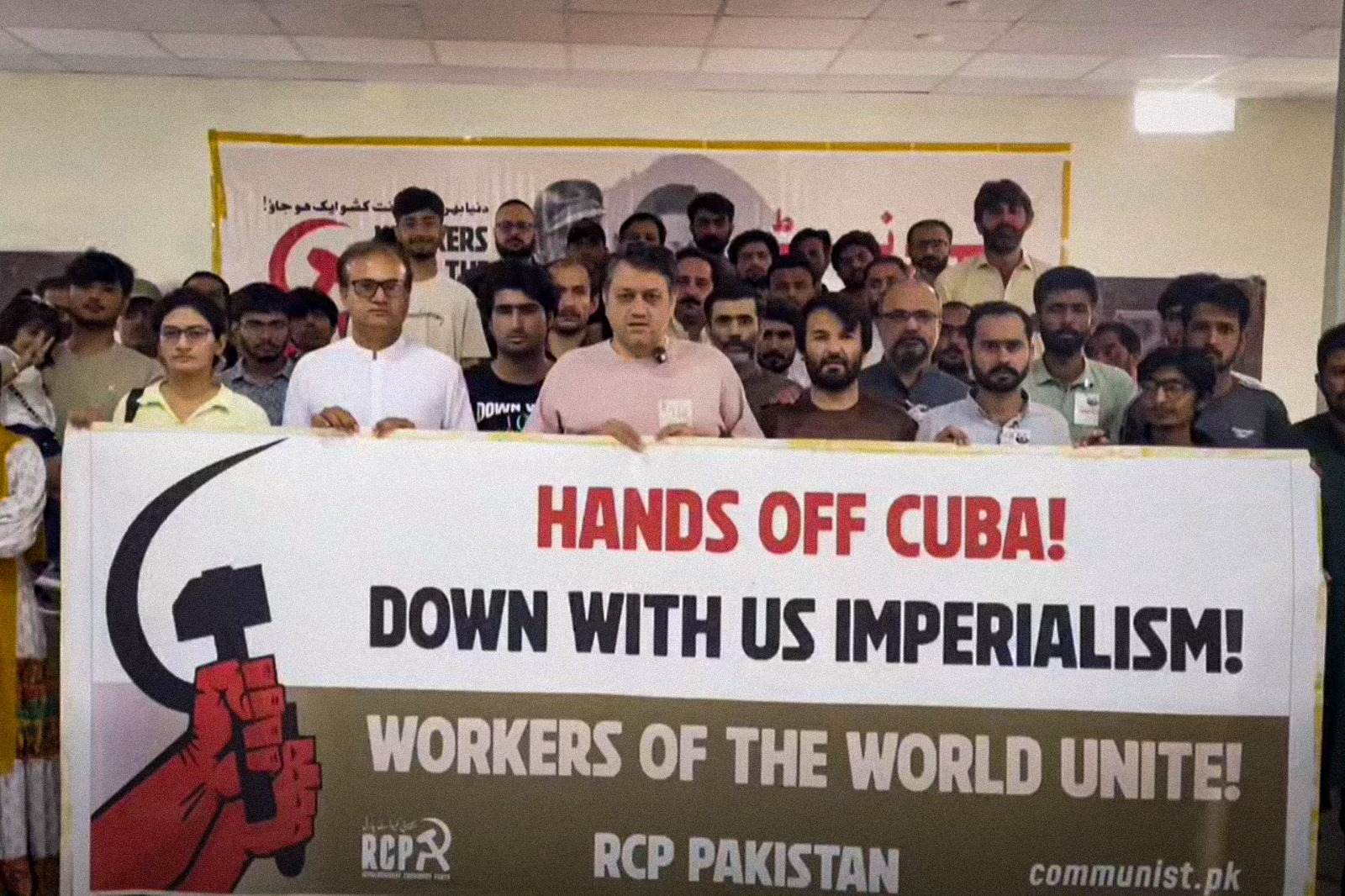
From 4-6 September, the 2026 Summer Communist School took place in Fort Munro, Dera Ghazi Khan, organised by the Inqalabi Communist Party. Around 100 attendees from across Pakistan participated in political and theoretical discussions aimed at understanding the conditions confronting the world today, and the struggle to change them.
[Originally published in Urdu at communist.pk]
The powerful movement unfolding in Pakistan-administered Kashmir, the growing state repression and violence across Pakistan, insecurity and the unprecedented rise in the cost of living are all shaking the consciousness of workers, particularly young people. It is these conditions that are leading a whole generation to begin to draw revolutionary conclusions.
In this context, the Communist School was an especially important event.
The first session, introduced by comrade Anand Parkash from Karachi, covered the current global economic and political crisis, as well as the mounting tensions between the imperialist powers, and the mass movements emerging across the world. A defining feature of the current world situation is the relative decline of US imperialism, which is leading to the unravelling of the world order established under its domination. This is being expressed in increased economic uncertainty, wars, political instability, and mass movements.
The US’ humiliating defeat in Iran is further intensifying this crisis. At the same time, Russian and Chinese imperialism are rising as new powers to rival the US, although the US remains the dominant power. Meanwhile, Europe is facing a steep decline, and its importance in world politics has been greatly diminished.
World capitalism is in its deepest crisis yet. And, as comrade Anand explained, alongside economic and political crises, the moral and cultural degeneration of the bourgeoisie has become more pronounced than ever, exemplified by the Epstein scandal.
In Pakistan, the effects of this global crisis are being felt sharply. The ruling class has proved completely incapable of solving any of the fundamental problems confronting society, and fears that it may soon become the target of the revolutionary anger of the working masses. This is why democratic freedoms have been increasingly curtailed and brutal state repression has been unleashed against popular movements.
The mass movement in Kashmir has stood against this state repression, and provides an example for the working class across Pakistan. The key lesson of this movement, and all of the movements that have occurred internationally, is the urgent need to build a revolutionary party armed with the ideas of revolutionary communism that can fight to overthrow the capitalist system altogether.
In the context of the relative decline of US imperialism and the rise of China as its main competitor, there are some on the left who celebrate this ‘multipolar’ world. They say that new powers like Russia and China can act as counterweights to the US and create a more stable and peaceful world.
But the question arises: if the emergence of a new world order is supposed to bring peace, why do we see no such peace in the world? The second session of the school, introduced by comrade Usman Sial from Islamabad, sought to tackle this question.
In the discussion, comrades explained that Chinese imperialism is increasingly carrying out exploitation across the globe through the export of finance capital. Furthermore, whilst it is yet to play the same direct role in wars as US imperialism, this does not mean that it is not imperialist. The working class cannot regard any imperialist power as progressive or emancipatory merely because it stands opposed to US imperialism.
To understand this question, it is also necessary to understand the changing role of imperialism. Whilst imperialism may have developed since Lenin’s time, it remains rooted in the same capitalist system. Today, the productive forces are more socialised and global than ever before, as an international market, supply chains, and division of labour have been established. At the same time, the working class of the world has also become more interconnected through global production. A worker in one country is linked to industry and production in another.
Here the fundamental contradiction of capitalism becomes even clearer: the working class of the entire world collectively produces and sustains society, whilst wealth and the means of production remain concentrated in the hands of a small number of capitalists and imperialist powers.
We maintain that US imperialism will not be abolished by Chinese or Russian imperialism, nor will a new world order automatically bring peace. Imperialism cannot be abolished through the shifting balance of power between different imperialists. The only revolutionary force capable of ending imperialism is the working class.
View this post on Instagram A post shared by Inqalabi Communist Party (@rcipakistan)
The third session, introduced by comrade Saqib Ismail, focused on Marxist philosophy and modern science, looking to answer the slander thrown at us Marxists that we are only concerned with economic issues.
The present period is often described simply as an age of science, and attempts are made not only to separate philosophy from science but, going a step further, to declare that philosophy is no longer necessary. Marxists completely reject this idea. Philosophy has a profound relationship with science.
Emphasising the importance of philosophy, comrade Saqib explained that the ruling class employs the media, education system, and other means to spread propaganda and justifications for its crisis-ridden system. When the system goes into crisis, it is often attributed to an individual or single event. Meanwhile, the problems plaguing society are presented as the natural order of things.
For this reason, the working class requires a revolutionary theory and philosophy in order to combat the anti-revolutionary ideas of the ruling class.
In every period, ruling elites have attempted to suppress new ideas. During the Middle Ages, many scientists were persecuted or killed for advancing new discoveries, because these scientific ideas and discoveries challenged aspects of the existing social order. When the old social system was eventually overthrown and replaced with a new system through revolutionary upheavals, science also experienced enormous development.
Today, as capitalism is entering a period of decline, the ruling class is once again spreading unscientific ideas in an attempt to defend its system, presenting these ideas as scientific and using them in its own interests. One example used in the discussion was the attempts in the US to find a ‘genetic’ cause for crime, with whole research centres dedicated to this question – propagating claims, for example, that black people are genetically more likely to commit crimes.
The comrades explained that the only antidote to these reactionary ideas of the ruling class is the revolutionary philosophy of Marxism – this is why the discussion went into detail on the fundamentals of dialectical materialism, and how it allows us to understand the world in order to change it, including in the field of science.
In a very important session on the mass movement in Kashmir, comrade Paras reviewed the political history of the region. He explained that the history of Kashmir has been marked by popular resistance and political struggle, despite heavy state repression. The role of students was given particular attention.
Comrade Paras detailed how the current movement in Kashmir has emerged over the past three years against electricity prices and other economic problems. But, rather than staying confined to economic demands, this movement has taken on broader proportions and revolutionised the political consciousness of the people. Special attention was given to the growing participation of women in this movement, which has brought a new energy to the struggle.
However, the discussion also raised the question of whether popular anger and resistance alone are sufficient for the success of mass movements. What is needed is an organised revolutionary leadership with a clear political programme. With this in mind, comrades discussed the revolutionary potential contained within the Kashmir movement and the crisis of leadership.
View this post on Instagram A post shared by Inqalabi Communist Party (@rcipakistan)
The movement in Kashmir has repeatedly demonstrated the possibility of establishing a revolutionary government of the people. However, the ideological weaknesses of its leadership have caused serious damage to the movement.
In the discussion, we heard from comrades Obaid and Shadab from Kashmir, who have both played an outstanding role in the movement. They shared their first-hand experience of this movement with the rest of the School.
The final session of the School was dedicated to discussing the building of the Inqalabi Communist Party (RCP). Introduced by comrade Shoaib Akhtar, this session explained that, in a period in which mass movements are repeatedly erupting in different countries, the need to build a cadre-based revolutionary party, built on solid Marxist foundations, is clearer than ever.
Despite powerful mass movements – many of which have taken on revolutionary proportions, like Nepal, Sri Lanka, Bangladesh, Indonesia, and Kashmir – the absence of a genuine revolutionary leadership has prevented these movements from going further.
In this context, the discussion on building the RCP was particularly important. Comrades shared how they have been working to strengthen branch meetings, train new cadres, and raise the political level of the party. Many comrades explained how young people, particularly in colleges and universities, have been increasingly showing interest in joining the RCP. This demonstrates a real thirst that exists amongst the youth to understand and study revolutionary ideas.
This demand for revolutionary theory was expressed in the success of the bookstall, which sold Rs 18,000 worth of Marxist literature over the course of the weekend.
The vital importance of theory, and of politically educating the new layers of young people turning towards our party, was the theme of Adam Pal’s conclusion to the school, where he explained the importance of the event. He used the example of the annual schools held in Kashmir over the last two decades, which had a profound impact on political consciousness in the region, and said that similar schools will continue to be organised in the future.
View this post on Instagram A post shared by Inqalabi Communist Party (@rcipakistan)
The revolutionary energy of the event was perhaps best expressed during the closing session, when a young student from Dera Ghazi Khan formally announced his decision to join the RCP right then and there! He expressed his determination to return home and invite his friends to engage with revolutionary politics and join the party as well.
The central thread running through the discussions over the three days was that the present crisis is not confined to the economic foundations of capitalism. Its political, social, moral and cultural contradictions are also becoming increasingly acute.
At the same time, the emergence of popular resistance and mass movements in different parts of the world indicates the widespread discontent that exists against the existing system.
But transforming this discontent into a conscious, organised and decisive revolutionary force requires theoretical clarity, political education, continuous organisation, and a strong revolutionary party.
The Communist School therefore provided an important space for comrades from across Pakistan to collectively discuss the challenges of the present period, draw lessons from struggles taking place at home and internationally, and strengthen the political and theoretical foundations necessary for the revolutionary transformation of society.
Read the full story at the source
Source: In Defence of Marxism