
Germany · CrimethInc. DE · · 3h
The White Whale: A Tale of Toil and Freedom
English (original) · Read in Deutsch ⇄
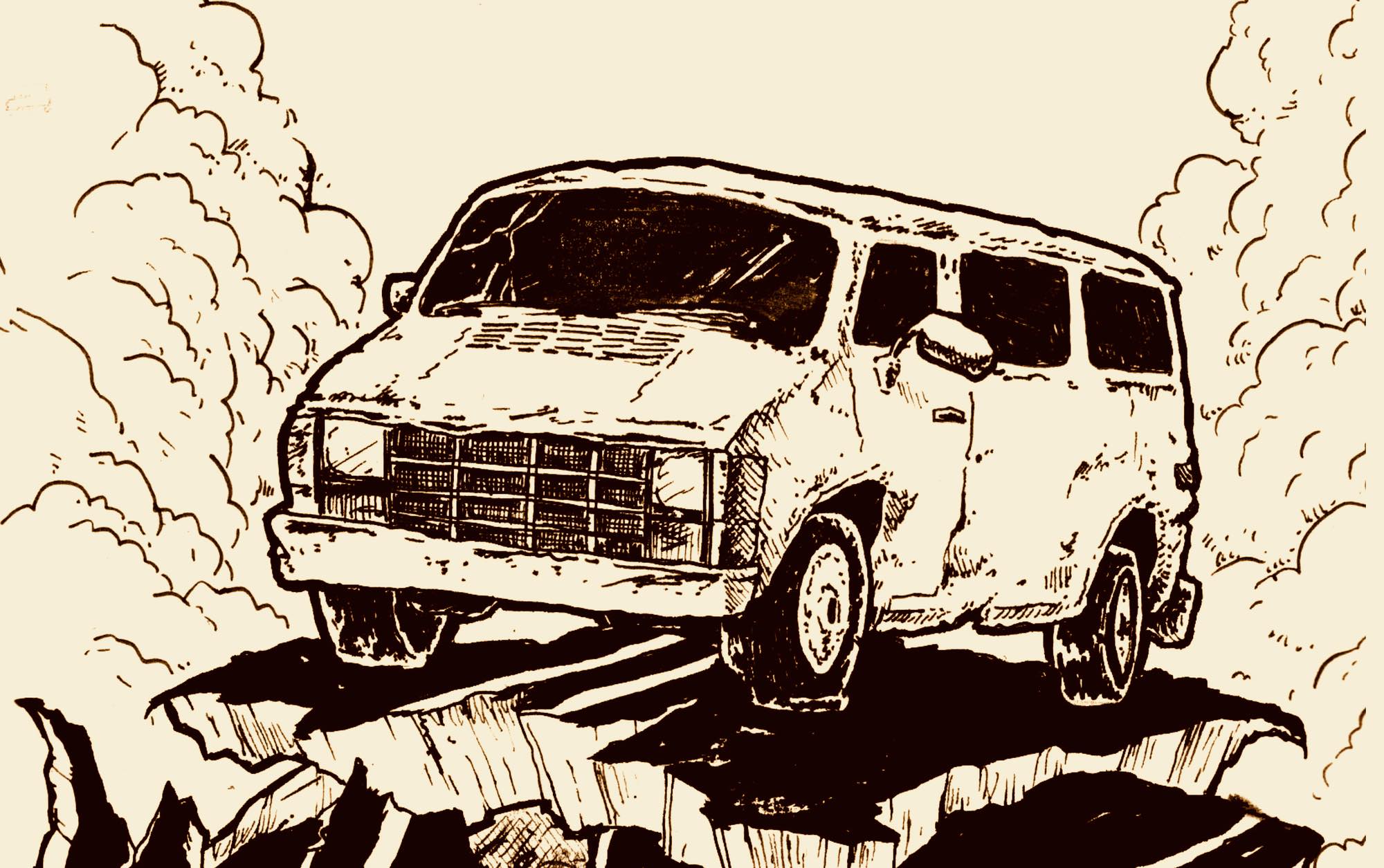
A punk band traveling the world in a free van held together only by duct tape and distortion? It sounds like a whale of a tale, but everything you’re about to read is true times two.
How do punks manage to travel internationally, fight the forces of authority, and dedicate their lives to making art without being independently wealthy? In this testimony, two participants in the punk underground describe how they wrested a vehicle from the economy and kept it running through a series of trials and tribulations.
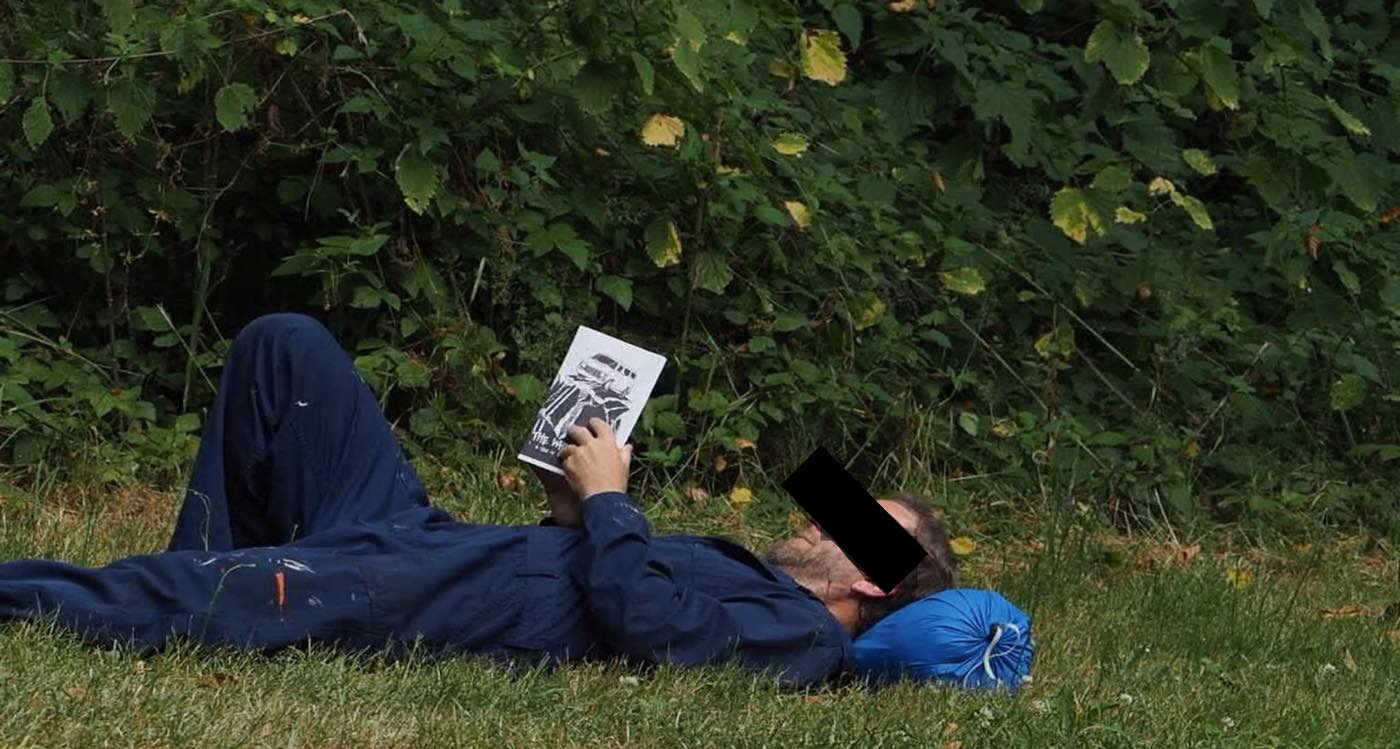
For more material from us in this vein, you can read this zine from 2003.
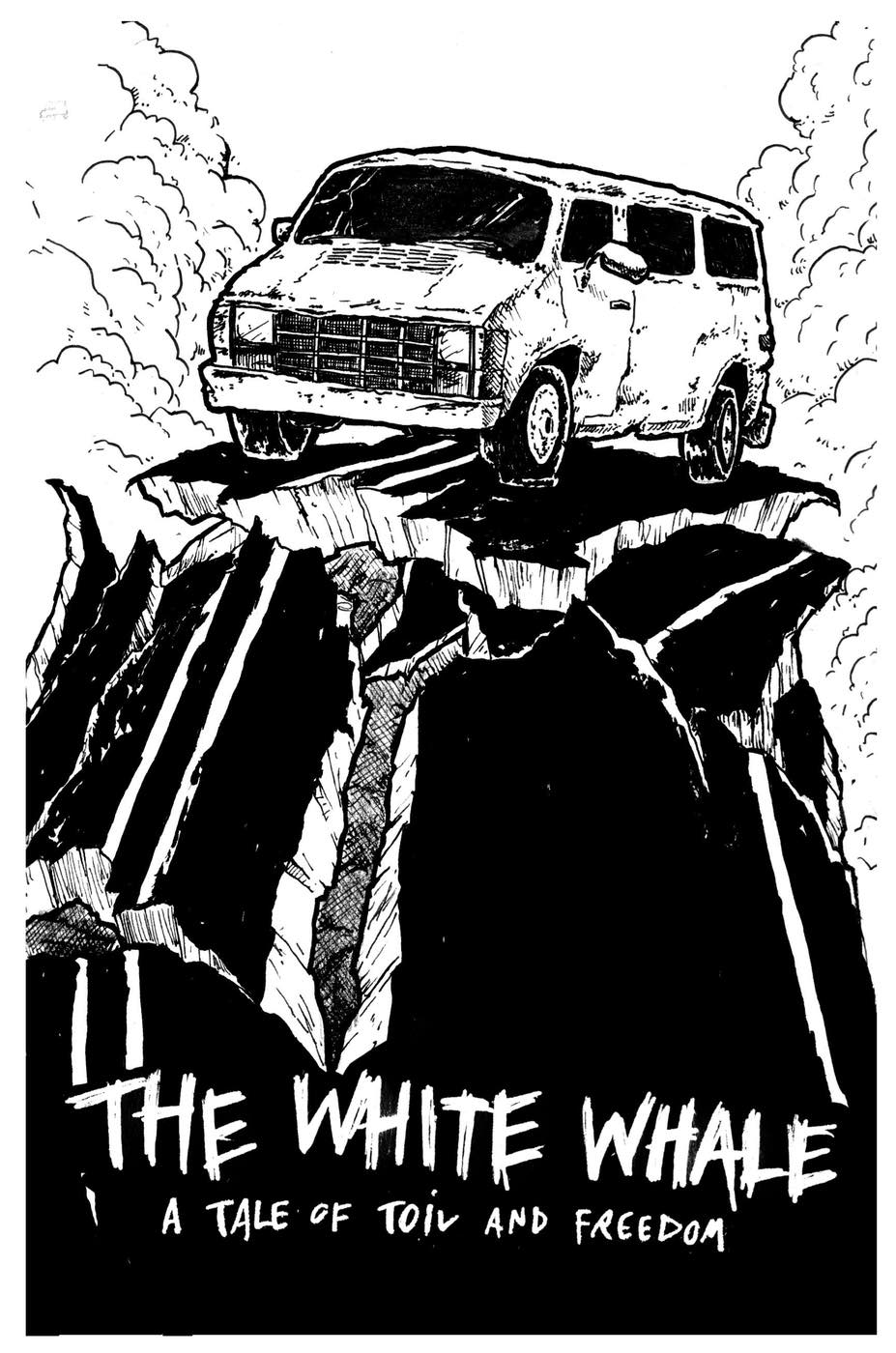
Click on the image to download a PDF of the zine, imposed for printing.
“What’s the best thing you ever got at a Really Really Free Market?” It was his first time attending one.
“Hmm. Maybe a computer monitor? Someone found a vintage Discharge shirt a couple months ago.” At twenty years old, he had no idea who Discharge was. “Or wait, no—it was a van.”
“A van?!”
“Yeah. We drove it all the way around the United States two and a half times, and even to Mexico and Canada. Every mile we drove, we expected to be its last, but no, it kept right on going.”
“Who would give away a van?” He looked at me in amazement. Then another question occurred to him. “And why did you have to ride around in it?”
“All I can say is—it was a different time.”
Here follows the story of the van that escaped the marketplace and the punks who kept it alive, narrated by Fritz and Phil.
Nervous Breakdown
🎵 Fugazi, “Waiting Room”
Beside the Highway, Summer 2008
“Hand me your multi-tool, I need to use the file,” Fritz barked, hunched inside the engine of our broken-down box truck.
A frantic thirty seconds of filing against a steel wrench and the file was ruined. Fritz flipped the multi-tool back to me and kept working.
I stared down at my beloved Leatherman, a necessity for any DIY adherent. There was no time to fight—we needed to get to the show. The file was a casualty of war.
It was the summer of 2008 and we were on the side of an interstate highway in Michigan. We had just embarked on a two-month tour to spread anarchy via punk rock and zines, with planned stops at the Republic and Democratic National Conventions. Our secondhand Wonder Bread truck, powered by illicitly collected vegetable oil, had broken down when we attempted to summit a marginal uphill grade. There we were, frantically attempting to fix it.

At the Garage in Braddock, a Week Earlier
We had spent the preceding week in Braddock, Pennsylvania. The town’s most recent claim to fame was being chosen as the location for the filming of the The Road, the Hollywood adaptation of the Cormac McCarthy novel about a father and son trudging through a post-apocalyptic wasteland in pursuit of bare survival. Local politicians hailed this as a sign of the town’s imminent revival. I guess any publicity is good publicity when you are Braddock, Pennsylvania.
Braddock has been the setting of many of our muddled attempts at automotive repair. It’s a decaying steel town outside of Pittsburgh, home to Andrew Carnegie’s first public library—built to appease disgruntled millworkers, who went on strike nonetheless. The town still hosts one of the region’s few remaining steel mills, though the employees who work there live in expensive suburbs with better air quality.
As a result, Braddock itself is a sea of abandoned buildings that represent desolation to most who pass through. Yet at that time, for a few punks and weirdos, it offered a horizon of possibility: cheap real estate, lax code enforcement, and a local government that desperately wanted you to succeed in your crazy project. The mayor was John Fetterman, later known for becoming a US Senator; at that time, he was just a massive tattooed crazy man driving around in a pickup truck and saying yes to any plan that seemed like it might bring folks to a municipality that had bled out its tax base. Artists from New York City bought old bank buildings complete with reinforced steel vaults; punks who were too broke even for Pittsburgh moved out to Braddock to buy houses for less than $10,000; and one aspiring alternative businessman seeking to expand his waste vegetable oil empire moved into a warehouse on the main street in town.
Unfortunately for the vegetable oil emperor, Braddock was not far enough away to escape his past of playing in punk bands. A long list of acquaintances with decrepit vehicles promptly became one of the most time-consuming and least profitable aspects of his business plan.
We were foremost among the destitute dirtbags occupying valuable garage space in his warehouse. Our first experience in Braddock was driving the former Wonder Bread truck there to convert its diesel engine to run on vegetable oil, in hopes of getting free gas via dumpster diving. The idea was to drive around the country, stopping along the way to suck free fuel out of the drums of used fryer oil behind fast food restaurants, then filter and heat it to work in a diesel motor. Like many of the ideas that filled the zines, posters, lyrics and late-night debates of our radical world, what seemed simple in theory proved messier in practice, both figuratively and literally.
Collecting vegetable oil ranged from mildly gross to downright disgusting; filtering the oil for use in the engine was fraught with peril. Everyone involved eventually had a story of disaster: a five-gallon container of oil falling, cracking, and leaking all over the inside of a trunk, a filtering setup failing and pouring oil all over a basement or garage. It was standard for the fuel filters to clog on the highway and leave you stranded. But the veggie oil king of Braddock managed to surpass us all when one his employees melted the side of a 10,000-gallon tank, causing it to burst open and flood his warehouse with veggie oil, which poured out across the street, shutting down traffic and requiring cleanup by a Hazmat crew—an event that made the evening news, distantly reminiscent of the Great Molasses Flood of 1919.
As a consequence of our interest, used vegetable oil was eventually transformed from a waste product into a commodity. Once businesses got wise to the idea that it was valuable to someone else, they began locking their dumpsters and signing exclusive contracts with collectors who would pay to collect their oil. They installed security cameras to catch the license plates of thieves trying to harvest their rancid gold under the curtain of night. This was the final nail in the coffin of the veggie oil dream.
But in those days, veggie oil was our way of life. Our veggie oil tank on the previous trip had simply been a 55-gallon drum ratchet-strapped behind the passenger seat. For this round, we planned to install an actual tank underneath the truck, cover up the loose insulation in the walls with actual wallboards, and, if we had time, add seats so that the rest of the band no longer had to lay on the floor while we were driving.
Our best-laid plans began to go awry from the moment we showed up. As we tried to pull into the garage, we realized our bread truck was six inches too tall to fit, halting inches away from destroying the garage door and our truck. Rather than working in the comfort of the shop, we had to stay outside on the street, trying to perform complicated fuel line routing underneath the truck as cars sped by and trash blew around us. As usual, we had vastly underestimated how long it would take to complete the work we had planned.
A few days in, with fresh gaping holes cut into the floor and walls of the truck, hoses and fuel lines disconnected, we realized we would need to work day and night to have the truck ready before the first show of tour. We slept on the floor of the truck, woke up in the dirty clothes we had fallen asleep in, and worked all day, only taking short breaks to decide on lunch at the Family Dollar or the gas station, the only two sources of food within walking distance. I remember working well into the AM hours and falling asleep on the floor of the truck, tools still in hand. A few hours later, I groggily put my glasses back on and immediately resumed turning the same bolt I had been working on the night before. I felt like Sisyphus, but not the happy one that Albert Camus instructs us to imagine.
The work was endless and filthy. Laboring on vehicles is inevitably a dirty job; clean-shirted professional mechanics have always been a mystery to me. The veggie oil system added an additional dimension of filth: previous spills in the truck had left a sheen of rancid oil on the floor and walls, with the intervening months adding another layer of dirt, not to mention the loose fiberglass from our attempts at noise reduction and the dirt blowing in off Braddock’s main street. With no shower in sight, our visibly dirtied faces and filthy, itchy clothes mimicked the steelworkers of old. Unintentionally, we fit right into Braddock, lamenting our fate and cursing the bandmates who had conveniently scheduled their arrivals in town for the day of our first show so we could not recruit them for this miserable project. With deadlines looming and no help in sight, we pushed the trash into the corners, zip-tied and ratchet-strapped the loose fixtures, and did our best to cover the insulation.
Exhausted, we finally went to a friend’s house for a long-awaited shower. I turned the tap, but the hot water I had been waiting for never came. I took a freezing shower and jumped in the truck.
On the Road, Summer 2008
🎵 Sammy Hagar, “I Can’t Drive 55”
Calculating the distance at highway speeds, we were on track to be only slightly late to our first show in Buffalo NY—that is, until we factored in the governor.
The governor’s sole purpose was to prevent the truck from going over 55 miles per hour. When we’d bought the truck at an auction, the governor wasn’t mentioned in the fine print. It wasn’t until Fritz and Marika had flown to Los Angeles, taken a series of buses out to the auction lot, retrieved the truck, and merged onto the highway to drive east for approximately 3500 miles that the reign of the governor became apparent. Despite pushing down on the gas, pedal to the metal, the speedometer needle remained stubbornly stuck at the number 55. We were under the thumb of a low-level bureaucrat, the governor, adding hours of travel time to our touring lives on a daily basis. Such was our fate.
We got to Buffalo late. So late that we couldn’t play because of noise considerations. Remarkably, it was the first show we had missed. After some rueful socializing, we drove out to a spot where our hosts had told us we could get veggie oil. Some bands demand a certain amount of money in order to play, particular items on a deli tray, or an ice sculpture of a star back-lit in red (as we later learned when we pilfered Rage Against the Machine’s deli tray in Denver). Our rider consisted of locations where we could get vegetable oil out of the trash. We couldn’t spend much time on this endeavor, though—we had to get back to Braddock to start working on the truck again before our show the following evening. That night, I once again fell asleep wrench in hand.
Finally, all our labor and struggle appeared to be paying off. We left for our next show with our projects complete: our newly expanded tanks were full to the brim with 100+ gallons of free veggie oil, stowed below the floor of the box truck rather than ratchet-strapped behind the passenger seat like before. We headed out the next morning ready to fall into the routine of being a band on tour, a welcome change from the continuous crises of the preceding few weeks. We were merrily screaming across Michigan, foot to the floor, going our typical 55 miles per hour, when slowly the 55 became 50, then 45, then 40… until we were dead on the side of the highway, still pumping the gas pedal to no response.
I say dead, but the truck was instantly a flurry of activity. Fritz immediately took off the “doghouse”—the little cover between the driver and passenger seats that allowed access to the parts of the engine. We examined the engine, throwing around theories and testing parts. Our bandmates tried to help, but there really wasn’t anything they could do. In our late-capitalist division of labor system, they were the poets and artists and cultural workers… we were the toilers.
As people often do when in denial about the truth of their plight, Fritz settled upon the theory that represented the easiest chance of bringing our beleaguered truck back to life: the problem was simply a seize-up solenoid preventing fuel from flowing into the pump and then into the motor. Replacing that $20 part should have us happily on our way again. However, try as we might, we did not have a single wrench that could fit the strangely-shaped nut that held the solenoid in place. Hence the scene in which Fritz destroyed my multi-tool trying to modify a wrench that was just a little too small. Things were not looking good.
In our desperation to make it to our show that night, we called a mobile mechanic. He pulled up, took one look at the chaos, and stepped no closer. We could not to convince him that one wrench and a simple solenoid swap could bring our truck back to life. He didn’t want to touch that mess with a ten-foot pole. He passed us along like a bad penny, giving us the number of the diesel truck repair shop and speeding off. The outlook on the truck and the tour was growing cloudier by the moment. Friends from the town we had just played in picked up our bandmates and whisked them away to safety. They had songs to compose, polemics to print, uprisings to organize; the toilers’ lot was to stay with the truck.
We had the truck towed to a repair shop: the kind where they don’t work on cars, where the bays are 15 feet tall and 60 feet long, where everything is expanded beyond human scale in order to work on semi-trucks and commercial vehicles, with hourly rates set accordingly. Like a grim highway rest stop, it was located in a desolate part of the interstate’s between-lands. The waiting room was a poorly-lit box with black and gray checkered tiles and uncomfortable red plastic chairs. Waiting for the diagnosis from the mechanic felt like waiting outside an operating room.
Growing up in the underground music scene, we were accustomed to being on the other end of this situation: we would drive hours out of town to see a band, only to learn that their van had broken down and they couldn’t make it. Bands would spend months booking tours, burning CDs, dubbing cassette tapes, silk-screening T-shirts and patches, and then one burnt-out clutch would cancel the whole tour. Looking back, I wonder if the bands that became everyone’s favorites from that time were actually the best musicians or just the ones with reliable transportation. The best band you never knew could have been one remanufactured alternator away from making it to your town.
Bands would get what they thought was a really nice van, yet it would still break down and ruin a meticulously booked tour. I’d heard multiple stories about bands giving up and moving to the town they broke down in. This was common lore for our scene in the 1990s and early 2000s. We were determined not to be that band.
Looking back from this vantage point, it is possible to see that we were one of the last generations of the original DIY punk underground for whom community-defined ideas of authenticity were important currency and being a band was defined by performing live in front of others. With our collective antipathy towards the internet, social media, commercialization, and “selling out,” playing shows was the core of what we were doing. No truck, no tour, no shows—so there we were, in purgatory, staring our future in the face at a repair shop.
A few hours passed and night fell. We’d missed another show. After years of booking tours, it hurt. You spend days sending emails, collecting the phone numbers of friends of friends, and finally secure a show in some far-off town—only to fail to make it there in the end. We were pacing in the waiting room when the mechanic emerged to deliver the news: it was the fuel pump. A new one was three thousand dollars, and we’d just spent our meager budget on the previous round of upgrades.
As anti-capitalists allergic to wage labor, interacting with the regular economy was a real dilemma. We lived in an alternate economy: dumpstering food, riding bicycles as our primary transportation, exclusively dressing from the bulk bins at thrift stores, packing double or triple occupancy into shared houses to keep rent cheap. For food, we would sneak into the dining hall of the local university and stuff as much as we could into our backpacks. At the time, we had about twelve people living in a three-bedroom house; that lasted until the animal liberation activists in the house liberated the landlord’s goat.
Fritz’s main source of income at the time was being a lab rat for the so-called Environmental Protection Agency. The study involved riding a stationary bike while breathing diesel exhaust, which was pumped into the sealed chamber from a truck parked out front. A few blood draws and biopsies later and you were a few hundred bucks richer. Fritz did another study where he got a CD with images of his brain; if you clicked through the pictures quickly, it was like a stop-motion animation of a descent into his troubled mind.
As a veteran of the medical study world, I had leveled up to broncoscopies at $300 a session. They’d stick a camera up your nose and into your lungs. You could even watch the live-stream if you wanted. While they were in your lungs, they’d offer an extra $10 if they could scrape your insides for samples, which was hard to turn down at that point. At one study site, every time they messed up a blood draw, you got an extra $5. I got pretty good at flinching at the right moment.
Our bandmates were artists, philosophers, poets, activists. If you asked any of us “What do you do?” none of us would have responded by describing a job. Jobs were the furthest things from our minds. In our world, we could live comfortably, if precariously, on $500 a month.
But that wasn’t going to cut it when it came to fixing the truck.
Contemplating the sudden negation of all the effort and money poured into the veggie oil truck plunged us into depression, but to lose the months of emailing, phoning, and texting the network that had arranged us two months of shows across the country was unthinkable. The truck was dead. Our plans lay in ruins. We called our friends and asked them to pick us up so we could put our heads together and figure out our next move.
There were two candy machines in that wretched waiting room. Fritz loved candy. In an attempt to feel the first good feeling of the day, he put a quarter in and turned the knob. Instead of the happy rush of a handful of sugar, the machine begrudgingly spit out one half of a dusty old Mike and Ike.
“Fuck my life,” Fritz said.
A New World upon the Ashes of the Old
🎵 Against Me, “What We Worked For”
One thing I’ve always appreciated about our community is that no one ever accepts their fate. No matter how dire, we always work to make our plans happen, even with the most limited resources. We often stumble to some sort of success, as you learn to do living the chaotic life of an anarchist punk.
We had encountered obstacles like this before. When the cops shut down a show, you would quickly find another basement or backyard so the remaining bands could play. In a riot, you would use whatever you had at hand: dumpster blockades, sawhorse battering rams, cobblestone projectiles. Solving insurmountable problems via improvisation was in our DNA.
And fortunately, we were part of the Worldwide Anarchist Conspiracy. Our bandmates already had a plan underway by the time we caught up with them. Our singer had called a friend in Chicago and proposed that he quit his job then and there and scoop us up in his minivan. What could go wrong?
Our friend from Chicago walked out of his job, got in his van, and joined us that very night. The only challenge was that his vehicle was a Dodge Caravan, a minivan designed for parents to drop their kids off at soccer practice, not the full-size work van that bands typically used for touring. It was a far cry from our behemoth bread truck. The bread truck was around 1000 square feet, the minivan approximately 500—and we had a lot of equipment.
To be specific, we had two tube-driven guitar heads, two 4x12 guitar cabinets, one solid state bass head, one 4x10 bass cabinet, three guitars, a PA system with two speakers, three microphones, two mic stands, several crates packed with enough books, records, zines, shirts, and other anarcho-punk ephemera to last around fifty shows, and folding tables on which to showcase our wares—not to mention five band members, another performer who read zines and had their own small distro, a roadie, our friend with the minivan, and all of our personal gear. (It was understood each of us would bring little more than a sleeping bag and a hoodie for the two-month tour. Like superheroes, we only had one outfit each.)
We stuffed all we could into his Dodge Caravan and hit the road. We were back in the game.
This was our seating arrangement: two people in the front seats, one on the floor in the gap between the front seats, four on the bench seat, and one laying across the width of the van at their feet. Our small size was an advantage, in this case—imagine eight people the size of members of Crowbar attempting this! With guitars in our laps and the van well over the maximum rated weight, we were on our way.
Winona, Minnesota, July 2008
Unfortunately, our minivan-owning-friend could not accompany us beyond Minnesota. Once again, we had to come up with the next step.
Our next show was in Winona, Minnesota. We arrived early to visit our friends and participate in their Really Really Free Market (RRFM), at which the community gathered to share things.
Winona was a beacon of small-town anarchy with a vibrant DIY community. We had strong connections there that brought us back year after year. The focal points on our atypical map of the United States didn’t reflect the size of the city but the personal connections we had to like-minded communities. Places like Winona, Grand Rapids, and Amarillo became major hubs on our cross-country journeys. At the Winona RRFM, we explained our plight to a good friend.
“You need a van? OK, no problem,” said Taylor, and made some calls.
We were confused. A van is a mystical object. You can’t just make a call and cause one to materialize out of the air. Taylor had never had a car—there was no way he understood what a big deal a van was.
Nevertheless, he connected us with a kid who was moving to Japan and wanted to give away his van. This sounded too good to be true. Taylor escorted us on a walking tour through downtown Winona to the van, which was parked on a nearby side street. Rusty, white, and smaller than we expected, there it was, flat tires and all. It looked abandoned. We pumped up the tires with a bicycle pump, put in the cheapest battery available at Walmart, and eventually got the engine to start.
Problem solved. Now we could get back to all the other problems that had compounded while we had been preoccupied with transportation. When we had left Michigan, we hadn’t been able to fit all our belongings into the minivan, so I drove back to the abandoned bread truck with one of our roadies to rescue the rest of our gear. It was a fairly uneventful trip—aside from running out of gas when I overestimated how much was left. Our roadie rightly warned that it wasn’t enough.
Meanwhile, Fritz spent two days in yet another borrowed garage, graciously arranged by a Minneapolis friend whose father happened to be an auto mechanic. With our budget of $100, he gave the van what tuneup he could in hopes that it might last the rest of the tour. Fritz ripped out the nonfunctional air conditioning pipes and compressor (a bourgeois luxury), replaced the rotten rubber windshield wipers, and changed the dry-rotted rubber belts. We ignored the dry-rotted tires. Replacing those cost a little more than we could spend, and what could go wrong?
Our friend’s father, the old-school mechanic, flushed the coolant directly onto the ground and washed it away with a garden hose before changing the oil and topping off the brake fluid. Our van was as good as new. The gas gauge didn’t work, there were no seats save the driver and passenger, and the floor was rusting through. But it was a free van. As we pulled out of the garage, we remarked on the outlined rectangle of rust we had left behind where the van had been parked. Lucky for us, we were able to register the van in Minnesota, where there are no vehicle safety inspections, so rust was no problem!
Now that the van was in showroom shape, we started loading in our equipment. It quickly became clear how little space there was. Later, we learned that it was the smallest van model that had been sold in North America the year it appeared: the Dodge Ram B150 small wheelbase. It offered a whopping 464 square feet, under half of the bread truck’s space and somehow even less than the minivan we had just squeezed into. The good news was that there was nothing in the way: no seats, no seat-belts, nothing inside whatsoever save the two seats in the front. The floor was mostly rust, with a few prominent holes through which water would spray in when we drove it in the rain. From years of touring, we were all masters of van Tetris and did our best to pack all our equipment in. There were no back seats, but we used the wooden boxes we had made for our guitar amplifiers as bench seats. Two people in the front seats, four on the amp boxes, one person laying on the floor in front of them.
The van was rated to carry 1305 pounds. With seven punks piling in at an average of 150 pounds each, we were already at 1050. Adding in the guitar amps and cabinets put us over maximum weight. But we weren’t done, not even close. We crammed in a full drum set, crates full of zines, a book distribution, a full PA system. At least I was sparing the van with my cheap Crate bass rig, as cheaper speakers use lighter magnets.
Having spent its whole existence in Minnesota, the van was at least half rust. The modern unibody design meant that there were no steel frame rails to support the weight; the rusting sheet metal had to bear the load. Nevertheless, thanks to the freedom-loving Minnesota Department of Transportation, we could rocket down the open road in the world’s sketchiest vehicle. To complement the safety features of our new van, there was no backstop to separate the gear from the humans: whenever we braked, our equipment heaved forward, threatening to crush everyone.
We left Minneapolis feeling fresh and hopeful. It’s said that the best day of a boat owner’s life is when they buy or sell a boat. The buyer, blessed with ignorance, has no idea what they’re getting into. The seller, cursed with knowledge, is ecstatic to escape. We were ignorant and happy. We had a van with wheels and brakes. What could go wrong?
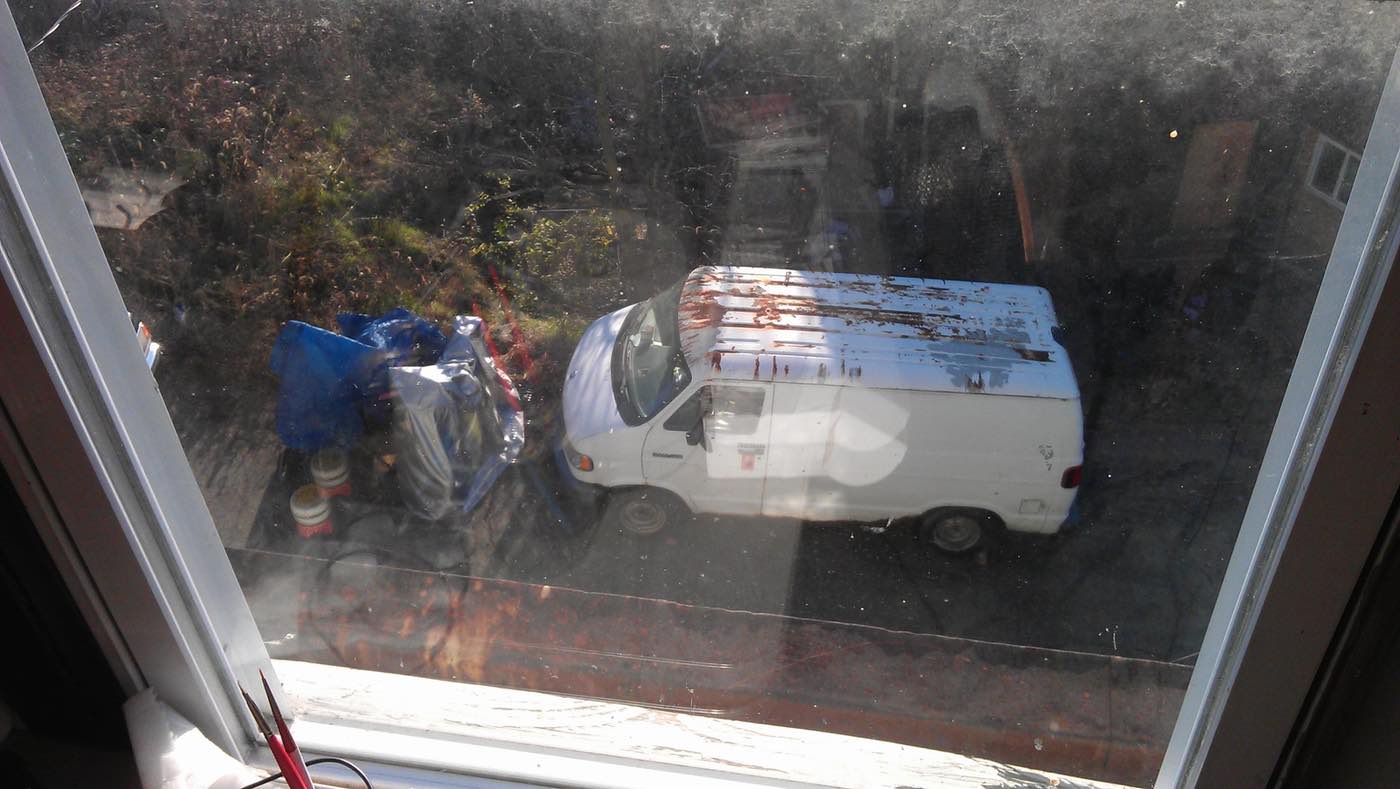
Rust you could see from space.
Don’t Lose Your Coolant
🎵 Talking Heads, “Road to Nowhere”
With the new van tuned up, our gear and people packed in, we settled into the routine of DIY touring. The mornings were spent herding our crew into the van, leaving hours late, then speeding to the next tour stop stressed out and frantic. To offset this, I pushed our departure time earlier and earlier. In the days before smartphones, I could get away with exaggerating the duration of each trip. Eventually, everyone got wise to this strategy and a complex set of mind games developed between those who wanted to arrive on time and those who wanted to sleep in.
Our travels involved an inordinate amount of time crammed into our tiny van in silence—silence, save for the white noise roar of our broken exhaust, the volume of which made it impossible to listen music, even with headphones. This did allow one to accomplish a good amount of reading, so long as motion sickness didn’t interfere. We read about tango in Buenos Aires, island gulags, survivors of shipwrecks drifting across the ocean, the political theory of bananas—only to be jolted from this austere existence when we beached onto some Midwestern town following homemade directions copied down from a phone call or email.
So there we were, rocketing towards Denver, alongside the local band we’d shared the stage with at a barn in Iowa the night before. We hummed down the flat, straight highway stretching to the horizon, hemmed in by an endless expanse of cornfields on either side. It was settling into being one of the most boring drives of the tour—until our friends in the other band suddenly tore past us in the other lane, furiously gesturing for us to pull over.
Expecting calamity, pull over we did. We got out of the van and walked around it, looking for an obvious sign of destruction. They explained that we had been trailing a huge cloud of white smoke while we barreled down the highway at a governor-free 75 miles per hour. Our van did have rear windows, though we could not see out of them, as our gear was stacked right to the ceiling. Thankfully, our friends had an eye on us, or else we might have cluelessly poured smoke into the air until something broke for good.
Expecting the worst, we began inspecting the van from all directions. Fritz popped the hood and stared at the mess of wires and hoses in the engine bay, searching for a puddle or a leak. We couldn’t find anything obviously wrong from looking around the outside and underneath the van. We pulled off the doghouse and looked there. Still nothing.
Fritz suggested we turn the engine on. I fired the van up, and we once again looked inside and out for any signs of something amiss. Nothing. Perhaps, Fritz theorized, the problem only happened when the engine was under the strain of propelling our little menagerie forward at highway speeds. He pushed his body through the doghouse, flashlight in hand, and craned his head inside the engine compartment so he could watch the rubber hoses running into and out of the engine. On his cue, I mashed down the gas. There was a scream and Fritz jerked back in pain.
A stream of hot coolant had shot out of the engine and hit him full in the face. I hastily threw him a t-shirt to wipe off the boiling antifreeze. Miraculously, he had suffered no permanent damage. We examined the hose that had sprayed the coolant and found a hairline tear where it had rotted away at the fitting. Apparently, as we’d been going down the highway, coolant had been shooting directly onto the engine and boiling off of it, leaving a white smoke cloud billowing behind us. I was searching for duct tape—the obvious solution to our problem—when one of the members of the other band offered to drive to the nearest auto parts store to buy us a new coolant hose.
This quick fix was unimaginable within our band; to spend money willy-nilly like that would require a prolonged consensus meeting. We had already used shoe goo to repair cracks in our windshield and spray foam to fill rust holes in the body… neither of which had worked especially well. I had already envisioned the re-taping of the leaking hose becoming one of my daily tasks for the rest of the tour.
While we were working on the van, one of Iowa’s finest pulled over to see what this was all about. He went through the standard questions, thoroughly wasting our time. Did we have anything he should know about? Drugs, weapons, large sums of cash…
“Large sums of cash.” I repeated, inviting him to listen to himself.
“Yes, over $10,000.”
I turned slowly towards the van, then back to look at him. No, despite all appearances, actually, we do not have over $10,000 in cash on us. I have never been able to resist being a smart-ass to cops. This has gotten me into trouble over and over, but on this occasion, he got back in his car and drove away without running all our licenses.
The replaced hose was the newest part on our van by a long shot. Breakdowns like that one occurred frequently. Once, our exhaust pipe fell right off on a street in Montreal; a few periodically tightened coat-hangers fixed that right up. Another time, our transmission wouldn’t shift up in Tacoma; it turned out that we just had to re-bend the spring with a multi-tool. Another time, all our transmission fluid drained out when the lines finally rusted into nothingness; we hose-clamped some rubber lines to replace them, refilled the fluid, and were back in action.
For many drivers, such solutions are intended to tide them over until they can get their vehicles fixed properly. But proper repair was unthinkable for us. We adhered to our foundational philosophy, All Funds Must Go to the Revolution. Besides, the van was temporary. There was no way it could be our “real van”—it was far too small, and it was sure to break down once and for all at any moment. Why would we do anything beyond the bare minimum to keep it running?
The Tuneup
🎵 Rage Against the Machine, “Killing in the Name of”
Yet somehow, we made it through the entire summer tour in that van, racking up more than 6000 additional miles on it. Anyone who has owned an unreliable vehicle can attest to the feeling of anxiety that driving gives you: every sound, every vibration provokes thoughts of impending doom, leaving you gaming out how to respond. Nonetheless, we hoped that a little TLC could enable the van to run for our next venture, too.
Most of us were inexperienced at car ownership. It’s hard to learn about proper vehicle upkeep when you can’t afford a proper vehicle. If we had had more money, we would probably have dropped the van off at some kind of service center, but that was expensive. Yet we lacked the skills to fix the van ourselves. Our grandparents had been mechanics who sent their children to college to escape a life of hard, dirty labor. We were the children of those children, sliding back down to the world of toilers, but without any of the inherited knowledge.
We knew that an oil change was probably in order and that the visible holes in the floor and walls might need attention. We collected what tools we could find for free; that criterion determined the scope of the work we would be able to perform. Unfortunately, not everyone considered tools an important resource. During spring cleaning, a previous housemate had come up to me holding a hammer, asked “When would I ever use this?”, and tossed it into a trash can—from which I promptly fished it out and hid it in a closet. Often, the people who need good tools most are the ones least likely to have them. We had a lot of work to do and the worst tools.
Until then, our van had spent its entire existence in Minnesota, which exempts vehicles from safety inspections because everything older than five or six years is bound to fail. The whole van was covered in rust, especially the undercarriage. The floor of the van was of particular concern: this thin layer of rusty sheet metal was the only thing between our bodies and our equipment (certainly our most valuable possessions) and the asphalt below. The first order of business was to install a floor; afterwards, we could install a divider to keep the gear behind us, especially in the event of a sudden stop. Fortunately, plywood was well within our reach: the dumpster of a local theater was always full of sheets and scraps from set builds. It was easy enough to pocket fasteners and brackets at the hardware store—a small task compared to the ridiculous heists we typically pulled there.
Before there were Youtube videos showing how to perform every possible repair or modification, repairing a vehicle was an experience of confusion and discovery. You were always in uncharted territory, playing telephone with all your friends to try to find someone who might know something about what you were attempting. I remember learning how to do plumbing, wiring, and carpentry in my $7000 Pittsburgh house by borrowing books written by hippies in the 1970s from the library, the best source of knowledge I could find at the time. Car repair was a similar process: trying to find a Chilton’s guide from the library for a similar model vehicle, then failing to understand the diagrams and just going for it.
Regarding the floor, everything we’d read told us that the first step was to remove the flaking rust. There were already several gaping holes in the floor through which water and highway grime spattered the insides; we started there. However, it quickly became clear that if we continued the rust removal process, there would be no van left when we finished. Staring at these now much larger holes, we figured that we ought to plug them in some way before placing dumpstered wood over them. Superglue, JB Weld, Marine-tex, duct tape, and spray foam insulation are the mainstays of DIY repair. We artfully attempted to fill the holes with spray foam insulation, but it just fell through—we hadn’t yet learned the trick of using cardboard to hold the foam while it dried. In hindsight, that was probably for the best—it might have caught fire as it drooped over the exhaust.
After cleaning the spray foam off the grass, we moved on to installing the floor. We were working in our front yard, a step below the pejorative “backyard mechanic.” Screwing the plywood into the floor, we had to be careful not to damage anything beneath it—there were fuel lines, a gas tank, transmission lines, and other valuable components. In retrospect, some short fasteners would have gone a long way. One of our roommates (out of a number that varied from nine to thirteen) worked making décor for the galas of the affluent and, thanks to the longstanding tradition of workplace theft, had collected innumerable boxes of 3” screws. We likely needed 1” screws, but we had 3” screws. For the first few, we painstakingly calculated exactly where the screw would come out underneath in order to protect the van’s vitals. Fritz was under the van and I was inside it; we measured and carefully placed each fastener. That was a very slow process, and seeing as we had a few dozen screws to set in, after the first few, we went to town screwing down into the abyss without looking. What could go wrong?
Afterwards, looking at our freshly installed plywood floor, I felt pride that we were making real progress on fixing the van. Spring in my step, I slammed shut the rear cargo doors, jumped into the driver’s seat, and fired up the van to drive the hundred feet to the concrete pad next to the shack that was both my bedroom and our practice space.
Focused on planning out the next repair tasks as I stopped the van, it took me a moment to register Phil gesturing frantically at me. Snapping out of my reverie, I opened the door to hear him shouting, “Turn it off! Turn off the van!” I noticed a dark pool expanding across the concrete beneath the van and smelled a familiar acrid odor.
As my life flashed before my eyes, in a single swift motion I turned the key to shut off the engine, flung the door open, and hurled myself over the rapidly expanding pool of gasoline. Envisioning a fireball, I ran. Phil joined me. We reached the house and huddled inside it peering out the windows, a seemingly safe distance from the hazard we had created. When the van did not explode, we trudged sheepishly back to inspect the evaporated ring of gas on the concrete and figure out what we had done wrong. In this branch of the multiverse, the van and I lived to see another day.
We peered underneath the van, trying to ascertain the source of the fuel leak. Often, with automotive issues, diagnosis is one of the hardest steps. Once you know what the problem is, you can chart a path forward—but until then, you’re lost. Lucky for us, a casual glance showed that multiple three-inch screws had ripped through the fuel lines.
I can’t say we were surprised. Those initial meticulous measurements were well worth doing. A dozen-mile bike ride to the hardware store—I lived seven miles out of town and only had a bicycle—and a few pilfered hoses and barbs later, we were back in business. In hindsight, that would have been a good time to check whether we had damaged anything else in our remodel, but instead, we loaded everything in and headed north to record an album, stopping to fill the gas tank on our way out of town. Lacking a working gas gauge, we filled the tank up to the top as we had been accustomed to doing. Shortly after we got back on the highway, the whole van reeked of gasoline. The fuel lines hadn’t been the only thing we had drilled into while installing our new floor. But we were behind schedule—as usual, we hadn’t left ourselves any margin for error—so we continued north, headaches and nausea building.
Once we had emptied and refilled the tank a few more times, we put it together that there was a hole in the top of the gas tank. If we filled the tank, the smell of gasoline was debilitatingly strong, not to mention our concern that the fumes would get onto the exhaust pipe and explode.
But if the tank was filled to three quarters or less, the gas smell was greatly reduced. The solution was simple: just don’t fill the tank above three quarters! The only wrinkle in this plan was that our gas gauge was broken, so there was no way to know how much fuel was in the tank. One solution would have been to reset the trip odometer each time we filled the tank, then estimate our miles per gallon so we would know when to fill up next… but our trip odometer was also broken. Instead, we all became amateur physicists, estimating fuel consumption rates based on laden vs. unladen weight, average speed, wind resistance, and aerodynamics. Were we getting 15 miles per gallon, or more like 17? Did we get better fuel economy in the flat Midwest? Worse when we were crossing the mountains in Colorado, California, Appalachia?
Our only tool for solving these complex equations was Phil’s flip phone—the only phone anyone in the band possessed. Factions developed around competing theories of gas mileage. Was it worse to be overcome by gas fumes filling the cabin of the van for hours at a time, or to run out of gas on the way to playing a show and fail to come through on a commitment? Would the van explode in a fireball if enough gas leaked out from overfilling it?
In the DIY and anarchist scene, you get used to break-ups over conflict. Be it tactics, ideology, or lifestyle, we were all highly opinionated people. Our band (not including whoever else was traveling with us) involved vegans and meat eaters, animal liberation activists and primitivists—and to our credit, we were able to handle disputes fairly well, considering the hard lines many of us had drawn in our beliefs. My worst conflict with a band member was over the gas issue. We fought while I was driving at 75 mph, light-headed from gasoline fumes. We didn’t fight over ideology, tactics, or beliefs, but over the gas tank. Do practical concerns trump ideology? Would the dissolution of our band come not as a consequence of political fractures, but of the low standard of living we subjected ourselves to?
As in so many conflicts between people who share daily life together, we argued and debated without resolution, but somehow kept going. Sure, we miscalculated and overfilled a few times, but we only ran out of gas once.
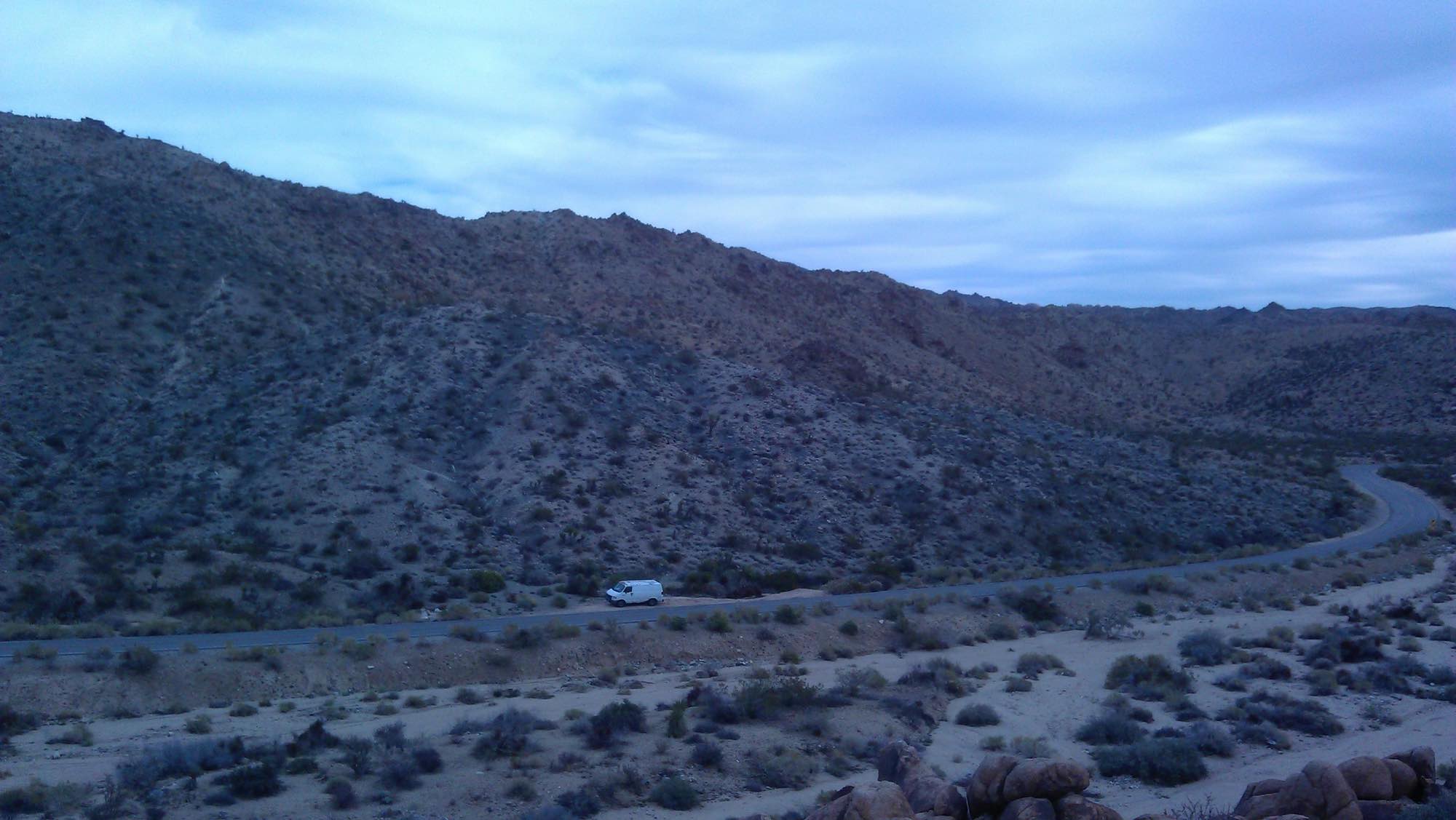
The Shakedown
🎵 Propagandhi, “Rock for Sustainable Capitalism”
While we spent the autumn crisscrossing the country in our “temporary” van, our old veggie-oil bread truck remained out of sight and out of mind. The estimate for bringing it back to life again was somewhere between $2500 and $3000, far beyond our budget. The old truck was dead, but since we were now halfway across the country with no plans of returning to Michigan anytime in the near future, it wasn’t in our best interest to tell the repair shop this and lose our free parking space there. Fritz was the registered owner of the truck, but I was the only band member with a cell phone—so I fielded the repair shop’s calls. I did my best to sound professional and explain that Fritz was “currently unavailable,” but they ramped up their calls as the months wore on, eager to remove our truck from the parking spot it occupied on their real estate.
Obviously, this wasn’t the first time someone had walked away from an expensive bill and left them with the wreckage. They eventually informed us that they were going to scrap the truck if we didn’t present a plan to remove it from their lot. After calculating that RV towing insurance would not cover the leapfrog tows from one Walmart parking lot to the next from Michigan to Pennsylvania, Fritz put a desperate ad on Craigslist to try to sell the truck before it was scrapped.
Sidebar: Punk Mathematics
Fritz listed the truck for $1500. Why? The answer will help you to understand the mathematics of our attempt at vehicular liberation up to that point.
We started by spending $1500 at an auction to buy the truck, sight unseen. A few weeks later, two of us flew to Los Angeles to collect our purchase from a shuttered Wonder Bread factory. Miraculously, it fired up and drove.
At least, it drove for ten blocks. It broke down in a Home Depot parking lot, where we were stuck for three days, assisted by a rotating cast of roadside mechanics until we were finally able to get back on the road. Luckily, we managed to scrap the interior shelves, which were made of a strangely valuable metal alloy, to pay for the diesel we needed. At that point, our finances were holding steady at $1500 in.
At a show in Athens, Georgia, someone who believed in what we were doing donated $1500 to aid our mission. In those days, that was a huge sum of money for punks. With this generous donation, we bought the veggie-oil system for the bread truck in order to tour North America and spread the salutary virus of anarcho-punk. A veggie-oil-powered vehicle fit perfectly with our aesthetic. We survived off the trash of a society of abundance; running our vehicle off of waste was a great match.
After a few weeks of installing a bewildering array of hoses, fittings, tubes, and valves, we had opened the portal to “free” fuel. This investment probably paid for itself on the first few tours. Then our friend borrowed the truck to distribute anarchist literature at the Vans Warped Tour while Katy Perry played “UR So Gay.” The truck broke down somewhere in Ohio. The diagnosis: a broken fuel injection pump, $2000 to replace with the cheapest used one we could find. The poorly filtered “free” veggie oil we’d been using was almost certainly the cause of the fuel pump self-destructing. Had we gotten another $2000 worth of free fuel? It was hard to say.
Sadly, the truck never ran the same after that. It was hard to start and idled raggedly—harbingers of its eventual doom. When it broke down again, the culprit was another exploded fuel injection pump, likely caused by veggie oil. Our bread truck had a famously efficient and well-regarded engine, the Cummins 4BT, which was less common than the ubiquitous Fords, Dodges, and Chevys. Thanks to the logic of mass production, replacement parts for our van were correspondingly more expensive. Another friend of ours had a Chevy Suburban powered by one of the most universally despised diesel engines—but when he broke his fuel injection pump, he found a replacement at a junkyard for $150. The cheapest replacement for ours was $2000. If you need to be cheap, maybe that means you also need to be boring, at least when it comes to vehicles. And that’s what we got when we inherited our free Dodge Ram Van. Boring, crappy, but cheap and easy to fix.
Autonomous Collection Agency
Lessons learned, we posted an ad begging someone to buy the Wonder Bread truck. The requested price of $1500 was a reference to the money that the generous person in Georgia had donated to us: we felt comfortable wasting our own money on our foolhardy plans, but it felt wrong to waste someone else’s. Of course, we added “accepting all offers,” the magic words any Craigslist buyer wants to see.
One of the first calls was a person who said that while he didn’t know if he wanted to buy the truck, he could tow it to his property to save it from the scrapyard. Having no other options, this sounded amazing. We let him tow it away, and soon thereafter, someone actually offered to buy it for the asking price. Things were looking good!
Unfortunately, the check never came. Not being in Michigan, we weren’t able to do anything about it. The dude never returned our calls and probably just blocked our number. He did not realize that we were willing to employ the same insanity towards getting our van payment as we did in the rest of our lives.
During a midwinter recording session in Ohio, being the person in the band known for not needing sleep, I took off for western Michigan at around midnight while Fritz slept in the back. It was really snowy, and other than stopping at Flying J to get gas and the huge vegan cookies that constituted the whole of our diet on the trip, we had an uneventful drive. We had looked up the address of the person who had the truck in the phone book. I didn’t know what we were going to do when we got there, but I figured Fritz and I would work that out during the car ride. We didn’t, because Fritz slept until the moment we pulled up in front of this guy’s house. If I was known for my ability to go without sleep, Fritz was known for his ability to keep sleeping in the face of anything.
“Ok, we’re here.” I shook Fritz awake.
He awoke, blinking a few times, then got out of the van and told me to follow. On the walk through the snow, to the front porch of this dude’s house, I asked what we were going to do.
“We’re going to get our money,” he replied.
I want to make something clear. We were not an intimidating duo. If we knocked angrily on your door, you’d probably think we were trying to register you to vote. Trying to get money out of a stranger seemed like a bad idea; I’d had no idea I had been recruited into a shakedown posse. As I trailed behind Fritz, trying to explain my perspective, he pounded on the door. The man who opened the door was tall. He was taller than the doorframe. He was wearing a tight black Harley Davidson shirt that showcased his well-defined muscles and a black bandanna pulled down to his eyebrows.
We asked for Mike, the one who owed us money, by name. To my relief, the gigantic man answered that Mike didn’t live there anymore, but his wife knew where he was. We acted friendly, saying we were coming by for a visit and curious if they could pass on his address. Things were looking pretty good, in that we didn’t have to try to extort money out of a man four times our size.
When we pulled up to Mike’s house, we could see our bread truck sitting in the driveway, forlorn and blanketed in snow. Not that we looked any better. Our new van did not look like it should be running at all. We had a standing bet that if anyone could find a running van in worse shape than ours, we would buy the winner a Flying J vegan cookie. There was ever only one challenger. We saw it across several lanes of traffic, partially obscured. It definitely looked in worse condition than our van. As traffic moved along, we discerned that the contender was actually in someone’s front yard—on cinder blocks. Our van was the winner of a contest no one wants to win.
To say that Mike was surprised to see us would be an understatement. Why would he think some kids from over a thousand miles away would show up to his home trying to collect for some minor level scam he had pulled? Lucky for us, this Mike was a lot smaller, roughly our size. His hair was disheveled and his sweater had paint stains on it. Things didn’t look too good for Mike, but he did owe Fritz money. We asked for it, firmly, and he began to make promises about how he would get it to us. Always ready with a solution of our own, we offered to drive Mike to the ATM. Let’s say we offered firmly.
His withdrawal limit was $300, so we took the $300 and told Mike to send the rest or else we would come back. He surely took it as an empty threat—what reason did he have to think we’d ever come back? He knew we didn’t live in Michigan.
Unfortunately for Mike, Michigan was in our regular touring circuit and we passed through it every year like clockwork. Six months after the first shakedown, we played in central Michigan on our way to the West Coast. After the show, Fritz assembled a proper collection team of several punks. This time, when the posse knocked at Mike’s door, he sighed as we accompanied him to withdraw another $300 from the ATM: it was almost procedural. We weren’t sure if we were going to pass through Michigan again, so we extended the offer to our friends who did live there. If you ever need money for your projects, you can go collect the remainder of the balance from Mike, $300 at a time. I’m pretty sure the total was never met, so that offer still stands.
The Wiper Fluid Fiasco
🎵 Dog Faced Hermans, “The Rain It Raineth”
Our relationship to finances was epitomized by the wiper fluid fiasco. It all began with the brilliant collective decision to record our debut album in Cleveland, Ohio in the middle of January, during what turned out to be one of the coldest winters on record. How were we going to get there? The van, of course. In our minds, we were going to drive it “just one last time” before we finally purchased the newer, much bigger van that we needed.
The first day of recording began with the studio engineer interrupting the session to tell us that we weren’t ready to record. Go home and practice for a few months and try again later. After we stubbornly refused that advice, he begged us to kick Fritz out of the band, or at least to hire a studio drummer for the recording. Naturally, we doubled down and rejected this sensible advice from a seasoned music industry guru. What followed was a weeklong slog that rapidly burned through our budget; once again, we were thrust from our dumpster-diving lives to confront the costs of the workaday world. When we finally staggered out of the studio for the last time, squinting in the sunlight like a gambler at the end of a long night at the casino, we needed a plan to recoup our losses. We turned to the only way of making band money that we knew: we set out to tour the Northeast in the middle of winter, during a blizzard.
As we left Cleveland, road construction signs flashed “Winter Storm Advisory,” urging sensible drivers to stay home. With our heavily overloaded rear-wheel-drive van sitting on bald tires and mushy brakes, we were among the last people who should have been on the road. At our final stop to fill the gas tank before we got on the highway, we made a plan of action.
Usually, only Fritz and I drove the van. One of our guitarists would drive occasionally, but he had a tendency to drive fast while looking at people in the back seat as he told stories. We could risk that at desperate moments, but certainly not in the Northeastern winter. Since Fritz had grown up in the snowy Northeast, our singer suggested that he drive.
We shot off the road within ten minutes. Attempting to halt abruptly at a stoplight with cars backed up behind it, Fritz discovered that the van was not stopping at all. He managed to steer into a ditch instead of hitting the line of cars. A helpfully-placed road sign added more character to our van by bending in the front bumper. We were stuck fast in the snow.
Fortunately, within minutes, a giant fellow in a F-350 pulled up and got to work without saying a word. As he hooked up his winch, I imagined the frame coming right off of the van. Thankfully, he towed us right back onto the road. It was like we were on our second life in an arcade game. I popped into the driver’s seat and drove for the rest of the winter.
On top of all the other safety hazards, the van was out of windshield wiper fluid. Thanks to the heavily salted roads, our visibility was often nil, so wiper fluid was what I have since learned to call a “non-negotiable need.” Yet as no one was equipped to buy windshield wiper fluid, we had to scheme another way to deal with the problem. Our guitarist suggested that when we get gas, we just dip a cup into the wiper fluid provided next to the gas pumps and top off. While this might have worked, he slept through every chance to enact his plan. A few hundred miles into the journey, we still had no wiper fluid. Until the situation could be resolved by group consensus, I resorted to hand-cranking the window down in sub-zero temperatures to fling water from my Nalgene bottle onto the windshield, then turning the wipers on as quickly as possible before the water froze and made visibility even worse.
I was now both the early riser of the group and the only acceptable driver. Absolved of responsibility, the rest of the band slept while I drove through storms, wrestled the van, flung water, and navigated by atlases and scribbled directions. As they slept, I built resentment for our collective miserliness with every mile. I understood that we were in debt and would continue to be for years because of this recording, but couldn’t we just spend a couple bucks so we didn’t fly into a guardrail in a blizzard? At this point, I think you understand the rhetorical nature of this question.
Towards the end of that blizzard tour, I broke down. One day at the gas station, with the rest of the band asleep, I walked in and picked up a gallon of windshield washer fluid. I had just completed a medical study in which they had pumped me full of coagulant and anti-coagulant, then did a few hundred blood draws to see which won. I put my hard-earned $3 on the counter and marched back to the van. I didn’t care if I was a sellout, I didn’t care if I was violating the consensus process. If collectivism wouldn’t provide for the collective good, individualism would.
I poured the fluid in and started the van up. I pulled the lever to spray the salt-encrusted windshield with fresh new cleaner—but nothing happened. I tried again. The wipers dragged across the windshield, smearing salt and grime. The jets were frozen: we had waited too long. Or maybe they had never worked. We weren’t going to get above freezing temperatures for the remainder of the trip, and we never tried to use them afterwards. I threw the water from my water bottle over the windshield as I pulled out onto the highway, and the band slept on.
Slipping By
🎵 Elton John, “Border Song”
After extensively touring the United States, we set our sights on the horizon. Logically, the next destinations were our neighbors to the north and south, Canada and Mexico. How would we get there? Our trusty van, naturally.
Borders, as everyone knows, are scars upon the earth, chokepoints at which we are forced into confrontation with authority. Most countries have strict regulations about foreigners making money and selling merchandise—exactly what a band needs to do to pay for that next tank of gas. For a touring band, it’s similar to a court appearance. You change your look and struggle to present a narrative that might enable a van full of criminals to pass through. As a group of people with varying criminal and deportation records attempting to break the rules and promote insurrection, we spent quite a bit of time and effort constructing elaborate stories to convince various border guards to look the other way.
Throughout our careers as traveling musicians, we’ve witnessed some pretty wild attempts to cross borders. One of my favorite stories is about a Canadian punk band attempting to enter the United States. They bought button-up shirts at the thrift store in order to look their best. When they pulled up to the border, the guard took one look at them and sent them to secondary inspection without a word.
Questioning began with a guard asking, “OK guys, where’s the weed at?” The band was silent. “Five dudes with dreadlocks and no one knows what WEED is?” From inside the border complex, the band watched as the guards tore apart their van, searching every nook and cranny. Anticipating this, they had brought nothing that would give away that they were a band. They had mailed all their merchandise across in advance, arranged to borrow instruments, and, aside from the banner displaying their band name in a black metal font that they correctly assumed no border guard could decipher, brought no typical punk gear. But as the border guards reached the wheel well, the drummer sighed. The guard pulled out a string of high-caliber bullets. This, of course, was not live ammunition, but a bullet belt. The drummer couldn’t imagine touring without that crucial component of punk fashion.
They were denied entry.
Our own bullet belt was a crate of literature presented to us in San Diego with the request that we distribute it in Mexico. We had carefully planned exactly what we were going to take with us and had sorted our literature so that the items we were bringing were all too esoteric or obscure to be recognized as subversive. But this last-minute addition featured a burning cop car on the front and was packed with content about murdering your boss, sabotaging your workplace, and so on. Although this isn’t the sort of thing you want to be caught with by any authority figure, let alone one who is deciding whether to let you enter their country, there was no question about whether we would take them. Our solution was to remove the liner from the ceiling and walls of the van and stuff them into those spaces. And if we were going to risk bringing those across, why not bring all the literature we had previously deemed too risky? We stuffed the rest of it into the van walls, as well.
Everyone we asked said that crossing into Mexico was easy compared to crossing into Canada. We brought a friend along who was bilingual, living in San Diego and regularly crossing back and forth into Tijuana. Surely, she could talk us out of any situation. As we approached the official border crossing, we saw a line of traffic lights flashing red or green as each car pulled up: green indicated that you could go on your merry way into Mexico, but red meant that you had to pull over and make your case to the guards. They claim that these are random, but as our overloaded van loudly rumbled up to the threshold of Mexico, unsurprisingly, the light turned red.
We pulled the van over to the checkpoint parking lot. A guard came over, collected all our passports, and disappeared inside. While we waited, I remembered the list that I’d been instructed to make documenting all of our music equipment with brand names and serial numbers. It had been a long list, and since I thought it was bullshit, I had only written down the serial number of the first guitar on the list and made up the rest. Not to worry, our friend had assured me, the border guards never check.
The guard returned, handed us back our passports, and asked to see the list.
I handed our equipment list to him. After looking it over sternly, he ordered, “Show me the equipment,” motioning for me to open the back of the van.
With trepidation, I opened the back door and pulled out the only guitar with a serial number that matched the paperwork. I waited for what seemed like an eternity as he checked the number, looked over the guitar, and handed it back to me.
“OK, you’re free to go.”
I repacked the guitar as quickly as possible, slammed the doors shut, and we drove across the border. We were in.
Learning all the wrong lessons, I took this strategy to an even greater extreme on a subsequent tour. While in eastern Europe, we were told we needed a very special document printed on the right color paper with the correct stamps in order to transport gear across borders. This document also involved pre-paying taxes and fees—in other words, spending money. Friends reported having to cancel whole tours due to errors or delays in this paperwork. Understanding the importance of this “ATA Carnet” form, I took the step to fabricate a Very Official Document with all the information required, truth being secondary to aesthetics. As we moved from country to country, getting closer to the borders where this document would be required, I was able to cajole random border guards into stamping it, even though it was not required by their governments. By the time we reached the first border at which we needed this paperwork, it had collected such an air of authority that, while the guards were confused by the document itself, they, too, eventually stamped it and sent us on our way.
Mexico, 2009
🎵 Lynyrd Skynyrd, “That Smell”
Back to the shows in Mexico. We were booked to play at a giant car wash lot in Mexicali. We arrived as the organizers were hanging giant political banners around the perimeter fence. Feeling an immediate sense of camaraderie, we asked one of the show organizers about the banners; he said that the first time they held a show there, a crowd of over a hundred people had watched from outside the fence. In fact, they were hanging the banners to make sure that everyone paid a few pesos at the door to see the concert.
Most of the organizers were affable, gentle, empathetic anarchist types. But they gave the job of collecting the entrance fee to a massive skinhead, because when he did it, everyone paid.
After nine bands, including a ska outfit with a full horn section, we were paid some of those diligently-collected pesos and headed north to the border. Converting pesos to dollars in the US was a losing game; we figured we needed to spend them all before we left. We went to a gas station, where we bought a bunch of snacks and filled the gas tank. Typically, we would have held a lengthy debate about how much gasoline to put in, but seeing that the alternative to over-filling the gas tank was wasting a few pesos, it was easy to reach consensus. We filled the tank right up to the gas cap.
The smell was sickening.
We had given away every copy of the aforementioned incendiary journal, so we had not hidden our literature in the bowels of the van for our return journey. Re-entering the United States can be more challenging than entering Mexico—but for once, the gas leak worked to our advantage.
We shot up to the border control, gas fumes coming off the van in waves. It was 4 in the morning. The sleepy US border guard looked at me and asked how many people were in the van. Seven, I answered. That woke him up a bit. He peeked in and drew back in surprise at the sight of all of us squished together. He asked to see the back of the van. I opened up the rear doors and showed him that the back was packed to the ceiling with gear. I could sense that he was about to pull us over for a lengthy search.
But at that moment, he caught a whiff of gasoline.
“What’s that smell?”
“Well, you see, officer, we think there may be a hole in the top of the gas tank. Maybe it’s from the floor we put in. We can’t really access it to tell what’s going on, but if we fill up, it leaks a little and fumes come out. We don’t like pausing for too long because the spray could get onto the hot exhaust pipe and—”
“GO! GET OUT OF HERE!” he yelled, motioning emphatically.
A dash of disaster and a side helping of privilege sent us right back into the United States, rumbling down the open road with pounding headaches. Victory was ours.
The Noise
🎵 Austra, “The Noise”
We still had to get into fortress Canada. In the past, we had played a week’s worth of shows in British Columbia, but that time, we had opted to not risk bringing the van and our equipment across. Passing as tourists, we arranged to borrow gear and took a ferry on foot in order to maximize our chances of getting in.
This time, we booked a week’s worth of shows in Ontario and Quebec between our shows in Michigan and the Northeast. To deal with the fact that several of our members had criminal records and some had even been deported from Canada, we split into two groups. The “cleaner” members would drive the van across with all our equipment, explaining that we were driving through Ontario to shorten our drive to New York. That isn’t unheard of; we figured it was a reliable narrative. The other members would take the casino bus that brings you from Detroit to gamble in the free land of Canada, where the “cleaner” members would scoop them up.
To make our cover story more convincing, on our website we listed a series of fake shows in small American towns during the dates we had booked our Canadian shows, in case the authorities figured out who we were and looked up our schedule. Unexpectedly, we received an email from a resident of Oswego, NY, expressing great enthusiasm and gratitude that we were coming to their town—unless it was just a cruel joke! Alas…
I was elected to drive the van across the border with one other member of the band. Unfortunately, by this point, we had developed an increasingly problematic exhaust leak. Typically, these leaks happen downstream, on the muffler or resonator, making a vehicle significantly louder but not undrivable. Ours developed at the header, so the exhaust system was completely disconnected from the engine.
It’s difficult to understand what this is like unless you’ve lived through it. The engine was so loud we had to wear earplugs in the van to protect our hearing. We couldn’t wear headphones to listen to music or audio-books during the countless hours of driving we did across North America. Conversations stayed fairly short due to the fact that you had to yell to be heard over the roaring engine. Seeing as there were no windows in the back, the only way for passengers to pass the time was to read by flashlight, provided they didn’t get car sick.
While eastbound in Michigan, before we arrived at the border, a cop pulled us over. He said that he had heard us approaching for a solid five minutes. While having the header rust off your engine isn’t explicitly illegal, it did bring us unwanted attention. Something similar recurred later, when we were pulled over in Connecticut for the same noise complaint.
This was the state of the van as we approached the Canadian border. We sat idling in the line at the checkpoint, trying to coax ourselves into imagining that we were just like everyone else, totally normal. When our turn finally came, the border guard waved her arms emphatically, yelling “TURN OFF YOUR VAN!” Obedient citizens that we were, we immediately complied. She informed us that she had made each of the three cars in front of us turn off their engines, each time assuming that the loud rumbling must be coming from that car. She had had to yell over our noise to speak to them. We laughed awkwardly, claiming that we hadn’t noticed anything, and tried to explain why we hoped to drive across Ontario’s fine roadways. Shaking her head, she checked our passports and waved us through.
We found our f
Read the full story at the source
Source: CrimethInc. DE