
World · Unicorn Riot · · 2h
Minnesota Ends Conviction Review Unit With 160 Cases Still Under Investigation
English (original) · Read in Deutsch ⇄
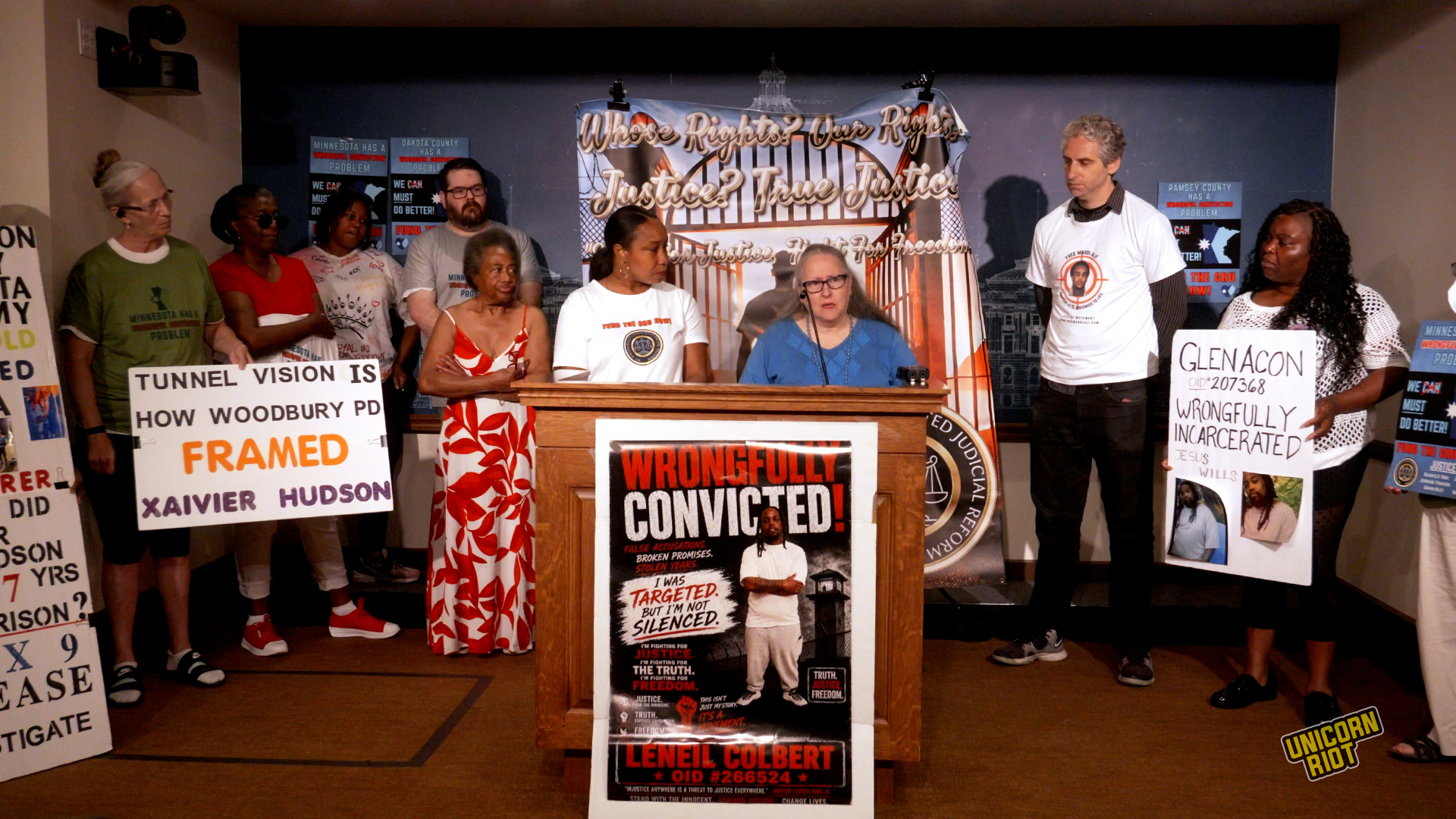
St. Paul, MN — Minnesota’s Attorney General Keith Ellison has decided to “eliminate” the state’s Conviction Review Unit (CRU) less than six years after he created it. The closure is a devastating blow to around 160 CRU applicants in Minnesota prisons whose cases were pending final investigation into their claims of wrongful conviction.
Designed to “identify, remedy, and prevent wrongful convictions,” the CRU was ultimately stunted by limited funds and officially completed just four investigations after receiving over 1,150 applications. Ellison said he closed the unit “due to budgetary constraints.”
“How can this be a funding problem,” asked Marvina Haynes, who successfully fought to free her innocent brother Marvin from prison after 20 years.
Haynes led a press conference among family of the incarcerated, advocates, and activists at the Minnesota State Capitol on July 14, 2026, calling for the state to fund the unit. “We are here today to demand that legislators move forward, fund the [Conviction Review Unit].”
“The CRU was created after us sitting at the table with Amy [Klobuchar],” said Ianna Burrell, the sister of Myon Burrell who was incarcerated when he was just 15 and spent 18 years in prison after being wrongfully convicted for murder before getting his sentence commuted by Minnesota’s Board of Pardons and released in December 2020. “He still has not went in front of the CRU,” Ianna said.
Burrell’s CRU application to get the wrongful conviction off his record turned into an open investigation in Feb. 2023 but the unit never completed the examination. Burrell reportedly faced threats by police and informants upon his release and has since been jailed for having a weapon, which he’s restricted from having because of his wrongful conviction.
Amy Klobuchar, a current U.S. Senator who’s running for Minnesota Governor this year, used Burrell’s conviction in 2002 as a cornerstone in her political campaigning, touting that she was “tough on crime” as the Hennepin County Attorney from 1999-2007.
During Klobuchar’s tenure, “the number of African-American men and boys who ended up in the state prison system, a good many of them falsely, increased by 600%,” said Michelle Gross, a paralegal working on wrongful conviction cases and the President of Communities United Against Police Brutality.
“We estimate that there are probably about 200 people who are falsely imprisoned in the D.O.C. … a good number of them ended up there because of Amy Klobuchar.”
Gross estimates a potential 200 people are currently “falsely imprisoned” in Minnesota with Klobuchar responsible for “a good number of them.”
Gross questioned if the CRU shutting down near a pivotal election season provided extra cover for Klobuchar, who previously faced an onslaught of protests during her 2020 run over her handling of Myon Burrell and others’ cases.
“So, she had a very big role in this and I questioned whether the shutting down of the CRU has something to do with covering for Amy Klobuchar. I’m frankly disgusted.”
High-profile cases frequently targeted Black youth for prosecution with incentivized jailhouse informants being a focal point of trials. Cases like Burrell’s, Marvin Haynes, Bryan Hooper, Cornelius Jackson, Deaunteze Bobo, Jermaine Ferguson and many others became a staple during this era, as hundreds claim they’re also innocent and were set up.
Bryan Hooper Sr. Freed From Wrongful Conviction After ‘Sordid’ 27 Years in Prison
“So many broken promises, so many delays, so many things that we’ve been through over the years,” said Ianna. “Our mom died in a car accident coming from seeing him soon, within a couple of weeks from my brother being incarcerated, and Amy denied him from going to our mother’s funeral.” She furthered that Amy promised an “independent investigation” that has also “not happened.”
After the closure, CRU’s website and its pages were quickly wiped and replaced with a statement of the program’s elimination and four resources “for assistance in reviewing or challenging wrongful conviction.”
Most of the applicants and families of applicants were left without warning as the unit shuttered with potentially hundreds of investigations incomplete despite some coming very close to being finalized.
Just last year, an external audit of the unit praised the CRU as “a model for how statewide conviction integrity work should be done.” The unit freed three people from prison, overturning the convictions of Thomas Rhodes, Edgar Barrientos Quintana and Brian Pippitt.
The unit went from holding publicly accessible Advisory Board Zoom calls with its director Carrie Sperling to closing with little to no transparency offered toward the applicants.
The CRU was launched with the help of the Quattrone Center, the Great North Innocent Project and an initial $300,000 grant from the U.S. Department of Justice (DOJ) in October 2020. The DOJ renewed that grant for a two-year period in 2022 at $500,000 and then denied a renewal.
Two local foundations gave grants to help the CRU several years ago. The Minneapolis Foundation gave a two-year grant for $310,000 to hire a paralegal and the Pohlad Foundation gave $100,000 to the GNIP for the “development” of the CRU. Neither those, nor the DOJ’s grants were enough to sustain the unit which hundreds of inmates depend on for freedom from what they claim are wrongful convictions.
Ellison blamed “the Trump administration” and said it’s “disappointing that our federal government has decided to deprioritize identifying and correcting wrongful convictions.”
2023 Coverage: Limited Funds Stunt Minnesota’s Conviction Review Unit — Families Want Expediency
The Minnesota Attorney General’s Office employed 443 people and laid off 17 of those employees at the time of the closing in early July. It’s estimated that a handful of those 17 were with the CRU.
“This is a unit that if you look at the Attorney General’s budget uses between 800,000 and $1 million,” said Gross. “That’s a very small drop in the bucket in our state’s overall economy.”
In fact, for the fiscal year of 2026, the AG’s expenditure is forecast at $65.7 million and Minnesota’s budgeted expenses are $71 billion. The CRU was not publicly noted as a line item in the AG’s budget but if they did actually expend $1 million on the unit annually, that is one-and-a-half percent of their total budget and 0.0014 percent of the state’s budget.
“There’s not one good reason this unit should have been defunded,” said Gross. “If you look at the cost of holding those 200 estimated innocent people in prison, the annual cost of that is $13,675,000. We can pay for this unit 13 times over.”
During the press conference, lawyer and activist Stacey Gurian-Sherman asked, “Attorney General Ellison, what did you do to prevent this defunding? Did you go to your Advisory Board? What other options were available? What others programs could have been not cut but decreased?”
“Tell me the difference between this progressive Attorney General and this incredibly fascist president,” said Gurian-Sherman, “I really need to know that answer.”
Gurian-Sherman called on Ellison and Klobuchar, who are both running for political office in November, to commit to fund and mandate an independent statewide CRU.
“It’s been a hard struggle for me for these 31 years of my son being incarcerated for a crime that he did not commit,” said Mary Riley during the press conference.
Her son Adrian Riley has been incarcerated since 1995 serving three life sentences after being convicted of a triple homicide in Carver County, Minnesota. Riley has studied law in prison and has exhausted legal options in attempts to prove his innocence.
After applying, he’s had his hopes resting on the CRU. Earlier this year, the state clemency board denied Riley’s parole because he hadn’t taken accountability for the crimes that he claims he hasn’t committed.
“Just as his commutation [hearing] was over, then that’s when my son got a letter saying that he’s no longer approved for the CRU, that they had cut the CRU program.” Mary Riley said that her son never trusted his lawyer. He was represented by Keith Ellison, before Ellison became AG he was a defense attorney.
Speaking about her son’s recent hearing in front of the Board of Pardons which features Gov. Walz, AG Ellison and Justice Natalie Hudson, Riley said she was “really disappointed” in Ellison. “He sat there and didn’t help my son. He knows how those people railroaded my son out in Carver County.”
“To me,” she said, “it’s all politics, lies. They all lies. They don’t want to help.”
With the closing of the CRU, there is only one county-level conviction integrity unit in the state — the Conviction Integrity Unit (CIU) of the Hennepin County Attorney’s Office.
The CIU was launched in July 2024 by Mary Moriarty and is headed by Andrew Markquart. The unit has received 249 applications and has 78 cases progressing to full investigation as of September 9, 2026. These cases include some cases that were being investigated by the CRU.
Questions to the MN AG Office went unanswered.
Cover image via video contributed by Aaron Johnson featuring Ianna Burrell, the sister of Myon Burrell who spent 18 years incarcerated for a murder he didn’t commit, speaks during a press conference calling for the state to fund the CRU. Prisoner advocates Nic Hallanger and Marvina Haynes flank Burrell.
View more Unicorn Riot prison-related coverage here.
Follow us on X (aka Twitter), Facebook, YouTube, Vimeo, Instagram, Mastodon, Threads, BlueSky and Patreon.
Please consider a tax-deductible donation to help sustain our horizontally-organized, non-profit media organization:
Read the full story at the source
Source: Unicorn Riot