
Politics · Unicorn Riot · · 3h
Berlin’s Queer Communities Reflect on Pride Attack
English (original) · Read in Deutsch ⇄
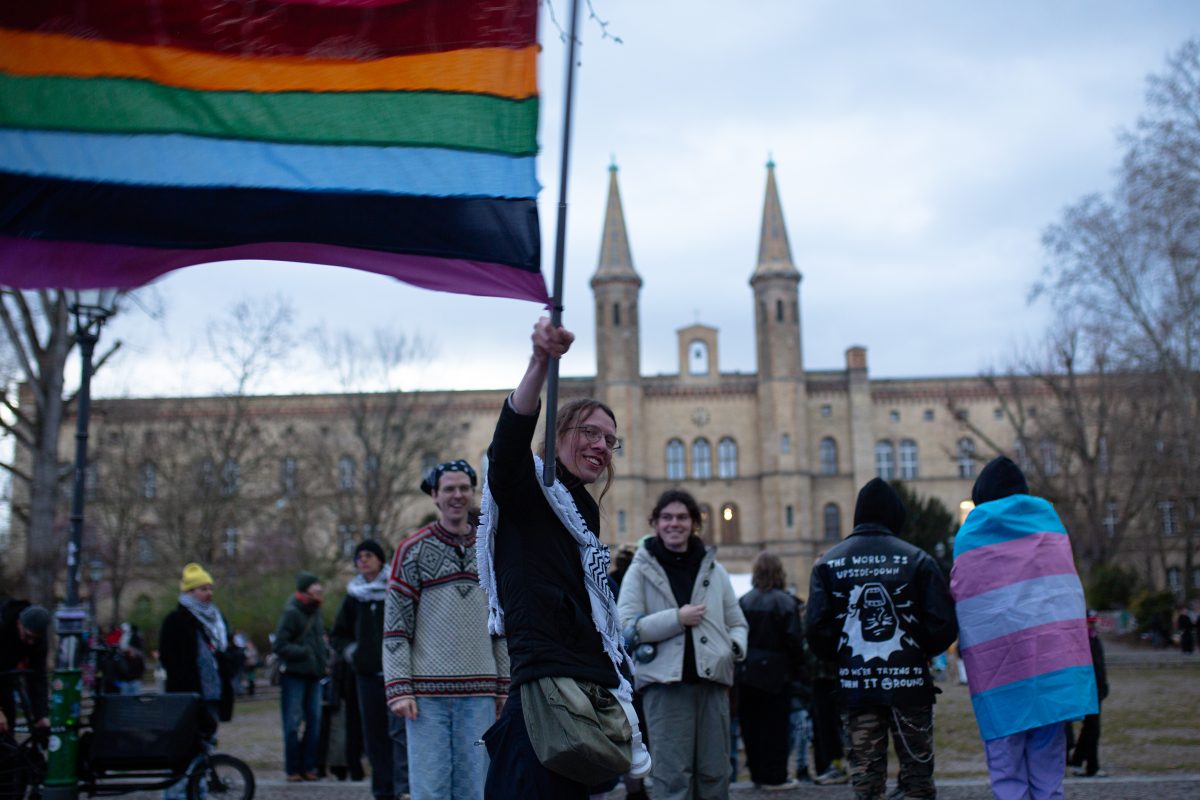
Berlin, Germany — On Saturday, July 25, 2026 a white van rammed into the crowd at one of Europe’s largest pride celebrations, the Christopher St., Day (CST) in Berlin Germany. One woman was killed and 29 others were injured. On Sunday, Germany’s Minister of Interior Alexander Dobrindt described it as an “Islamist terrorist attack.”
The suspect, 21 year old Berlin-born Abdul Ballout, of Lebanese descent, was shot and killed while the police were trying to apprehend him on July 26, after allegedly threatening the officers with a blade, according to Al Jazeera. The suspect has been on the authorities radar for several years now, having been radicalized online and frequenting a particular extremist mosque in Berlin known for their radical beliefs that was also being monitored. The Economist reported Ballout had been recently sentenced and was ordered to attend a deradicalization course after numerous attempts to join the Islamic State group.
While these facts have been repeated across a large number of mainstream media platforms who picked up the story, a deeper look at the story reveals a much more complex and nuanced picture. The fact that such a crime against the LGBT+ community could happen in a city that has proudly built a reputation as a safe haven for diversity and personal freedom — and arguably the birthplace of the modern Western gay identity — had a huge impact both in local and international media.
The Left Berlin called it “a hate attack” targeting “the LGBTQIA+ community” and “a direct consequence of the rise in political violence and anti-LGBTQIA+ rhetoric promoted by the far right,” in particular the AfD and the Christian Democratic Union (CDU). Both parties currently occupy a significant number of positions both in local administration and federal government.
Politicians were quick to use this incident as a way to further their agenda, instrumentalizing the death of an LGBT+ person to push their own anti-immigrant, pro-police stance and call for further surveillance, while carefully avoiding to use words such as “gay” or “queer” and focusing on the racialized profile of the assailant. Berlin’s current Mayor Kai Wagner framed it as “an attack on our free and cosmopolitan society” and thanked the police in a speech at Tiergarten. “We are open and freedom-loving — and we will preserve and defend that. The crime will be investigated and prosecuted to the fullest extent of the law,” chancellor Friedrich Merz from the Christian Democrat Party wrote on X.
In an essay on their Patreon, queer Jewish pro-Palestine activist and author Udi Raz argues that the politicians are only mourning the loss of queer bodies when it suits their political needs, saying that they weaponized the tragic incident as a general threat to people’s freedoms in order to push anti-immigrant and increased surveillance measures, while deliberately leaving out any direct LGBT+ reference. They also document how Merz and the CDU, the government elected in February 2025 have consistently taken measures or made policies against queer people, from refusing to honor the Pride tradition of flying the rainbow flag over Germany’s Parliament, the Bundestag, and a larger debate over acceptable symbols to siding with Trump on gender essentialism. “A Germany that needs its queers dead and grants us nothing but the promise that our death will smooth the flow of genocide,” they write.
What most of the larger outlets failed to report is the fact that CSD was not the only LGBT+ pride parade taking place in Berlin at that time. In 2021, local queers and activists, particularly those belonging to other marginalized groups, who felt like the CSD doesn’t represent their values anymore, created Internationalist Queer Pride or IQP. “We fight for a world free from oppression, where sexualities, gender expressions and identities are lived freely, boldly and without fear, shame or permission,” said their 2026 manifesto. The IQP is also known in activist circles for having a pro Palestine bloc.
Since October 7, it has been widely reported that activists expressing solidarity with the Palestinian people are coming under increased state surveillance and pressure. From the Palestine conference organized in 2024 by Udi Raz that got canceled and led to their arrest, to suppressive measures prohibiting protest speech in Arabic mandating that translators be present at said protests. In June 2025, the Council of Europe’s Human Rights Commissioner expressed concerns about Berlin citizen’s freedom of speech.
One of the most striking things on July 25 was the fact that the smaller IQP march taking place at Gesundbrunnen — in the immigrant and working class neighborhood of Wedding — had a significantly larger police presence.
Alex, a long-time local queer activist whose name has been changed to protect their identity, told Unicorn Riot over the phone that even before IQP there has always been a more radical counter march, which the police had on their radar. Reportedly nine peaceful protesters have been arrested at IQP and many more were also beaten by the police, including Alex. Alex recounts that, on their journey towards IQP, when passing through the CSD march on their bike, they noticed the diminished police presence at CSD. Given the number of participants, they found it fairly odd, as normally one wouldn’t have been able to cross through the crowd on a bike. Once they got out of the metro and walked from Leopoldplatz to Gesundbrunnen, the atmosphere was completely different — the police were everywhere in large numbers. “Actually, when we protest it’s almost as if nothing too bad can happen to us because there’s always so many cops left and right, surrounding us,” they say. They’d approximate there being almost one police officer for every four people. “It’s really incredible how many cops they prepare for us as soon as there’s something vaguely political or connected to Palestine,” they say.
Alex tells us that the police’s approach to these kinds of protests is to always target the most physically vulnerable people, doing rounds among the protesters and being quick to make arrests, even among the press. Alex said that the police always use unnecessary force when making these arrests. In return, the protesters and organizers have developed several strategies to protect themselves. “The people holding the banners did a really good job because they also serve to hide us from the cops that are constantly filming us,” they say. They take banners around six and a half feet long and hold them up high, which they say serves both to protect their identity from the police and the fascists who infiltrate the protests. “There’s always some fascist journalists who show up, hidden between the corporate ones […], who go up to the cops and tell them who to arrest. It’s been like this for 3 years now.”
At the end of the protest Alex says that the people holding the banners made a very smart move in folding them quickly and running straight away. “So everyone quickly scattered except for me because I can’t run,” they say. For Alex, the main issue is that this took place at the end of the protest in front of a children’s playground. “I was walking parallel to a fence and the police arrived from everywhere,” they said. “So in between me and the fence it was maybe 3 feet and the police were in this space kind of surrounding me, and in this space they pushed me and I almost fell.”
The incident left them with bruises all over. They stated that they had developed a case of sciatica after the encounter. “What hurts the most is that they attack you and you cannot do anything, that really rattles me to my core,“ Alex says.
Even before the incident, Berlin was already dealing with increased surveillance with the arrival of Flock cameras in “hotbed areas” such as Kottbuser Tor, a predominantly immigrant central neighborhood and Alexanderplatz. In April, arms manufacturer Rheinmetall was also approved to build a munition factory within city limits.
On the July 31 episode of the Queerocracy Now! podcast, three members of the SBSG/Queerokratia political collective discussed the incident drawing parallels with similar attacks and the LGBT+ community in the United States. “The police, their failure, and the failure of the whole surveillance state is self-evident,” they wrote to Unicorn Riot. “The attacker was well-known and under a high level of surveillance. The IQP faced — like in former years — heavy policing and was dispersed before it reached its destination, and in recent years AI camera surveillance has steadily increased. None of these things stopped the attacker.”
They also think that more police and surveillance wouldn’t provide more security, and would in fact, have the opposite effect. “Excessive policing on demonstrations and surveillance in the streets criminalizes whole communities, while these same communities lack resources to deal with people, like the attacker,” they say.
With the upcoming Berlin local elections on September 20, things are about to get more intense. Zuher, the co-founder of ADIRA, a queer SWANA party and event series thinks both the right wing and conservative parties will try to use the attack for their own racist agendas.
“The political climate has become more toxic within and outside queer communities,” he says. While their events have always been a safe, close-knit community space, he is worried about how the rise in Islamophobia will affect the rest of local nightlife. “I do not believe that we are going to be affected directly,” he says. “But the question is: what will [white] people in the nightlife scene that we work with think of Arabs and Muslims? Are they anti-racist and aware of structural dynamics? Or will they fall for racist tropes of racist politicians and media platforms? Will they make us feel welcome or hostile?”
He also points out how Arab and/or Muslim queer people are almost invisible in the mainstream, with their intersectionality often ignored, misunderstood or erased by the German media. Their post after the attack received a lot of attention online, with many people showing their support for the community. “ I think this is why so many people liked and shared our post,” he says. “It was as if we didn’t exist. Arabs were perceived as the straight homophobic perpetrators while Queers were the victimized, white others. That dualism is dangerous because it does not leave room for nuances and complexities.”
While the incident took place in Berlin, it plays into a larger trend of terrorist attacks where vehicles are used to ram into a crowd. These attacks targeting large outdoor gatherings have been happening around the world since the mid-2010s on a semi-regular basis. The first Christmas market attack in Berlin took place in 2016, with the most recent in December 2024.
The main difference this time around is the attack also being considered a hate crime. Given Berlin’s international status as a safe haven for LGBT+ people, the attack was quickly read as a sign that the gay sanctuary was about to fall.
One of the more shocking online international reactions came from Romania, where reportedly numerous people on social media sites such as Facebook, TikTok and Instagram groups expressed solidarity and praise for the suspect. Messages ranged from calling the suspect a “hero” and offering to give him Romanian citizenship to allusions to burning queer people and other various death threats. This is symptomatic of the rise in homophobia Romania has experienced in recent years that numerous LGBT+ groups and NGOs have warned about.
Activist and TransCore NGO member Valentina Biru doesn’t think that the average Romanian person is necessarily homophobic although she acknowledges the prevalent conservative opinions in Romanian society. She views the homophobic 2018 referendum and Calin Georgescu’s 2024 presidential campaign as a major push towards an “ultra conservative discourse centering family, tradition and sovereignty as tools against the decadent, ‘woke’ west.”
“This is what worries me the most — all those prejudices have started to be validated and transformed into political capital. “When a politician says something anti-LGBT+ and then millions of people are constantly being exposed to this discourse, of course whatever people find acceptable to say in public changes,” she says. “This also extends into people’s behavior in the public space. If Romanian politicians are validating your biases, perhaps next time you see me [as a queer person] on the street you would feel entitled — or even morally obligated — to spit in my face or hit me.”
This is why she thinks that we should take those reactions to the CSD attack seriously. “Because for the queer community violence is not abstract and not something that happens ‘elsewhere’,” she adds. “We know very well that hate speech and violence are not completely separate things. There is a direct link between [phrases like] ‘I don’t have anything against them but I wouldn’t want to see them,’ ‘don’t let them do any LGBT propaganda’ or ‘we need to protect the children’ — this idea that queer people don’t have the right to exist publicly which further translates into queer people not having the right to exist, period.”
The CSD attack was one of those instances where many of Berlin‘s fragmented groups came together and had something to say whether they were part of the queer community or not. IQP issued a statement on July 30 saying “Despite the profound political differences between the CSD and the IQP — which we have never shied away from and never will — we mourn alongside everyone affected by this heinous act of patriarchal, homophobic and transphobic violence, regardless of ideology that breeds it. An act of violence against one of us is an act of violence against us all.”
Organizers for the sex-positive gay event Gegen also wrote on Instagram on July 29 — “The contradictions of this weekend could not have been clearer. While official speeches celebrated diversity and inclusion, other queer demonstrators in Berlin were met with police violence simply for exercising their right to protest. Freedom cannot be celebrated in one place while being suppressed in another.” Even the expat-themed meme account berlinauslandermemes wrote, “The conclusion one can’t help but draw from all these facts, is that at best, Berlin politicians and authorities are not only negligent and incompetent, but do not care about LGBTQ+ lives.”
In light of the growing tensions and compounding problems, local activists are still fighting and trying to find solutions. “We need funding that enables these communities to deal with such dangers on their own,” SBGB says. “We need independent research into hostility against queer people and other communities, including from Christian fundamentalists that exist in certain currents of the CDU, Islamic fundamentalists, and the secular Right alike,“ they add.
Zuher advises people to find a support group they can rely on, join an anti-racist party and inform themselves about their rights. “Berlin has so many great groups and activists who are fighting for the safety of Berlin BIPOC in general,” they say. “Always together, never alone.”
Follow us on X (aka Twitter), Facebook, YouTube, Vimeo, Instagram, Mastodon, Threads, BlueSky and Patreon.
Please consider a tax-deductible donation to help sustain our horizontally-organized, non-profit media organization:
Read the full story at the source
Source: Unicorn Riot