
World Tribune
Lebanon: Hezbollah Holds Out
As the Iran campaign flounders, the empire turns to Beirut.
English (original) ·Read in Deutsch ⇄
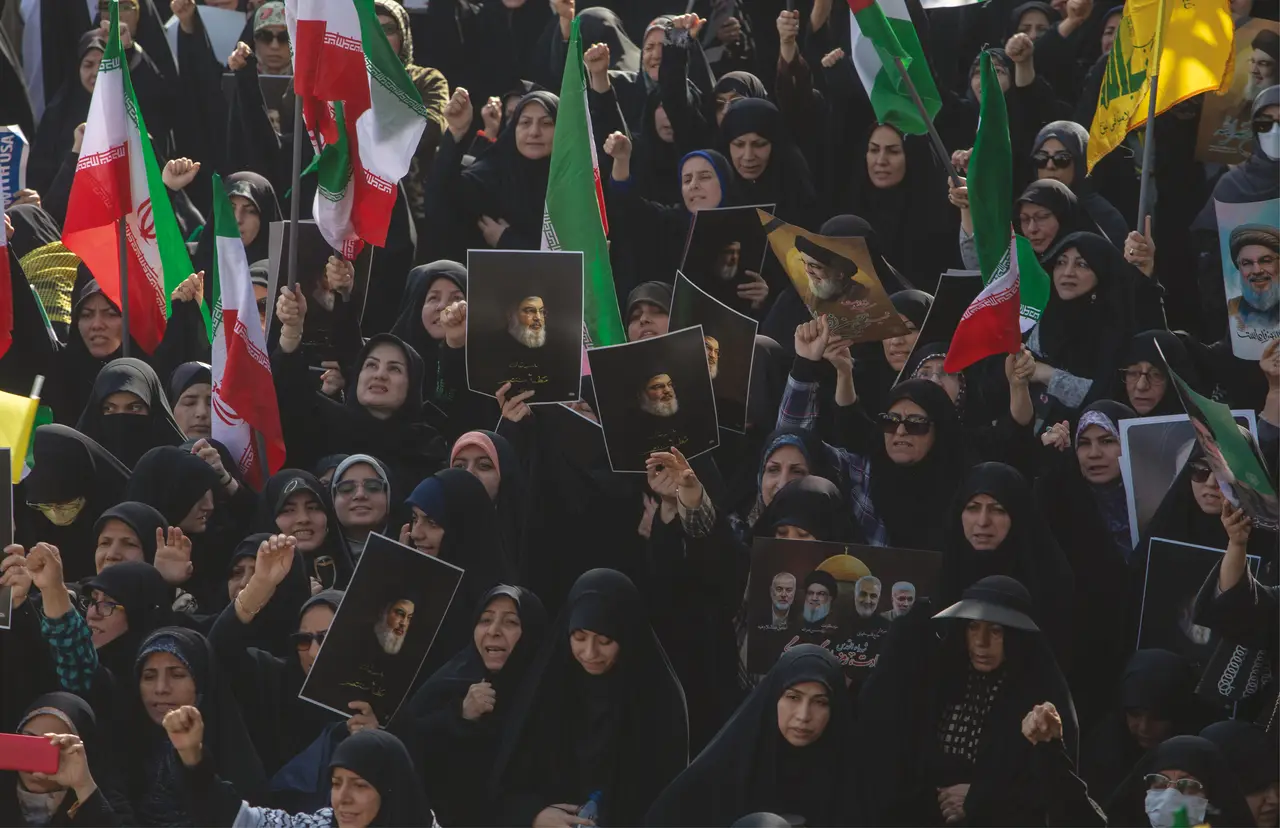
December 2024: Hezbollah has been defeated. Its year-long engagement with Israel has left Nasrallah dead along with the rest of the top brass. The party has signed a ceasefire deal pledging to withdraw its fighters from the south of Lebanon’s Litani river. Its enemy continues to rampage through the region, terrorising southerners and occupying crucial territory, while its main ally, Iran, beats a hasty retreat from the Levant after the fall of the Assad regime. Many wonder whether the regional resistance is finished.
March 2026: Hezbollah fires six missiles into Israel and declares that operations have recommenced following the assault on Iran. It retains its positions in the south and conducts operations from areas right along the border with the Zionist state. The new leadership ties their fortunes directly to those of the Islamic Republic — and the gamble appears, at least in part, to pay off. The resistance is not dead yet.
What explains this reversal of fortune? Soon after the one-sided ceasefire, President Joseph Aoun and Prime Minister Nawaf Salam came to power in Lebanon on a US mandate to disarm Hezbollah. The population was split between those in the south who remained the targets of Israeli terror and others who were able to move on. The central government showed little regard for the former. No support was offered for the people now living under constant Israeli surveillance and the buzz of killer drones. The priority was simply to win favour from Washington by regaining the state’s monopoly on violence.
Hezbollah’s defeat in 2024 flowed from several contingent factors. While Nasrallah was a shrewd political tactician — pragmatic in many respects — he and his military commanders were deeply ideologically committed to both the Palestinian cause and to a broadly Islamist anti-imperialism. This outlook shaped Hezbollah’s understanding of October 7th as the trigger for a process of regional reordering. It believed that the only sensible course of action was to turn the idea of the ‘resistance axis’ into a reality: a united front that would stretch across Palestine, Syria, Iraq, Yemen, and most importantly Iran.
By opening up a front in support of Hamas on October 8th, Hezbollah pushed these different forces to negotiate about the extent of their collective involvement in the conflict. But each of them had hesitations. Yemen’s Ansarullah had reportedly asked the Assad regime to allow it to conduct operations from Syria. Yet mere days after the war began, Assad expelled Ansarullah representatives from the country and later handed the Yemeni embassy in Damascus to their Saudi-backed opponents. His refusal to join the fray had the effect of concentrating it in southern Lebanon and the Beqaa valley. This placed an enormous burden on Hezbollah, which was reluctant to escalate given the risks involved, and was eventually overwhelmed by Israel’s superior intelligence and firepower.
Thereafter, the Trump administration was heavily involved in the theatrics of disarming Hezbollah. It dispatched its Deputy Envoy to the Middle East to take photos of weapons depots supposedly being decommissioned. But Hezbollah officials remained unwilling to comply with the disarmament process as long as Israeli attacks continued. The general sense that the government had abandoned the south, and the fear that its populations would be left defenceless against the Israeli war machine, helped to amplify support for the party. Hezbollah’s military wing worked quietly in the background to reorganise its command structures, rearm itself, and shift tactics back to its earlier days of guerilla warfare, while integrating modern technologies like fibreoptic cable-guided drones. It was reported that the IRGC was directly involved in these efforts, though this is yet to be confirmed.
Having rebuilt some of its forces, Hezbollah saw a potential opportunity when the war erupted in Iran. This was a chance to bring southern Lebanon back onto the geopolitical stage — ensuring that its peoples could not simply be ignored — by conjoining its fate to that of the Islamic Republic. The gamble was high risk and high reward. If it succeeded, not only would Israel be compelled to withdraw from Lebanese territory, but Hezbollah and the axis of resistance would be able to reassert itself.
Israel responded with immense brutality, launching an aerial campaign that killed at least 4,350 people. Entire villages were wiped from the map in southern border areas, while no less than 5,000 acres of forest were destroyed, alongside the vast destruction of agricultural land and orchards. The Lebanese government outlawed Hezbollah’s military wing and called for direct talks with Israel to reach an agreement to end the fighting. Netanyahu rebuffed the request.
But as Trump saw his plan for regime-change go up in smoke, he came to view the prospect of a deal with Lebanon as a potential escape hatch. By the end of spring, it seemed that the White House would be forced to accept a peace deal slanted in Iran’s favour. When the MOU was finally hammered out in June, it explicitly extended the ceasefire to Hezbollah — which threatened to rejuvenate the party and thwart Washington’s plan to bring Lebanon fully into the imperial fold.
The US therefore decided to override Israel’s initial objections and host simultaneous talks between Tel Aviv and Beirut, which culminated in a ‘Framework Agreement’ signed by three countries. This established an intent to end the war between Israel and Lebanon, while asserting the Lebanese state’s exclusive monopoly on military force and obliging it to disarm Hezbollah through a four-stage process: neutralisation, third-party verification, armed deployment and state-led reconstruction. The plan was to test this out in ‘pilot zones’ in exchange for conditional Israeli withdrawal.
The Framework thus raises the prospect — however unlikely — of direct military confrontation between the Lebanese Armed Forces and Hezbollah. It ties the IDF’s exit from Lebanon to the government’s ability to prove that it has torn down Hezbollah’s military infrastructure (likely an impossible task) without any binding timelines. It also renounces Lebanon’s right to pursue legal action against Israel in international forums. So much for the Lebanese government’s strategy of ‘sovereignty for compliance’.
In the weeks that followed, the agreement suffered setbacks in its implementation, with disagreements over the location of the pilot zones. Israel insisted on starting with areas that were never under its control, which was unacceptable to the Lebanese government. By early September, Israel had expanded its occupation in the south such that it controlled around 5 percent of the country. Hezbollah has meanwhile continued to reject both the agreement and the negotiation process, though it has expressed openness to delimited security talks and to speaking with the US. As things stand, the future of Lebanon is in a state of suspension. It will be shaped by how things transpire between the US and Iran.