
Politics · Tribune · · 2h
In Sweden, the Far Right is a Victim of its Own Success
English (original) · Read in Deutsch ⇄
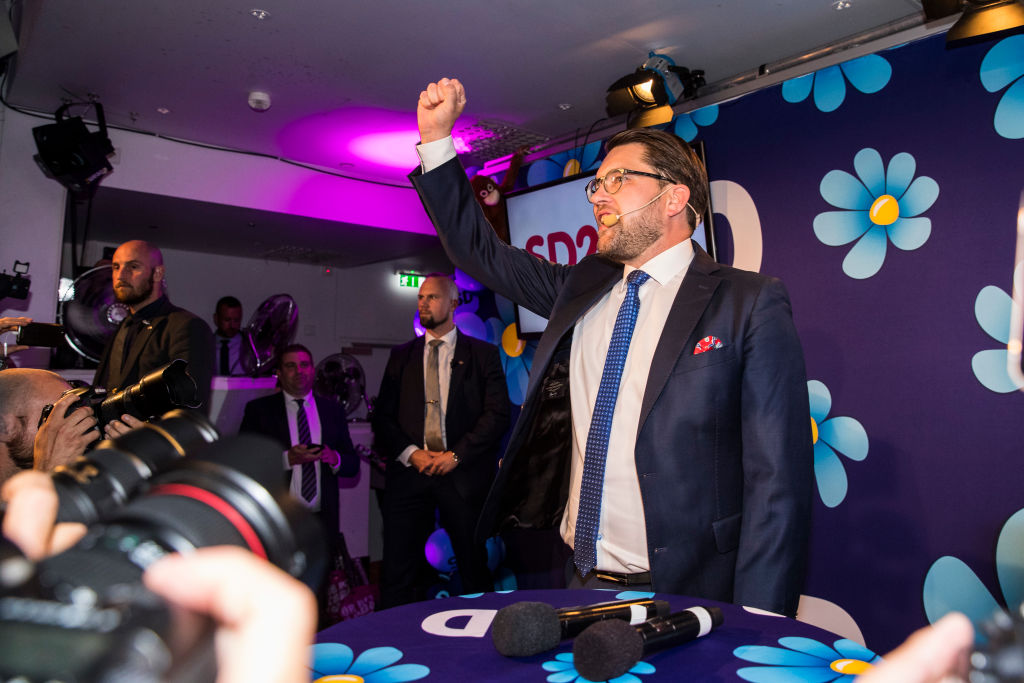
A few weeks ago, polls were predicting a comfortable win for the left in Sweden’s general elections. But when the ballot was held on 13 September it returned a knife-edge result, one that was too close to call for several days. It was finally announced that the left bloc, led by the Social Democrats, had won 176 seats in the Riksdag to the right’s 173 — a margin of just over 50,000 votes. Though it looks like the Social Democrats will lead the next government, this will go down as the party’s worst electoral performance since the introduction of universal suffrage in 1918.
Few are happy with the outcome. While the Social Democrats’ loss in terms of overall vote share was made up for by the combined gains of the three other parties that make up the left bloc — the Left, the Greens and the Centre — these smaller formations don’t have much to celebrate either. At least not yet. To translate their new votes into power over policy, they must first reach an agreement both with the Social Democrats and with each other. That may prove difficult, especially for the Left and the Centre, whose economic policies often tend towards opposite ends of the spectrum. The Left has insisted they will not support any government in which they aren’t included, while the Centre has ruled out supporting any government that includes the Left. It falls to the leader of the Social Democrats, Magdalena Andersson, to get them to come to an agreement.
Meanwhile, Ulf Kristersson’s right-wing coalition which ruled for the past four years has been booted out, but not nearly as decisively as the left had hoped. Kristersson’s Moderate party advanced slightly, while the far-right Sweden Democrats (SD) — on whom his government has been heavily reliant — lost 3 percent of the vote share compared with 2022, shrinking to 17.5 percent. In an election with only small vote swings, this was the single biggest loss of any party, and the first time the SD’s seat share has diminished since they entered parliament in 2010. The smaller parties in the right wing bloc, the Liberals and the Christian Democrats, saw modest increases, but not enough to offset the far right’s decline.
Over the past four years, the SD has been a ‘collaboration partner’ of the Kristersson government, supporting it without being an official member of the coalition. In 2022, the SD signed an agreement (‘Tidöavtalet’) with the Moderates, Christian Democrats and Liberals, in which it gave up any formal government role in exchange for wide-ranging influence over several policy areas, including immigration and crime. While some commentators described this as an enviable position — SD wielded enormous power without governing responsibility — the reality is somewhat different. In the eyes of the public, the SD may as well have been part of the government, so obvious was its impact on policy. As a result, the party has had to navigate the inevitable difficulties involved in supporting an already unwieldy three-party coalition, and voters have held it accountable for the less popular parts of the government’s programme.
Despite the far right’s dropoff, its election campaign proved that the party has now been normalised within the Swedish political landscape. As its leader Jimmie Åkesson told members after the polls closed on Sunday, the SD may have lost some votes, but what they have gained over the past four years, as collaborators of the Kristersson government, is a level of respectability that was previously unthinkable. Their representatives are no longer a maligned and untouchable group within the Riksdag, their voters no longer ashamed of their affiliation. For a party with roots in the neo-Nazi movement, there was no guarantee that this detoxification would succeed. But now, for the first time ever, the Sweden Democrats have campaigned alongside the Moderates, the Christian Democrats and the Liberals as equal partners in a unified team. No demands were made that they be kept out of a future governing coalition.
The party has not needed to water down its policies or rhetoric to achieve this normalisation. It campaigned on the slogan ‘Make Sweden Sweden Again’ and insisted that the participation of Sweden’s Muslim and immigrant population in the political process, skewing the results in favour of the left, was an urgent problem in itself.
Ironically, one of the reasons for the party’s poor performance in this election may be that it has already had huge success remaking Sweden in its image. Over the past four years, the SD have been so adept at bending politics to their will that some of their previous voters appear to think that their reforms have now gone far enough, or even too far.
Since the Kristersson government came to power, Sweden has done a decisive U-turn on immigration policy (which began as a series of temporary measures introduced by the Social Democrats in response to the migration crisis of 2015), while systematically overhauling its criminal justice system. The coalition has made temporary rather than permanent residence permits the default for asylum-seekers and severely restricted the possibility of family reunification. It has curtailed the possibility of being granted asylum on humanitarian grounds, hiked salary thresholds for work visas, and severely reduced the number of refugees accepted via third-country resettlement schemes. It has introduced laws requiring public officials to report suspected illegal immigrants, given the police increased powers to carry out internal immigration controls, and made it possible to deny or revoke residence permits, not just for those convicted of crimes, but also for people who have shown ‘bristande vandel’ — meaning, roughly, a ‘lack of good conduct’ (a standard which legal experts warn is just as arbitrary as it sounds). Paths to Swedish citizenship have been restricted, and, to add insult to injury, the government has introduced voluntary repatriation grants of around £26,500 for immigrants to permanently leave Sweden.
In the sphere of criminal justice and policing, the reforms are just as extensive. Longer and tougher sentences have been introduced for a wide range of crimes, and the government has reduced or removed rules relating to more lenient sentencing for offenders under 21. The age of criminal responsibility has been lowered from 15 to 14, and the rules governing court procedures have been changed to allow for anonymous witnesses as well as Crown witnesses. Police have been given unprecedented new powers — including, in terminology by now familiar to all Swedes, ‘secretive and preventative coercive methods’, which can be used against adults and children alike, whether or not they are suspected of any crime. Police have also been given the power to temporarily designate certain areas as ‘visitation zones’, where they can stop and search anyone they please.
It would have been easier for the left to make a strong case against the record of the Kristersson government, and the deep damage it has done to longstanding legal and democratic principles, were it not for two uncomfortable facts. First, the swerve in immigration policy, as well as parts of the criminal justice reforms, have been incredibly popular. (So deep is the shift in the political landscape that the Social Democrats, too, now accept many of these reforms and are unlikely to reverse course.) Second, the Kristersson government has overseen a significant drop in gang-related gun violence, a problem that has shaken Sweden in recent years and sailed to the top of many voters’ priorities.
During the election campaign, the left were nevertheless able to capitalise on some of the most egregious effects of these policy changes, including the gratuitous cruelty of deportations in which the children of immigrants with permanent resident permits, who have been raised in Sweden, have received orders to leave the country on the day they turn 18. Many of those who supported tighter controls on immigration did not seem to imagine it would extend to cases like this. But, by and large, the left bloc squandered its lead. The Left was plagued by a scandal over local and regional electoral candidates who posted antisemitic and homophobic sentiments on social media, exposing a lack of basic political discipline and failure of due diligence. And while the Social Democrats campaigned on several popular policies (such as improved affordability, cheaper dental care and better sick pay), they did not always succeed in setting the terms of the debate, and all too often slid into their old habit of warning the electorate of the danger of the far right, including the unthinkable horror of giving the Sweden Democrats ministerial posts. Such warnings made little sense in a context where, as far as the public is concerned, the far right has basically already been in government. In Sweden as well as elsewhere, fearmongering about the far right is no substitute for the articulation of a distinct left-wing alternative.
Read the full story at the source
Source: Tribune