
World Tribune
Gifts on the Periphery
At the height of decolonisation, architects from Austria to Indonesia built a world beyond empire.
English (original) ·Read in Deutsch ⇄
Everyone knows that ‘state socialism’ didn’t work. Most people also know that it was insular and autarchic, its economies and populations incarcerated behind literal concrete walls and barbed wire fences. If you’re a socialist — apart from a handful of either very elderly or very online cultists — you also know that it wasn’t ‘socialism’ at all but a bureaucratic parody, really a ‘state capitalism’. These positions have become increasingly untenable in light of recent investigations into what those states that called themselves ‘socialist’, whether professedly Soviet in inspiration or non-aligned, actually did during the period when they made up a third or more of the globe. Researchers, most prominently the Polish historian Łukasz Stanek, have found economies that were anything but insular — ones that were in fact profoundly international, just not particularly well connected with North America or Western Europe — and economies where non-capitalist, non-monetary forms of exchange were hugely important, with development projects from dams to factories to entire cities created through gifting and barter, rather than through the actions of the state as a ‘collective capitalist’.
This research has often centred on buildings, because building was a huge part of what these countries did — most were involved in breakneck industrialisation and urbanisation projects — and because it was a crucial means of exchange, with literal bricks and mortar being the object of political alliances and networks. At the heart of this is a phenomenon of considerable contemporary interest: decolonisation. As the European colonial Empires were dismantled, many of the revolutionary or reformist regimes that emerged in Africa and Asia were committed to some kind of socialism, and were therefore welcoming to the various competing brands of socialist state and their concrete-pourers, whether the original brand of the USSR and Warsaw Pact, or the independent-minded offspring of Yugoslavia, China and Cuba.
This poses a whole host of questions. Can you ‘decolonise’ and industrialise at once? Was ‘modernism’ just another form of western domination, or could it mean something more? Could the ‘master’s tools’ of urbanisation and ‘scientific socialism’ build better houses for the people, or just rebuild the master’s house? Was a socialist global economy for a time a real, plausible proposition? Was all this an outline of an interrupted future or just a statist rehearsal for today’s mundane capitalist globalisation?
Answers are sought in a rash of recent books and exhibitions on Yugoslavia, on West Africa, on India, on Central Asia and on China. The newest and among most interesting examples are Global — Neutral, edited by the curators at Vienna’s Architekturzentrum Wien, and The Gift, edited by Stanek. The former looks at a single country — Austria, one of Europe’s few ‘Non-Aligned’ states during the Cold War — and the latter at a single idea: that of construction projects freely given by big states to smaller ones. Both books abound with fabulous photographs, hauntological architectural drawings and utopian models, as well as sometimes distressing and sometimes encouraging images of the changes made to the buildings over the years.
For Stanek, these gifts are examples of both ‘generosity and violence’, with little room for nostalgia; ‘global socialism denotes a Cold War geopolitical Other and a latent alternative to the colonial-capitalist core’, but there is often as much coercion and repression here as elsewhere. There is also considerable cynicism: some of the ‘recipients’ of Soviet/East European, Yugoslav, Cuban or Chinese gift-buildings were professedly revolutionary, anti-imperialist or socialist, like Indonesia under Sukarno or Ghana under Kwame Nkrumah, others were repressive nationalist regimes, like Ba’athist Iraq. The book’s contributors come from a range of perspectives from liberal to nationalist to Maoist but all are nuanced, with little condemnation or praise. The buildings described tend to be strongly modernist, often futuristic and daring, and the book doubles as evidence of the sheer enthusiasm there once was for modern architecture — especially in postcolonial countries, where it was generally believed to be a more neutral form than Westernised classicism imposed by European empires. In a telling image on the back cover, Sukarno — along with Nehru, Nkrumah and Tito the major figure of the anti-imperial Non-Aligned Movement — grins with glee as he pulls a cord at the opening of the Soviet gift of a new sports stadium, as Nikita Khrushchev looks on.
Some of the gifts were responses to natural disasters, particularly earthquakes. There are two essays on the rebuilding of the Macedonian capital of Skopje and one on Tashkent, capital of Soviet Uzbekistan. There are acts of solidarity against imperialism, as with Cuba and Yugoslavia’s assistance in building modernist social housing in Angola, or East Germany’s hospitals in Ethiopia and Nicaragua; but there is also the simple building up of trade links and portfolios, as in the Romanian project for the Parliament of Sudan under the violently anticommunist government of Jaafar Nimeiry. The book moves from the late 1940s to the early 1990s, with the latest project being the National Theatre in Ghana, a late gift of socialist China, designed by a team of architects in Hangzhou and completed in 1992. The line between solidarity and imperialism can get rather blurry, as in the USSR’s first satellite, Mongolia, which received entire housing districts and public buildings from both the Soviets and the PRC, showcased here in a photo-essay on the contrasting projects.
Some gifts really were just that, no questions asked; some involved more generous lines of credit than the West would offer, with low or no interest; some involved detailed programmes to train local workers and professionals; some did none of these things. But the ideology of gifting was so strong that the rhetoric would be used regardless. In her essay on the Parliament of Sudan, Miruna Stroe notes that its Romanian architect Cezar Lăzărescu constantly described his Brutalist parliament building as an anti-colonial gift, though there’s zero evidence that it involved the slightest transfer of technology or knowledge. On occasion, there’s a tension between the findings of the researchers and the memories of still-living gift recipients: writing on ‘Brezhnev’s Blue Gift’, a sky-blue tiled housing estate donated to Ulaanbaatar in Mongolia, Dariusen Azbayar stresses the coloniality of the project, while her interviewees in their somewhat crumbling blocks stress their gratitude, their comfort, and their enduring belief in the Soviet project that brought the buildings into being.
There’s also an uneasy sense here of different temporalities, and of these gifts sometimes being baubles, projects that were beyond what the country actually really needed. In Stanek’s own essay on the high modernist new campus for the University of Kumasi in Ghana, he notes Nkrumah’s salty scepticism about the project: in his speech opening these gridded, cantilevered concrete buildings, he observes the sharpness of the contrast with the rural area around, and enviously ponders how Stalin would have made sure the students did some manual labour with their study. And sometimes, the gifts were uneasy in terms of their technologies or their upkeep. East Germany donated schools to Managua, Nicaragua, as an act of solidarity with the Sandinista government under attack from American imperialism, and large housing complexes to Vinh, in Vietnam, destroyed by the American war. But the simple reproductions of East German schools were far too hot for comfort in Central America, and the Vietnamese housing has become dilapidated: Christina Schwenkel notes that residents, still very attached to their flats, firmly believe that it’s the contemporary German government’s responsibility to renovate them, in the original spirit of the gift.
Global — Neutral’s focus on Austria might at first seem like a puzzle — the small, wealthy Central European state is hardly considered a revolutionary outpost — but the book reveals that under the socialist foreign secretary and then long-standing leader Bruno Kreisky, the country had ambitions to be a force for non-aligned, social-democratic development across the world, reflecting its own model of a highly statist market economy that refused to choose between East and West. Under Kreisky, Austrian architects and institutions donated and designed an enormous amount in the postcolonial countries. Here you’ll find a palace for Emperor Haile Selassie in Addis Ababa (among the very few classical buildings in these two books) and for King Hussein in Amman; a proliferation of TV Towers inspired by Vienna’s own, designed by its globetrotting architect Hannes Lintl; mass social housing in Iran; cultural centres in Bahrain, by the talented modern architect and ex-Nazi Roland Rainer; technical colleges in Burkina Faso; a Centre for Economic Development in Kathmandu; and much else.
These drew on the country’s self-marketing as, in Platzer and Bick’s words, ‘unburdened and ideologically harmless’. Kreisky claimed Austria could be trusted by the formerly colonised world because it had no colonies of its own. This was factually untrue — and would have come as a surprise to former subjects of the Habsburg Empire, like Romanians, Ukrainians, Czechs, Hungarians, Slovaks, Trieste Italians, Croats, Bosnians and Poles — though unusually, Austria’s colonies were all European. But Kreisky’s statement nonetheless signalled a rare reimagining of a European ‘core’ country: what would it be like to not privilege oneself as the source of civilisation and enlightenment, to wallow in postcolonial nostalgia, but instead to act as a disinterested force for redistribution and modernisation?
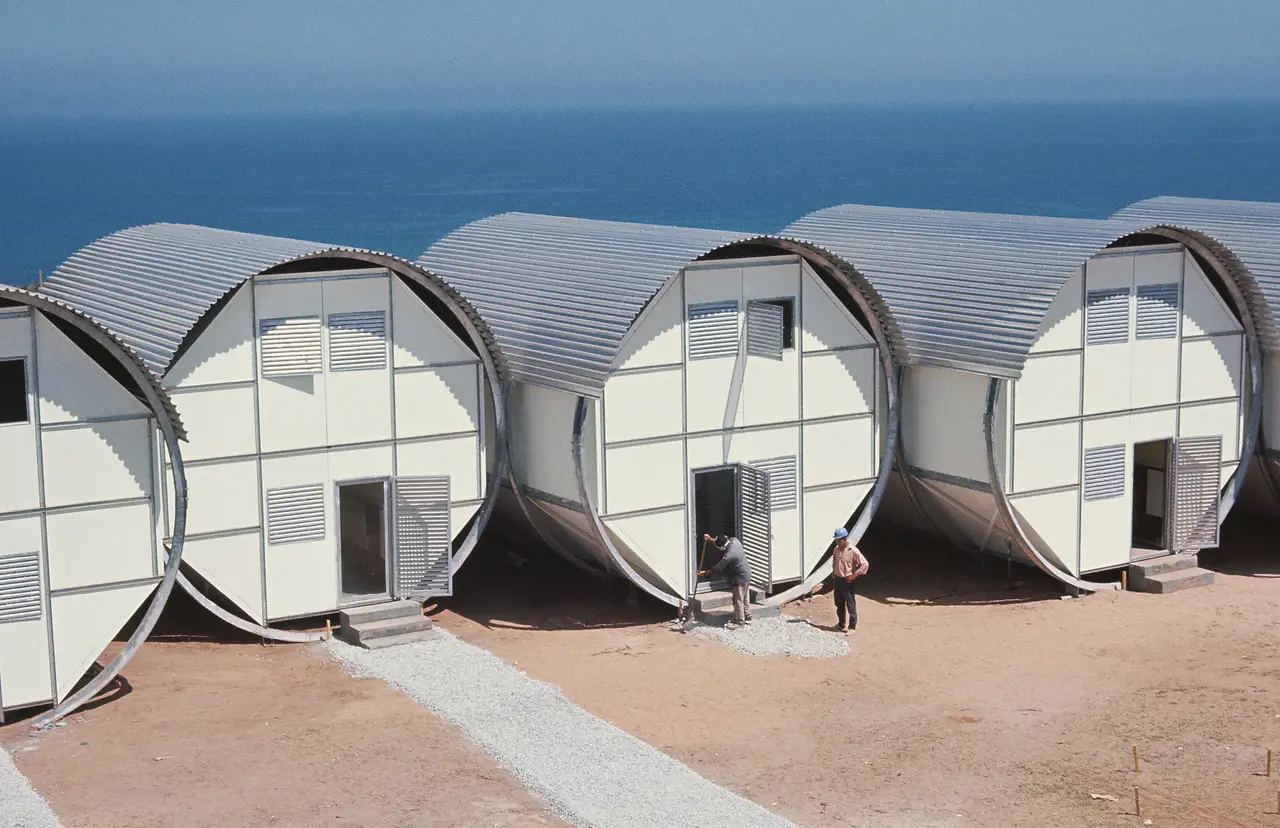
One outcome was the training of architects from the Global South; two of the most impressive were Iranian, educated in Vienna or Graz. In Reza Alirezaieyan’s essay on Djamshid Farassat, the focus is on his design of the USSR-funded new steel town of Aryashahr under the Shah, in a fusion of traditional courtyard planning and Soviet system-building. There’s also a detailed interview with Shahrzad Seradj-Kraupp, educated in Vienna and Graz, who set up an all-female firm of modern architects, BANU, in Tehran in 1971; she remembers arriving in a Vienna airport far less modern than that she had departed from in Tehran. There is a lot of melodramatic, hulking concrete here, but some of the work is lightweight and ephemeral, like Eva Mang-Frimmel and Karl Mang’s temporary trade pavilion for Bangkok, of 1966; or the prefabricated houses designed by Walter Hildebrand and Eckhard Schulze-Fielitz as part of a Caritas scheme for rehousing refugees displaced by the Biafra war in Nigeria, in São Tomé and Príncipe: as historian Warebi Brisibe shows in his essay, these were airy, tube-like, and well calibrated to the climate.
What they also were is charity, a practice rather different to gifting, at least in the terms that socialist movements and governments had seen it — much more a matter of pity, concern, and perhaps condescension. The Catholic church is a large presence in the story of Global — Neutral (religion of any kind is marginal at best in The Gift), and sometimes the results were sinister. Worst of all here are the SOS Children’s Villages, a series of aid schemes for child-centred care complexes, built in Delhi and Daegu among other locations, designed by several talented Austro-modernists. Since the 2010s, it has been revealed that these villages had harboured systematic child abuse. And obviously, there are violent dictators everywhere, with real anticolonial fighters like Sukarno and Selassie mixed up with neocolonial appointees and potentates like Hussein and the Shah. As in The Gift, we see how the project finally unravels at the end of the 1980s, with the Fall of Communism causing Austria to turn its attention to its actual former colonies, in newly ‘free’ Eastern Europe.
Even charitable aid from Western governments is at a low ebb in 2026 — budgets for it have been cut by leaders of the far-right, like Donald Trump, and centre-right, like Keir Starmer. A still professedly socialist China, with its Belt and Road Initiative, appears to be an exception; or is it? Perhaps the most thought-provoking essay in The Gift, by Ye Liu, is on gifts and aid under Maoism in China, from 1949 to 1976. This ‘South–South’ aid made up an astoundingly large part of the PRC’s budget — 7.2 of the total in 1972, compared with an average of 0.38 at the time in the OECD — or 0.5 in China in recent years. In this account, enormous importance was placed on these projects under Mao, with their spirit of ‘sacrifice’ and ‘the poor helping the poor’ seen as a model for an alternative global socialism. Some of the results were impressive and enduring, like the Tanzania–Zambia Railway, with its spacious stations. The Belt and Road, on this account, is not a revolutionary solidarity project, but one that presents China as neutral: ‘an apolitical, prudent, and non-discriminating goods supplier who can make the risky capitalist world more sustainable, human and reliable’. There is perhaps one continuity, though — the process of modernisation no longer has much need for the West.