
World Socialist Project
The UAW Needs a Strategy for the Future of Manufacturing
The United Auto Workers (UAW) has a problem: the future of the auto industry. The crisis facing autoworkers is unfolding on many fronts. Beyond the chaotic corporate-led electric vehicle (EV) Keep rea
English (original) ·Read in Deutsch ⇄
The United Auto Workers (UAW) has a problem: the future of the auto industry. The crisis facing autoworkers is unfolding on many fronts. Beyond the chaotic corporate-led electric vehicle (EV) transition, there is also the ongoing restructuring toward non-union manufacturing in the South, continued labor-replacing reorganization, and growing international competition. Workers bear the brunt on every front, most recently weathering plant closures, mass layoffs, and cross-border supply chain shocks.
UAW President Shawn Fain – whose entire slate swept the recent election for top office – has rhetorically distanced himself from UAW’s legacy of concessions. “Keep in mind how far we’ve come in the last four years,” Fain said at the June UAW Constitutional Convention. “We’ve gone from defense to offense.”1
In reality, after decades of managed decline, the UAW has only just started to play defense. Fain’s administration, which came to power in 2023 through the organizing of Unite All Workers for Democracy (UAWD), has revived splashy, agitational contract campaigns. Yet the long-standing culture of union-management collaboration has left the UAW unable to resist the harm from the EV rollbacks. Moreover, the corporations are restructuring the industry faster than the union can build power.2
Organizing the South
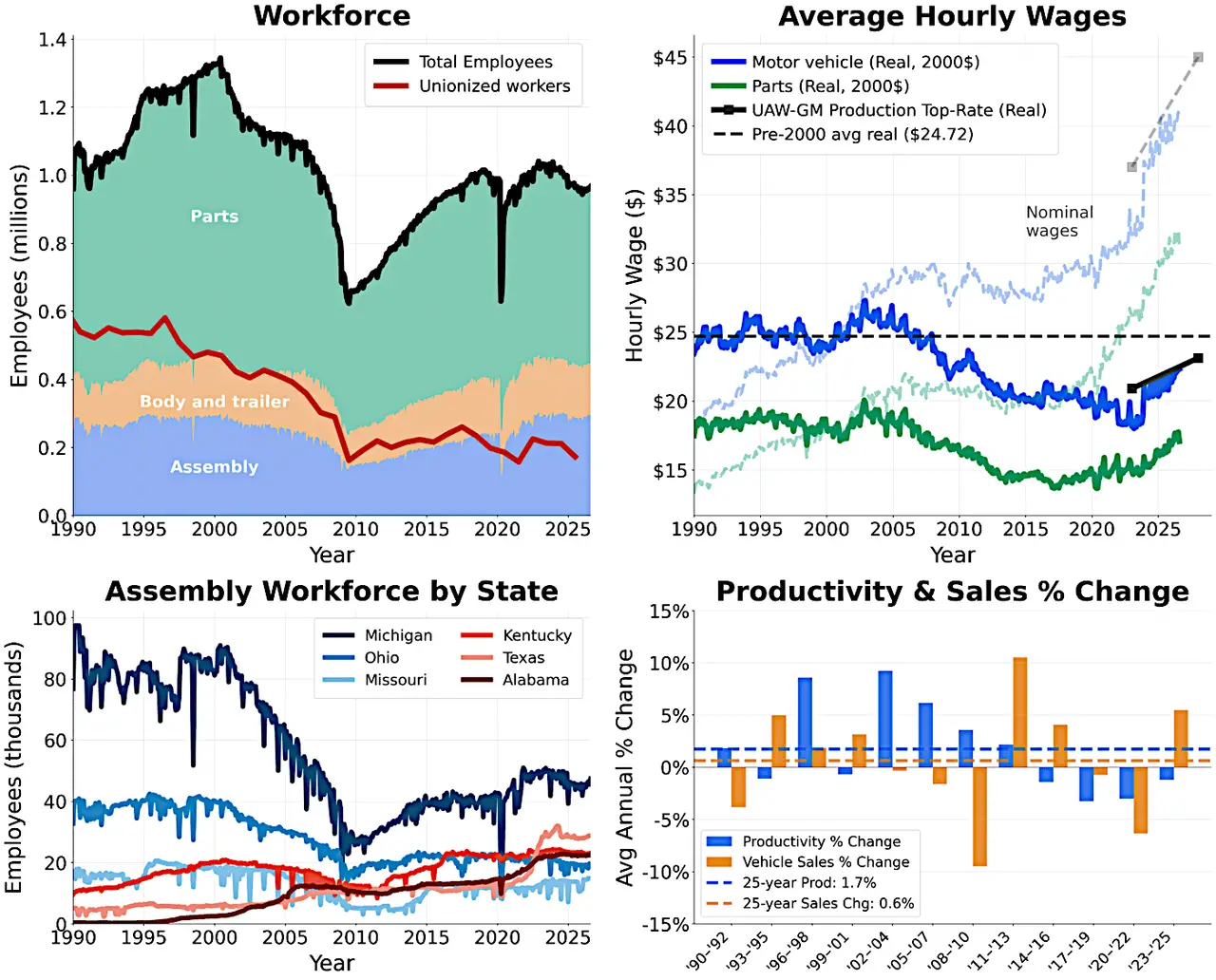
Non-union production is nearing two-thirds of the market share as UAW’s renewed push to organize the South faces setbacks, including its loss at Mercedes and its withdrawal from some campaigns.3 There is still no plan for the heavily non-union parts sector. If a 2028 strike against the Big Three wins back the retirement benefits Fain campaigned on, it would essentially bring unionized assembly work to pre-2008 standards. But it would cover fewer workers, and inflation-adjusted wages would likely still be lower (Figure 1).
The situation is grim. Even with its renewed dynamism, the UAW’s current trajectory is a continued loss of leverage on an industry-wide scale. If the next administration tries to accelerate EV development again, corporations will cite the Trump-era rollback as a reason to demand more federal guarantees at labor’s expense. If protectionist policies prevail, a zero-sum market dynamic will force competition over jobs and devastate solidarity among North American workers, trapping the union into tailing corporations as they jolt back toward fossil fuels. The United States will continue to produce overpriced trucks to sell at home while Chinese companies sell better and cheaper EVs around the world. The result will be a weakening union presiding over a slow decline.
But there is an opening for workers: the recent pivot away from EVs reveals the corporate-led transition’s fundamental inability to deliver clean and safe transportation for the working class. This impasse is an opportunity to introduce political solutions that long seemed out of reach. If workers are serious about going on offense, they must look to UAW’s roots: a strategy of class struggle unionism that breaks with union-management collaboration, invests in militant shopfloor leaders, and fights for worker control alongside bread-and-butter demands.4
Shopfloor militancy is necessary, but not enough on its own. The deeper problem is capitalist competition and workers face too many threats at once to beat them with one-off bargaining pushes. The way out is to chart a path toward collectively controlled manufacturing that serves the working class. This could look like building affordable EVs and public transit needed to improve working people’s lives and addressing the climate crisis, with public procurement enabling planning for decades to come. Such an approach would both break the zero-sum market trap and enable the rebuilding of worker-led solidarity at home and abroad.
How Workers Experience the Corporate-led EV Transition
Between the EV restructuring and uncertainty from the trade war, plant shutdowns, mass layoffs, and production pivots have roiled the industry over the last three years.5 Employment in the entire US auto sector decreased by over sixty-five thousand jobs, though the decline has recently plateaued and is slowly recovering.6 This number represents an expansive picture of the sector that includes parts and assembly subsectors, union and non-union jobs, and production workers and supervisors.
In the Midwest, thousands of workers face temporary or indefinite layoffs as EV production at several factories is spooling down and multiple plants are being re-retooled from EV assembly back to combustion engine vehicles.7 GM laid off over one thousand workers at one Ultium Cells battery facility, closed another to retool for energy storage, and sold off a third.8 Reneging on its 2023 agreement with the UAW, Stellantis canceled plans for their EV assembly lines and battery plant in Belvidere, IL, eventually leading to the UAW’s “Keep the Promise” campaign.9
Perhaps most illustrative of the current moment is the recent closure of the Kentucky BlueOval electric-vehicle battery facility co-owned by Ford and a South Korean company.10 The 1,600 workers who were fired had previously voted to unionize with the UAW in the face of rabid anti-union corporate tactics. But now, Ford is using the closure as an opportunity to bust the union, claiming it will reopen the facility in 2027 for battery storage manufacturing, in part supplying data center construction driven by AI speculation. Workers from the plant held a rally with the help of the UAW, but other Ford Locals have not mobilized in solidarity, leaving the fired workers with little leverage.11
When I worked at General Motors Factory Zero, which produces gigantic luxury EVs like the $100,000 Electric Hummer, I experienced the plant shifting from mandatory overtime in 2024 to mass layoffs in 2025. The company used a loophole in the contract, which allows for waiving overtime restrictions when launching new vehicles – forcing workers to work six days a week for 12.5 hour shifts (including a half hour of unpaid lunch) for almost a year. GM also relied on the inability of over a thousand new hires to get relief through the federally protected Family Medical Leave Act (FMLA), which only kicks in a year into employment.
Local 22 union officials were uninterested in organizing against the brutal mandatory overtime, even when the death of one of our union siblings while driving home after a long shift galvanized anger on the shopfloor. The rank-and-file formation I was a part of, anchored by UAWD members, put out a petition demanding easing of the mandatory overtime schedule and raising striking as a threat. Local officials quashed the organizing despite more than seven hundred workers signing the petition. Officials pushed through a vote to adjourn during one membership meeting to avoid discussing the matter. In the monthly newsletter, the Local president claimed that signing the petition may result in workers getting fired. Regional leadership was made aware of these actions and the conditions the workers faced, but did not support the campaign either.
After Trump’s EV policy reversals came into effect, management at the plant started to ramp up layoffs in 2025, ultimately impacting over a thousand workers. In union newsletters and from the front of the room during membership meetings, Local union officials blamed the downsizing on so-called “absenteeism” rather than fighting to keep workers in the plant.12 Many workers were finally able to take time off with FMLA after a brutal year of mandatory overtime. This boom-and-bust dynamic over the span of just two years revealed deep cultural challenges at the Local level: instead of the corporations’ decision to make luxury EVs with limited market appeal or the Trump administration’s anti-EV policies, workers were being blamed for their own layoffs, weakening solidarity and pitting the union against itself.
A union that put the blame where it belonged and oriented around expanding worker control would have fought for strong work-sharing provisions to spread the downturn’s burden across the workforce, and over the longer term, for a say in the product decisions that caused the bust in the first place.13
At the Local level, organizers face the profound challenge of breaking with business unionism – the ideology that seeks labor peace with the boss and narrowly confines the union to bargaining better deals for its own members. Some of our strongest opposition came from proud union members who have been in the Local for decades, and many come from UAW families. Their positions on the Local Executive Board or as union stewards kept them from grueling work on the shop floor, which in turn made them worried about losing their union role. This reinforced the conservative belief that fighting management is more destabilizing than smoothing over conflict.
Such was the reality on the ground, despite UAW’s claim that a “just transition” was won.14 The 2023 national agreements gave the UAW little contractual standing to resist the EV-related mass layoffs and plant closures, as the companies used “market condition” exception clauses to explain their restructuring.15 UAW’s current focus on contracts ultimately obscures that management’s control over workers is a question of power, not legalism.
The biggest experiment in resistance was UAW’s aforementioned Stellantis Keep the Promise campaign.16 After the Stand Up strike, Stellantis began a wave of layoffs, reversed its decision to reopen the Belvidere Assembly Plant, and dropped other product commitments. Fain tried to unite Local presidents around escalating strike threats in solidarity, and the UAW reported that 28 Locals passed resolutions that put them on track to strike over violations of the contract’s product commitment provisions. Two Locals of parts-distribution workers cleared the strike authorization threshold, but assembly-plant workers were more conflicted.17
As a co-chair of UAWD’s Organizing Committee at the time, I worked with others to support rank-and-file workers in launching a small bottom-up campaign across assembly plants to build support for Fain’s strategy – convening meetings, handing out flyers, and intervening at membership meetings.18 While some in the rank and file grasped the importance of cross-Local solidarity, many were resistant and skeptical, especially as officials fear-mongered about further layoffs. Decades of business unionism had atrophied the muscles for bottom-up deliberation. Without a meaningful democratic process, the campaign felt like an imposition, and the chance for political education and buy-in was lost. UAW’s top leadership cut it short after Stellantis agreed to some demands, while cancelling plans for a battery plant and parts megahub in Belvidere.
The inability to resist the corporate-led EV restructuring while the Big Three continue to profit reveals the overall weakness of the UAW, especially between contract negotiations.19 The ideology internalized across UAW workers, staff, and union officialdom is that management has a right to do what it wants, and workers can only ride the boom and bust cycle of the industry and hope they make it out on the other side.
Organizing Setbacks and the Way Forward?
UAW’s organizing drive in the South is one of the most ambitious and important endeavors in the labor movement today. Coming out of the recent Constitutional Convention, in June 2026, where delegates approved an increase in the organizing budget from $60 to $100-million over four years, UAW’s current organizing approach should be critically evaluated.20
In 2024, UAW homed in on new organizing, claiming to focus on more than a dozen non-union assembly and battery plants, mostly in the South.21 As multiple analyses have revealed, this increased funding also came with a pivot in strategy emphasizing worker-led organizing, leadership identification, workplace mapping, public pressure campaigns, and the use of experienced staff (primarily coming from the higher education sector).22
The big breakthrough has been the Volkswagen plant in Chattanooga, Tennessee, where workers recently settled a contract after nearly two years of bargaining with the company.23 A parts plant down the road from the Volkswagen facility also unionized with the UAW, showing the possible ripple effect of southern organizing wins.24 Workers at Daimler Truck plants in North Carolina and elsewhere in the South ran an animated contract campaign that secured significant wins.25 The unionization victory at BlueOval, mentioned above, was eked out with an 11-vote margin, and would have continued the pattern if the company did not deliberately shut down the factory for retooling.26
Yet, in the face of unrelenting union busting, the UAW appears to have reassessed its strategy and pulled resources from certain organizing drives.27 A UAWD member leading an organizing drive at an Alabama plant recently told Daily Struggle, “I feel there was a ton of enthusiasm from International at the start, but when things got hard, like they inevitably do in new campaigns, they kind of folded to the adversity. We don’t dislike our staff, they’ve just been hard to reach for months, they’re managing multiple campaigns across the South and they’re not down here that much. They sometimes have advice for us when we get them on the phone, but, beyond that, there aren’t organizing resources flowing to us as workers.”28
A similar pattern is playing out at a Rivian electric vehicle plant in Normal, IL. The UAW has pulled back support for the organizing drive, after establishing a neutrality agreement that will only kick in once the company reaches a threshold of profitability. Certain Rivian workers publicly disagreed with this strategy, telling WGLT: “Money’s not in the Top 5. I want a say in what goes on in my work life and my home life. Right now, I don’t have any of that. They can change your schedule. They can do whatever they want because I don’t have a seat at the table.”29
The Mercedes unionization drive in 2024, which failed by a margin of about six hundred votes out of five thousand voters, is an important recent case study. There have been many insightful analyses by workers and labor researchers assessing the loss.30 As the campaign is regrouping for another push, the organizing demands are worth analyzing more deeply.
Mercedes organizers picked eliminating the wage and healthcare tier that was instituted in 2020 – or what they dubbed the “Alabama discount” – as a key target of their campaign.31 Under pressure from the organizing drive, the company eliminated the tiers and went on a charm offensive after replacing their CEO. According to organizers, who were able to secure a large majority of “yes” commitments, the company’s pivot swung many voters to “no” in the weeks leading up to the election. Then, months after the election, the company reasserted its control by, for example, forcing excessive Saturday work and dragging its feet on addressing shopfloor issues. The defeat at Mercedes closed the chapter on what organizing leaders in the Fain administration had previously called a “movement moment,” raising questions about the way forward.32
One aspect of the way forward would include parts plants. Briefly, the 2008 crash and subsequent restructuring drove a wave of closures and mergers, leaving a more centralized parts sector with fewer but larger facilities across the Midwest and South.33 Yet, despite the organizing advantage of a more concentrated supply chain and recent signals of rank-and-file militancy, the UAW has not pursued a sectoral effort to organize parts plants.34
While not mutually exclusive, these setbacks and missed opportunities point to an underlying weakness of more narrowly targeting “bread-and-butter” demands (like wages and benefits), rather than issues of workplace conditions and control (like maintaining production standards, protections from new technology and outsourcing, union control over training, immigrant protections, product decisions and commitment, and so on). It is a lot easier for the company to shift its finances to take the wind out of the sails of an organizing drive than to fundamentally relinquish control over its operation. Campaigns like these take longer because they depend on developing ideological worker-leaders, but that work is essential to waging class struggle on a larger scale.
The Zero-Sum Trap
Given the challenges posed to organizing and by the EV transition, the UAW has turned to supporting protectionist trade policies in hopes of tipping the balance in its favor. But in doing so it has accepted a false premise: that North American autoworkers are locked in a zero-sum competition for jobs.
In a comprehensive policy paper, the UAW argues that, “If the production-to-sales ratio in the United States were 1-to-1, we would manufacture nearly 6 million more cars per year.”35 But because most of the current imbalance comes from a highly integrated supply chain across North America, they are essentially saying that Mexican and Canadian workers should give up their jobs to American workers.
Shawn Fain’s administration, aligning with past UAW presidents Bob King and Ron Gettlefinger, is right to blame NAFTA and other pro-business trade policies for undermining labor’s strength.36 But it is actually UAW’s lack of international solidarity and inability to avoid harms to workers from technological advancement and industry restructuring that led Fain to cheer on Trump’s tariffs.37
Even if we accept the UAW’s reshoring premise, corporations would need billions of dollars of investment to ramp up domestic production (as was the case when investment flowed for Mexican auto industry expansion).38 But the automakers have already been burned by whiplash from Biden to Trump. The rollback of the Inflation Reduction Act and tariffs have cost them billions in their scramble to restructure under Trump’s new policies.39 If the state makes an onshoring push or attempts to accelerate EVs again, corporations will extract concessions from the federal government and demand strong assurances before moving forward. Such state-capital alignment premised on appeasing corporations would surely further undermine labor.
The scant evidence of reshoring under the current 25 percent tariffs on Mexican and Canadian vehicles and Trump’s inability to push his nationalist agenda further are signs of capitalism’s strength and inertia.40 The conditions that limit a Mexican autoworker’s daily pay to what a Michigan autoworker makes in an hour cannot be undone without class struggle.41 And, in any case, to bankroll such a massive pivot in a short period would require either increasing vehicle prices or massive amounts of federal subsidies and loans, or both.
Why accept this zero-sum framing? And if the federal government is going to cough up billions, why let them give it to corporations again and not workers?
Beyond Protectionism and Competition
The recent uptick in protectionist policies is already eroding the possibility of cross-border solidarity, perpetuating the downward spiral of union power. The impact on the United States’s “most loyal ally” has led former research director of the Canadian Auto Workers, Sam Gindin, to conclude that “Canadian auto isn’t in ‘crisis’, it’s in danger of extinction.”42 With pressure from Trump’s tariffs, GM’s CAMI and Stellantis Brampton plants each recently shuttered.43 The same month as Canadian workers rallied against these shutdowns, UAW cheered the move of these jobs from Canada to the United States, enabling cross-border whipsawing.44 At the same time, US trade policy has already led many Mexican parts plants at the border to close, impacting tens of thousands of workers.45 Lear Corporation is relocating a Juarez plant to find cheaper labor in Honduras, threatening the possibility of bigger capital flight.46
If a substantial increase in domestic production does occur, it will likely happen at non-union plants in the South, like Toyota’s recent expansion in Texas or Hyundai’s in Georgia.47 This will continue to erode unionized market share if organizing drives do not pick up, and corporations will continue to use every restructuring period to advance their technological frontier, which arcs toward requiring fewer work-hours to produce a single vehicle.
What’s more, a protectionist orientation subordinates the union to state interests. At a Rutgers University bargaining training in November 2025, Chris Brooks (Fain’s former Chief of Staff) revealed that the Trump trade officials the UAW was negotiating with would stop responding whenever Fain said something that the Trump administration did not approve of.48 This kind of engagement belies the misguided view that the ‘antiworker’ Trump administration will be swayed through lobbying and that the union’s strength can grow through alignment with whichever party is in power.
But the backdrop to Trump’s and UAW’s turn to protectionism are the deeper forces of capitalist competition that continue to shift control away from workers toward management. As Kim Moody convincingly argues in On New Terrain, the lion’s share of the decrease in the manufacturing workforce over the last few decades is due to increasing work intensification, new management tools to control workers, and the continued rise in “productivity,” rather than offshoring or increased imports.49 Even through waves of offshoring, the US light-vehicle annual production rate trends modestly upward (if you smooth out the ups and downs of the market).
Today, the evolving technological frontier entails a combination of cobots (collaborative robots), humanoid robots, AI-modified manufacturing processes, and new assembly platforms like the one Ford is launching, all of which are already displacing or on track to displacing future work.50 I witnessed the leading edge of automation when I worked in the “Body” department at Factory Zero. My work involved aligning and staging stamped sheets of metal for robots to pick up and weld. In so-called “dark factories” in China, this part of the process has been essentially fully automated, meaning workers are not needed and the lights can be turned off.51
Neither US automakers nor the UAW has an answer to increasing competition from Chinese corporations, which now build three out of every four EVs produced globally.52 Without a secure plan for workers, if the United States were to suddenly drop its auto tariffs against Chinese vehicles, or let Chinese companies enter the United States (as Trump recently toyed with), conditions for US workers would enter a tailspin.53 For the labor movement, solidarity with Chinese autoworkers is a true puzzle, but a necessary one to solve.
To make headway on these questions, workers must realize their power actually lies in class independence and solidarity with their working-class allies internationally.54 So far, however, the UAW has sided with short-term gains over long-term power building. The UAW must rethink its zero-sum assumptions and understand that the way to break the false choice between protectionism and international competition is through a commitment to fighting over workplace and industry control with a path toward collectively controlled manufacturing that meets working-class needs.
Of course, these ideas are not new. Through the late 1940s, workers set their own pace on machines, which allowed them to establish simple forms of workers’ control over the speed of work.55 In the 1960s, the UAW helped organize World Auto Councils to unite workers across countries in shared fights against multinational corporations.56 French and German autoworkers have made progress on reducing their workweek.57 And workers around the world, like in the UK, Canada, Italy, Argentina, and elsewhere have long fought for collectively controlled manufacturing.58
Some starting points for such a program within the UAW could include political education campaigns, preparing stewards and rank-and-file members to take over plants threatened with closure, or pressure against the next administration to launch manufacturing facilities controlled by UAW workers. While the specific implementation lies beyond the scope of this analysis, such an effort must expand capacity for worker self-organization rather than simply replace a capitalist boss with a state technocrat. Even one success would be significant, as it would demonstrate how public funding enables planning of socially useful manufacturing, while shifting the paradigm away from both business unionism and protectionist cooperation. Paired with winning policies like a shorter workweek, this path would build working-class power and could secure millions of jobs for decades to come.59
Live to Fight Another Day?
“We did what we had to do to get to tomorrow,” said Ron Gettlefinger, UAW president who oversaw the negotiations of the concessionary contracts following the 2008 crash.60 Tomorrow has now arrived, and the depth of the well-documented UAW decline should be an alarming call to action.61 The union had 1.5 million active members primarily in the auto industry in 1979, but today has roughly 400,000, with only about 150,000 in the Big Three.
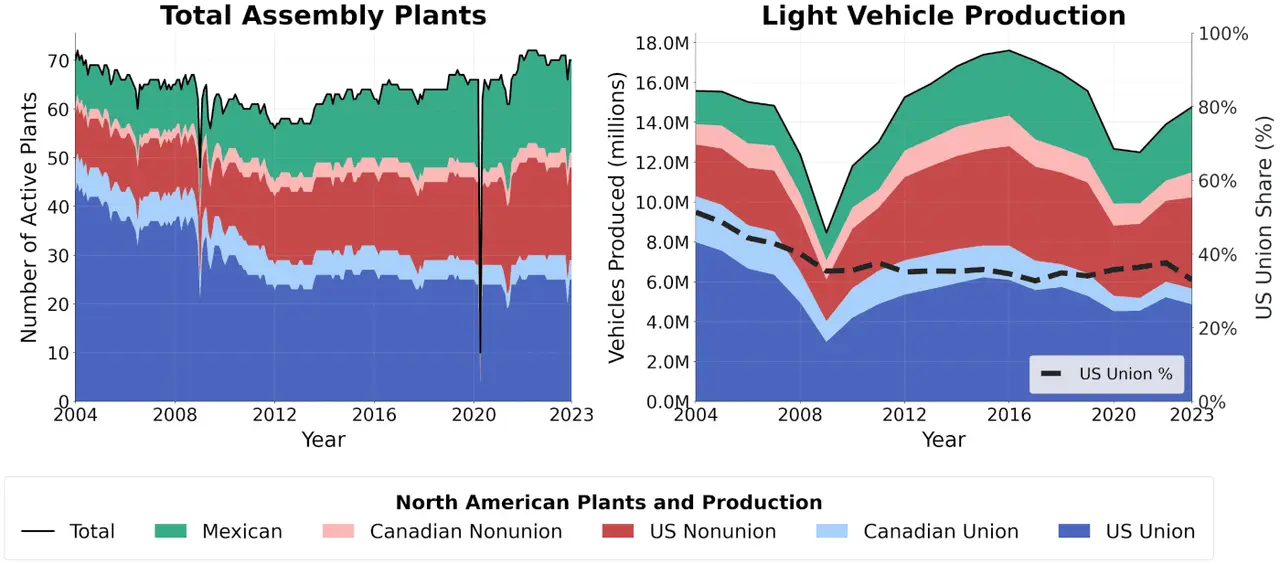
Over the last twenty years, unionized US plants have dropped dramatically from around forty-five down to below twenty-five, with non-union plants in Mexico and the US South increasing to fill the gap (Figure 2).
This restructuring is easily seen by comparing auto employment in a few major states in the Midwest and the South (Figure 1, bottom-left panel). The Midwest workforce dramatically decreased leading up to and during the 2008 crash. Southern states, like Alabama, Kentucky, and Texas, now surpass Ohio and Missouri in assembly worker counts.
With the exception of the recent expansion into the Volkswagen plant, the union foothold has been set by the number of Big Three assembly workers, as well as some parts plants. In 1990, over half a million workers across the entire sector were unionized, including assembly and parts plants. Today, that number is below two hundred thousand.
Average real wages across the entire assembly subsector, accounting for inflation, were relatively flat at around $25 per hour from 1990 until the 2008 crash; after the collapse, wages dipped below $20 per hour (in 2000 dollars; Figure 1, upper-right panel). They have still not recovered, and even the top rate from the UAW-GM contract in 2028 will be below the pre-crash inflation-adjusted average.
Meanwhile, although more challenging to interpret due to periodic economic fluctuations, the productivity rate increase (or the decrease in the number of work-hours required to produce a vehicle) since 1990 outpaces sales growth roughly by a factor of three – 1.7 percent to 0.6 percent per year (Figure 1, bottom-right panel). The decrease in productivity over the last decade – likely due to the launch of new EV manufacturing – is becoming less of a factor, especially with the recent EV reversals.62 This is further evidence that with each restructuring, corporations continue to need fewer workers.
Labor Peace and the Seeds it Buried
To best respond to the shifting terrain, the UAW would do well to tend to seeds planted about a century ago.
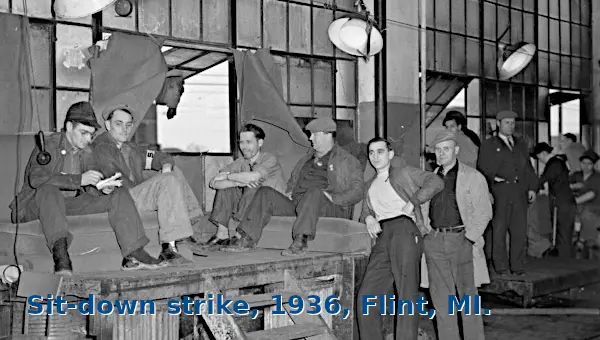
The GM sit-down strike of 1936 took place during a time when industry-wide wins were born from class struggle waged by ideologically-minded militant workers willing to take collective risks and execute aggressive tactics during upsurges. This layer of worker-leaders was made up of organized socialists and other militant trade unionists ready to build fighting strategies.63 Studying history shows that such working-class breakthroughs did not rely solely on spontaneity but rather required years of organization building, political education, and deep connections to the surrounding community.64
But the union-management collaboration that grew during this period of class struggle now has a stranglehold over the UAW. This tendency finally won out when UAW President Walter Reuther signed the Treaty of Detroit in 1950, codifying a regime of labor peace in exchange for a bigger cut of capital’s growth. The UAW agreed to longer contract durations, “no strike” clauses during the life of the contract, stronger management-rights provisions, and an increasingly bureaucratic grievance procedure.65 Decades later, this ideology of labor peace was eventually institutionalized through joint programs, the system of co-governance between the UAW and management that became the vehicle for union corruption and led to further co-optation of the union bureaucracy.66
At my UAW-GM orientation, the joint programs official said nothing about the grievance procedure or shopfloor fights, but repeated the following phrase for what felt like a hundred times: “Don’t be late, be on time, do your job.” The lesson he imparted to hundreds of new UAW members, many of whom were young Detroiters who had never been in a union before, was simple: management is in charge.
Even as individual workers stayed relatively well-off, labor’s aggregate share of capital’s gains plummeted along with UAW membership count after its 1970s peak.67 Worse, over the last two decades, the average share per worker has declined (Figure 1; top-right panel). Yet, throughout this decline, the union’s culture of collaboration and business unionism has prevailed. This perspective has resulted in the UAW focusing narrowly on wage and benefit fights, rather than control over jobs or production decisions.
Under the current UAW administration, the lack of a plan for the future of auto manufacturing is concomitant with Fain’s political approach: a form of progressive bureaucratic unionism that, despite its militant rhetoric, has ultimately been captured by the top-down bureaucracy he previously ran against.68 This limitation stems largely from Fain’s orientation toward internal union maneuvering rather than the rank and file – an approach that quickly ran into political headwinds.69 The fact that only about 7 percent of the UAW membership voted for him in the recent election with 90 percent not voting at all, shows the deep disconnection between the membership and his slate’s program.70 More importantly, Fain’s perspective – as well as recent proposed strategies from UAW organizers – does not grapple with labor’s key barrier: the continued avoidance of fighting for worker control over capital’s decision-making power.71
In this period of limited class struggle, what does it mean for workers to organize themselves with a goal of developing class struggle?
Seeds of Class Struggle Strategy
Workers looking to go on the offense for the long haul ought to revive the class struggle unionism of the further past. Key to this work is continuously identifying where workers have been organizing themselves to fight collectively over their material conditions. Even in a time when the organized left is weak, workers in non-union Toyota plants in the South have been staging walkouts against mandatory overtime, GM workers fought job mergers through work-to-rule campaigns, and parts workers voted down three contracts, to name a few examples.72
In the absence of either a working-class party or a socialist party with a broad working-class character, building independent left organization within industrial workplaces is a way to develop worker-leaders who see both the possibilities and limitations of shop-floor struggles. Shop-floor militancy can improve conditions and win reforms but will not challenge capital’s exploitation at scale on its own. Coming up against those limits advances the conclusion that the fight is not against a single boss but rather the system that every boss answers to, and that winning it requires a revolutionary rupture with capitalism.
Independent self-organized working-class formations anchored by socialists and radicals take years to build and are important both to resist the coercive forces of the union bureaucracy and the ruling class parties and to introduce bold class-struggle strategies to fight for the working class’s future.
Worker-led formations like Unite All Workers for Democracy and the Southern Workers Assembly (SWA) are putting such class-struggle strategies to the test.73 At their core, these strategies begin by recognizing that the working class and capitalist class are fundamentally at odds and focusing on bottom-up militant approaches to expand worker control. Vying for control starts small – for example, resisting unilateral management decisions on the shop floor or winning job security during downturns – but it must expand to decisions over production, the industry, and ultimately, over society as a whole.74 This control concerns political questions about the movement of people and wars abroad as much as economic organization.
UAWD is committed to a “vision of class struggle unionism and fighting to build a militant, democratic UAW.”75 Rather than focusing on reforming the UAW, it has prioritized developing worker-leaders who can draw their coworkers into shop-floor struggles over working conditions and workplace control. That means running work-to-rule campaigns, resisting mandatory overtime, fighting layoffs, and preparing members to strike over economic and political issues like ICE escalations.76 It also laid out a long-sighted vision for a worker-led transition to EVs and public transit.77 UAWD pursues this program in three ways: it supports worker-leaders in building chapters in UAW Locals that are rooted in shop-floor action; it runs trainings on class-struggle unionism; and it carries out a political education program by producing and distributing its publication, Daily Struggle, online and to more than one hundred UAW workplaces.78
There is a fundamental difference betwee