
World Tribune
Films from the Future
The cinema of the Otolith Group is a last stand in defence of a dying revolutionary culture.
English (original) ·Read in Deutsch ⇄
Sometimes, television produces images which manage to capture the neurosis of a national culture better than any theorist ever could. Shortly after the riots which swept through parts of London in 2011, the historian David Starkey appeared on Newsnight. He had been invited on the show to perform and had dressed the part. Wearing a blue suit, paisley pocket scarf, red polka dot tie and looking out from bright tortoiseshell glasses, he gave off an air of theatre and mischief. ‘I’ve just been re-reading Enoch Powell’, he said, stretching out the vowels, trying to repress a smirk at the discomfort he was causing his co-panellists Owen Jones and Dreda Say Mitchell. He flashed his eyebrows above his glasses before continuing — he had practiced his lines in the mirror and wouldn’t be stopped from getting to them — ‘. . . . the rivers of blood speech’. At one point he drew from his pocket a transcript of a text sent by one of the looters and read, in SMS speak, a message about the ‘dem pigs’. Then came the crescendo. There is only one conclusion to be drawn from the multi-racial make-up of the riots, said Starkey: ‘The whites have become black’.
Jones and Mitchell leapt to denounce him and the show descended into accusation and recrimination. But beneath the cross-talk there was something interesting going on. Starkey wasn’t just making a racist assertion; he was publicly mourning the death of a particular form of culture, what used to be called a culture of deference. Here is the working-class boy, now a kind of Tory, from a former Labour-voting family, dressed up in his suit and tie, doing his best impression of an aristocrat, and lamenting the fact that the youth looting shops and confronting police have none of this admiration for their betters. If rioting has any political meaning, it is disrespect for authority.
I thought about this episode, which I watched live, when I first saw John Akomfrah’s Handsworth Songs (1986), another account of rioting and the decline of deference, a few years later. The documentary runs along two parallel tracks: scenes from the riots and community meetings by victims of police violence, along with footage of Windrush arrivals from the Caribbean dressed in suits who give the impression that they would unironically have referred to England as the mother country. Stuart Hall described this generation, of which he was a part, as the ‘last colonials’; they still thought that empire was, if not the same as progress and modernity, at least a forerunner to them. Handsworth Songs is about the disappointment of these expectations, reflected in contrasting images of prim and proper middle-aged Caribbean men and women and younger generation in jeans and t-shirts strutting through the streets past lines of police. As anti-racist organisers tell the camera how police violence and harassment sparked the unrest, the comparison with 2011 is hard to miss. The outburst of 1985 was triggered by the death of Cynthia Jarett, the grandmother of the grime artist Scorcher, from a heart attack after a police raid; the later eruption was set off by the killing of Mark Duggan in Tottenham.
Handsworth Songs was met with a hostile review by Salman Rushdie, who was a year away from publishing The Satanic Verses and presumably had the book’s concerns with multicultural urban Britain in the late-twentieth century in mind. He found something frustratingly avoidant in Akomfrah’s film:
There’s a line that Handsworth Songs wants us to learn. ‘There are no stories in the riots.’ It repeats, ‘only the ghosts of other stories’. The trouble is, we aren’t told the other stories. What we get is what we know from TV. Blacks as trouble; blacks as victims; Here is a Rasta dodging the boat; here are the old news-clips of the folks in the fifties getting off the boat, singing calypsos about ‘darling London’.
As clumsy as Rushdie’s critique was, it seemed to be grappling with a bigger question. Was there something harmfully obscurantist about a cinematographic style which offered its own interpretation of social reality rather than taking its cues from its subject? Was this an approach inherently at odds with documenting minority life in the metropole? Rushdie claimed that better, non-clichéd representations of black life could be found in the art of the Harlem renaissance and, incredibly, Maya Angelou. He might also have pointed to the kitchen sink cinema of Horace Ove’s Pressure (1976), a work admired by Akomfrah. Yet whatever we think of these judgements, his criticism posed a stark choice: either cinema about black life could be at most a kind of playful social realism or, if it ventured beyond these confines, produce alienating and disorientating images.
While Akomfrah has steered a middle path between these poles over the course of his career, others jettisoned realism altogether and embraced the aesthetic of alienation. The British experimental film collective called the Otolith Group, founded in 2002, are the standard-bearers of this genre, which takes Rushdie’s criticism as a provocation — depicting the collapse of faith in imperial Britain and its universal promises through the medium of theory-inflected documentary.
In an interview with Kodwo Eshun and Anjalika Sagar, the Group’s founding and only members, Akomfrah interpreted the challenge they were trying to overcome as follows: ‘if you’re Black and British, and you live in the UK, there’s a hierarchy of expectation about how you enter the cinematic frame. There’s a way in which Blackness is positioned vis-à-vis the cinematographic machinery.’ This anxiety was typical of the mood of many artists in 2020. At the height of the Black Lives Matter protests which swept across parts of the rich world following the death of George Floyd, images of black figures were everywhere, and the atmosphere it created for black artists was stultifying, creatively, politically, intellectually. In this atmosphere of ubiquitous representation, the Otolith Group channelled a discomfort with the all-too-recognisable, a suspicion of received images and the conformism they inspire.
They got there through a somewhat circuitous path. The collective kicked off with three films Otolith I (2003), Otolith II (2007) and Otolith III (2009) which were loosely inspired by Chris Marker’s Sans Soleil (1983). In Marker’s film, we hear a woman read a letter by a fictitious filmmaker, Sandor Krasner, about a film he would like to make, her voice overlaid with images of that film. In Otolith III we see characters cast roles for themselves in a murder mystery and describe how they would act were they in the film whose fragments we are watching. For the Otolith Group, the cinematographic image comes with baggage because it is so tied up with the legacy of colonial-era photography. One hypnotically read monologue from Otolith II describes seeing so many images of Mumbai sold by vendors in markets; each a generic photo of street scenes, families, farmers, flattened out into a series of archetypes. ‘If I could, I would withdraw them all from the market’, our narrator tells us, before wondering whether this would simply ‘create a new demand for old photos’.
Yet producing novel images is equally difficult. As if responding to Rushdie’s insistence that we pay attention to the quotidian realities of black life — Eshun and Sagar began their careers when the language of political blackness was still in vogue — the camera turns from the montage of stock images to film footage of the site of an old factory. Surely here we will see what everyday life in Mumbai is really like? Instead, we watch a crew assemble red metal sheets into the shape of a London phone box: some kind of cops and robbers film is being shot with Indian actors wearing flat caps and the city’s river filmed to look like the Thames. Eshun and Sagar push the viewer to the realisation that even the most candid images of quotidian life can, in our globalised world, produce only generic scenes.
These three films set the coordinates for the Otolith’s Group’s later projects: a global perspective which combines, in non-narrative fashion, reflections on the colonial and post-colonial history of India and Ghana — the directors’ countries of origin — but always with an eye to producing visuals that are slightly askew and fragmentary. Running consistently through this undertaking is a kind of futurism: the idea that technology has produced a culture which requires new ways of thinking, which can be trialled in cinema even if they are absent from the world of practical politics. Sagar came to these ideas through her studies in the early new millennium at the theory-heavy Middlesex University, where the Centre for Research in European Philosophy acted as the UK’s outpost for postmodern French thought. She and Eshun are part of the generation of artists that emerged in the arid period after the defeat of socialism and the start of the War on Terror, when the weakness of the actually existing left prompted a flight into new imaginative realms.
All sorts of wild ideas flourished during this interregnum. Eshun started his career writing in the similarly theoretical world of 1990s music journalism. Back then one would find names like Deleuze and Battaile in the pages of NME, woven into criticism of house and techno. Eshun was resolute that theory was essential to understanding these emerging globalised genres. He insisted on this point in a 2008 interview:
For me, it seems far more urgent to understand what computerisation is doing to rhythm than to understand that a particular musician was a bad boy who grew up in care and had a really hard time. 99% of writing is still socio-historical and my attempt to totally destroy that is probably doomed to failure, but it’s an experiment to show that it’s viable, using the particular example of black electronic dance music, machine music, computer music
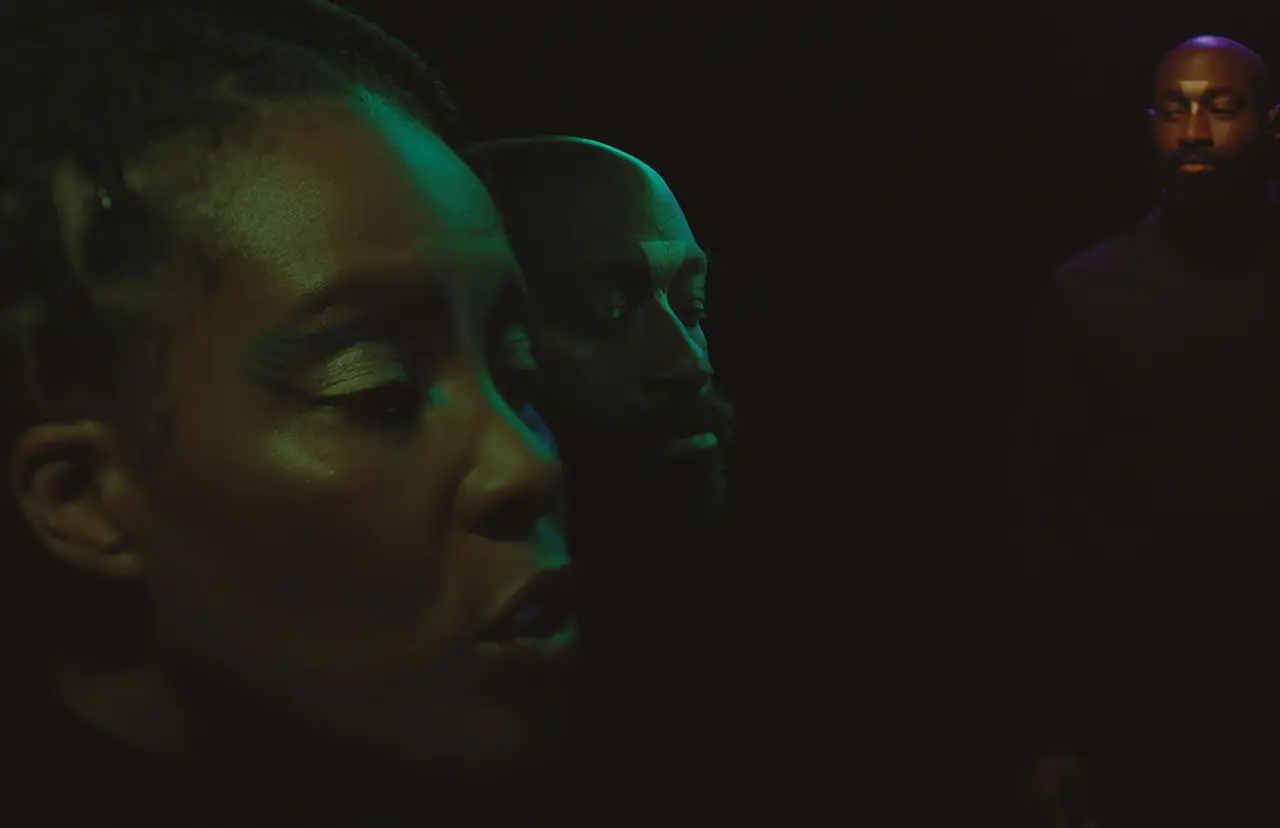
There is a commitment here to detaching sound and image from its context to understand its real meaning, even if that meaning is then rendered obscure, alien, perplexing. This became Otolith’s principal pursuit. The Group’s filmmaking, which continued into the 2010s and 2020s, is a holdover of this tradition of unapologetic theory today deprived of its popular organs. One encounters ideas in bold impressionistic bursts in films like Infinity Minus Infinity (2019), with snippets of deliberately disorientating dialogue:
The inhuman as a natal condition is both person and matter. There’s a forced intimacy in the inhuman. Particularly through slavery, but also tied together with the genocide of indigenous people. That forced intimacy provided geopower for colonizers. It provided the colonial settlement of the surface. As a white surface. It used the enslaved like batteries, like an energy force, to be expanded across the globe. . . . so what do we mean when we say black lives matter? What kind of ‘matter’ are we talking of?
To treat passages like these as if they were advancing a thesis of some kind would be to miss the point. They’re closer to a stream of associative thinking which, when combined with certain images — free jazz and modernist dance in this case — produce a productive kind of confusion. It is as if there is a world in which these thoughts make sense, but it is not our own, at least not yet.
Often, this futurist tendency involves an attempt to bypass the present and cut loose from its confines, conflating the rejection of realism with mere detachment from reality. But this is not always the case. O Horizon (2018), the Group’s most compelling film, blends the poetry of the West Bengali writer Rabindranath Tagore with fragments of the region’s musical, dance and literary traditions. Groups of genteel students at Visva-Bharati University read Tagore’s verse aloud, laborers recite it as they lay down railway tracks, dancers move to it in unison. This kaleidoscopic picture of India evokes Wang Bing’s snapshots of China, yet the flow of imagery is gentle, free of the neurosis common to much documentary that the meaning is being imposed from the outside. This is an immanent work, rooted in its setting, which reflects on what it would look like to create the kind of experimental communities Tagore envisioned, in which art and education harmonise with the natural environment, producing a world beyond the grip of empire. In O Horizon the escape from convention is not just temporal — travelling forward into the future — but geographical, transporting the viewer to a place on the peripheries where dissident legacies still linger.
The outlook of the Otolith Group feels remote today. How many still read A Thousand Plateaus, pencil in hand, to try and understand what a rhizome is? How constructive is it to understand our era as a post-colonial one, with Europe, at least a decade into its Century of Humiliation, drifting further into irrelevance? Hasn’t the battle against social-historical interpretations of art and music been lost, with criticism resigning itself to potted biography? Maybe. But this has lent the Otolith Group’s film the aura of an artefact. One feels as if one is watching some member of the Politburo, recently reanimated, give their thoughts on the Lysenko affair. This last stand in defence of a disappeared culture is, in a strange way, in line, if not allegiance, with Starkey’s theatrics. But in Otolith’s films what we are invited to mourn is not a conservatism defeated, but a revolution that never arrived.