
Migration Tribune
‘Earned Settlement’ Is a Viscious Attack on Migrants
Behind the government’s talk of ‘fairness’ is a major intensification of the hostile environment.
English (original) ·Read in Deutsch ⇄
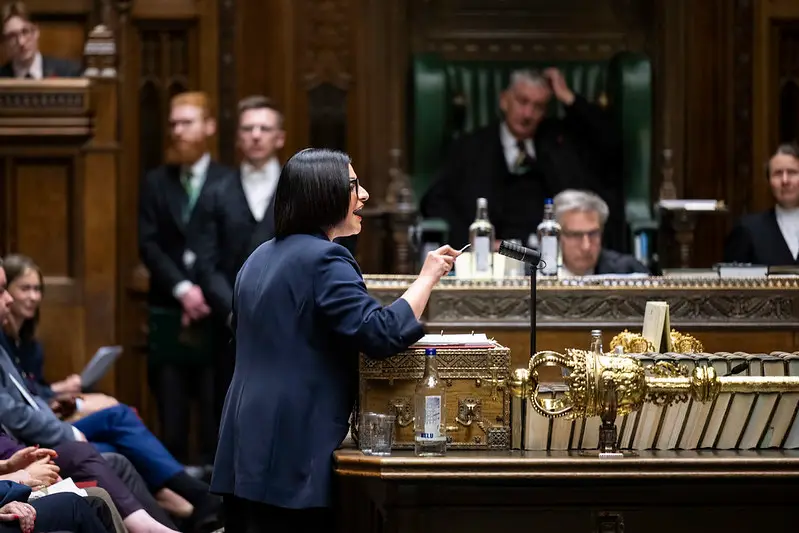
On November 2, Home Secretary Shabana Mahmood announced that she will officially make the process for migrants to acquire permanent immigration status in the UK significantly longer, harder and more expensive. For some, it will now simply be impossible.
Mahmood’s flagship ‘earned settlement’ policy substantially restructures the immigration system. In an address to parliament, she explained that settling in the UK ‘now depends upon a contribution made and responsibilities met’. The policy doubles the length of the standard pathway for most migrants from five years to ten, and introduces significantly longer timelines of twenty or even thirty years for those judged to be ‘non-compliant’ with the immigration regime, for reasons such as overstaying a visa or seeking asylum after arriving by a small boat. Those with a criminal conviction will be barred from settlement forever.
Media responses to the announcement have failed to capture just how extreme these changes actually are, instead focusing on a partial U-turn that exempts migrant care workers from a proposed fifteen year wait to settle. The Guardian, for example, led with ‘Shabana Mahmood softens immigration plans’, while the BBC went with ‘Mahmood scraps settlement plans for migrant care workers’. Following the lead of Conservative shadow Home Secretary Chris Philp’s description of the policy as a ‘capitulation to the open borders left’, The Telegraph declared: ‘Mahmood waters down migrant crackdown’.
In reality, earned settlement signals a major intensification of the hostile environment and targets nearly every person in the immigration system — a fact that claims of ‘softening’ or ‘capitulation’ completely obscure. Rhetorical ‘contributions’ and ‘responsibilities’ mask a punitive regime that will impose real harm on millions of people as punishment for circumstances they have little or no control over. And while Prime Minister Andy Burnham throws his weight behind Mahmood’s rules as a ‘fair’ way of ‘gripping this problem’, the changes run directly counter to his headline-grabbing commitments to address homelessness, child poverty and violence against women and girls, revealing the total hypocrisy at the core this government.
Immigration for the Wealthy
Above all else, these new immigration rules judge migrant people according to their fiscal contribution, rewarding high earners and penalising those facing destitution. Once the changes come into effect in 2027, applicants earning over £125,141 per year will be able to settle after just three years, while those who access public funds will be forced to wait up to twenty years.
For many migrants, life on the pathway to settlement is a relentless cycle of saving and borrowing money for immigration fees, preparing applications, waiting for decisions, repaying debts and then saving for the next application — all while working long hours in poorly-paid and demanding jobs, raising families and caring for elders. The costs of migration quickly pile up: until they acquire settled status, migrants are required to renew their UK visa every two-and-a-half years, and the standard cost for an individual renewal is currently £4,000, or £5,000 for a ‘super-priority’ service.
All it takes is an unscrupulous lawyer missing a deadline or a change in financial circumstances that makes the next application unaffordable for someone to fail to renew their leave in time. Under the incoming earned settlement regime, that person will now be subject to ten additional years of immigration insecurity as punishment for ‘non-compliance’ and branded an ‘overstayer’ who is barred from working or renting accommodation.
Most people on the pathway to settlement already have a ‘no recourse to public funds’ (NRPF) condition attached to their visa — estimates from 2025 put the number as high as 3.6 million people. NRPF blocks them from mainstream welfare support, including Universal Credit, homelessness services and other benefits, leaving them with scant protection from crises such as redundancy, ill-health or domestic violence.
The impacts of NRPF are as glaring as they are predictable. Non-UK nationals make up less than 10 percent of the population, but 25 percent of the homeless population. In London, it’s over 50 percent. Over 380,000 children] are estimated to be living in poverty due to the restriction, and eight out of ten low income families with NRPF regularly go without essentials like food, clothing or heating. NRPF also bars women from support services and pushes them into situations of exploitation and vulnerability; rates of violence against women and girls are three times higher amongst those without access to public funds than in the wider population.
Every year, a few thousand people — less than 0.1 percent of the population subject to NRPF — complete an immigration application that allows them to access welfare support. Applicants must be facing destitution, exceptional circumstances such as disability or child safeguarding concerns, and meet strict evidence thresholds. The majority of people who make these applications are women with children, while a significant proportion either have a disability themselves or care for someone who does.
Yet now, anyone who does manage to access public funds will receive a sanction of up to fifteen years — a policy change that exemplifies the true viciousness of the new regime.
Rowing Backwards
Earned settlement won’t stop people in dire straits from seeking support when they have no other options, but it intends to punish them when they do. The government’s policy document does offer a vague intention to explore whether exemptions to the public funds sanction are appropriate for vulnerable groups. But given that migrants already have to evidence acute vulnerability in order to lift the condition, it’s hard to imagine an appropriate safeguard short of completely abandoning this element of the plans.
It’s revealing that Labour’s Child Poverty Taskforce, formed only two years ago to ‘address the root causes of child poverty in the long term’, explicitly committed to ‘ensuring that vulnerable migrant children receive the support that they require, regardless of their immigration status.’ Similarly, the Labour government’s VAWG Strategy, published less than a year ago, pledged to halve violence against women and girls. And as mayor of Greater Manchester in 2023, Burnham himself wrote to Suella Braverman, then home secretary, highlighting ‘the incoherence between commitments to end rough sleeping and current asylum and immigration policies that drive homelessness’, and called on her to ‘end NRPF in order to end rough sleeping.’
Barely three months into his premiership, he’s signed off on a policy that will deliver the exact the opposite of these promises.
The government may say that earned settlement is about fairness and reciprocity, but those who are underpaid, fall ill, have a disability or experience abuse cannot expect this Labour Party to treat them with fairness. Despite their last minute carve out for care workers, Mahmood and Burnham have still shifted the goalposts for millions of people, dramatically altering their prospects and inevitably driving them into deep poverty, homelessness, exploitation and danger for years to come.