
Migration Jacobin
Kurds Have Become Britain’s Latest Demonized Migrants
During the war against ISIS, the Kurds were feted in Britain as heroes. Today the stateless Kurdish population is increasingly demonized as a source of illegal immigrants and people smugglers.
English (original) ·Read in Deutsch ⇄
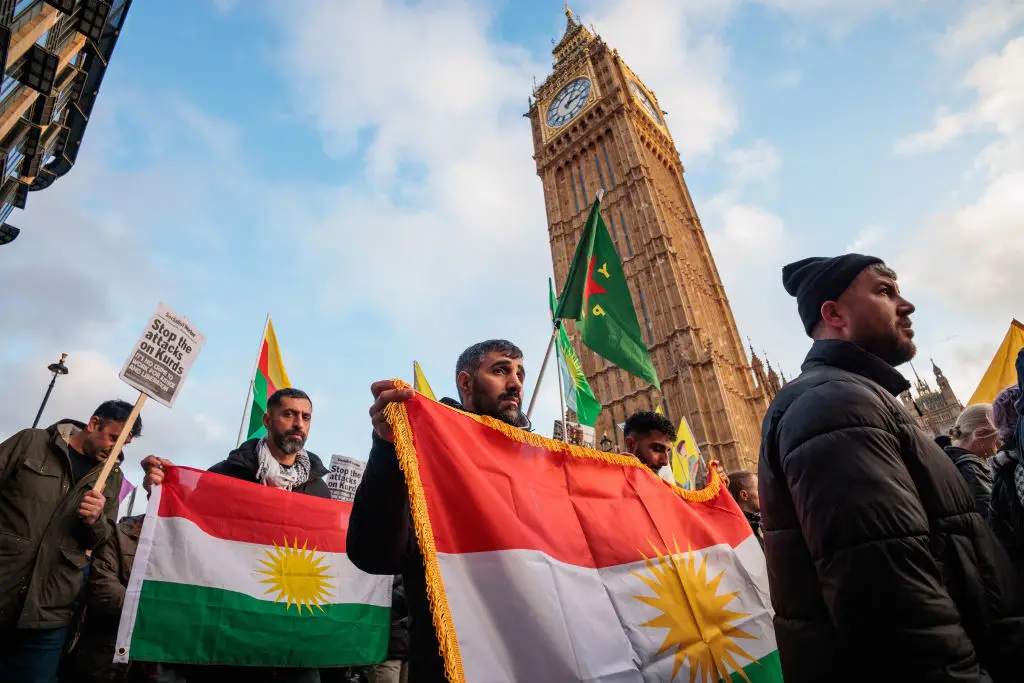
A decade ago, the Kurds briefly figured in Western public consciousness as the feted heroes of the war against the Islamic State in Iraq and Syria (ISIS). In Britain as worldwide, audiences were fascinated by fetishized, orientalized images of “badass” Kurdish female fighters battling the Islamist terror group on the ground, backed by the UK and US militaries. Today the most populous stateless people in the Middle East are making headlines in the UK once again, but this time depicted as people smugglers, organized criminals, and unwanted illegal immigrants.
Broadly speaking, both migrants themselves and the smuggling networks who profit from their need to travel are hysterically depicted as united in highly organized, criminal, Islamic gangs that need to be “smashed” by the UK government. And a recent slew of right-wing media commentary has specifically focused on the Iraqi Kurdish groups, who are admittedly the current top dogs profiting from migrants seeking to make the treacherous journey between Calais and Britain.
This newfound attention feeds into BBC investigative journalism targeting Kurdish criminal networks in the UK allegedly running hundreds of illegal barbers and vape shops, which in turn leads to right-wing attacks on migrant-run high-street barbershops by Nigel Farage and Richard Tice of the far-right Reform UK party, and Robert Jenrick of the even further-right Restore UK. At the extreme, this discourse even leads to incidents like the attempted decapitation of one Kurdish barber by a Bristol neo-Nazi. As Western sympathy toward the Kurds occasioned during the ISIS war finally expires, media commentary and government policy is gradually setting up another marginalized ethnic group as the migration villains du jour.
Another Anti-Migrant Wave
For sure, it’s unlikely that axe-wielding fascists could or would distinguish a Kurd from a Turk or Arab. Likewise, the far-right politicians peddling anti-migrant narratives in Westminster have tended to refer conspiratorially to networks of “Turkish barbers.” Indeed, for better or worse, the Kurds — who number around forty million but have never had a recognized state of their own — have more often remained invisible in British public discourse.
The Kurdish ethnicity only made it onto the UK census for the first time in 2021, meaning that while official figures suggest there are around a hundred thousand Kurds in the UK, community representatives estimate the true figure is several times higher. Some Kurds are assimilated or prefer to refer to themselves as Iraqi, Iranian, Turkish, or Syrian for reasons of personal security or simple brand recognition: many of the UK’s nominally “Turkish” barbers or “Mediterranean” restaurants are actually Kurdish-owned.
On one level, the Kurds are thus simply being swept up in the latest broad wave of anti-migrant sentiment, targeting small boats in the English Channel and small businesses at home. And the same story is repeating itself elsewhere. There are rather fewer Kurds in the United States than in the UK or Europe, but there too recent Kurdish migrants report being caught up in new waves of anti-immigration sentiment. In Germany, cases of anti-Kurdish racism more than doubled in the past year, though this was primarily driven by Turkish, Iranian, and Arabic migrant communities themselves discriminating against the Kurds. Even Japan has seen its own tiny population of around three thousand Kurdish migrants become the key target of a specific xenophobic hate campaign spearheaded by the Asian country’s own far ight.
Kurdish Blame Game
The latest hysteria in the UK can’t be ascribed to the Kurdish ethnicity in particular. After all, the channel crossing has successively been controlled by groups from various nations: Iran, Iraq, Afghanistan, Albania. But this is just why increasingly frequent British media mentions of the Kurds in connection with organized crime are worth tracking.
While terms like “people smuggler” are weaponized by prosecutors and the media to smear and criminalize innocent migrants, Kurdish criminal organizations certainly do profit from the trade, sometimes on an exploitative basis. The Kurds’ long-term statelessness and the occupation of Kurdish-majority regions by Turkey, Iran, Iraq, and Syria has left many of the Middle East’s estimated forty million Kurds occupying impoverished borderlands. Unsurprisingly, some turn to the grey- and black-market trade in legal or illegal goods to survive, including the Kurdish kolbar porters trekking through remote mountain passes between Iran and Iraq who are killed in their dozens every year. Decades of (legal) Kurdish migration have allowed these networks to extend to Europe, laying the foundation necessary to facilitate continued migration amid increasingly tough policing of UK and European borders, and create a profit for certain Kurdish individuals at the expense of others.
Throughout the Middle East, state violence against Kurds has often been linked to racialized depictions of Kurdish minorities as backward, uneducated mafiosos — as in the universally popular Turkish soap operas that frequently represent Kurds as villainous people smugglers and drug traffickers. Related negative stereotypes of Kurds are already somewhat more prominent in continental Europe, influenced by propagandistic Turkish depictions of the country’s domestic Kurdish opposition as narcoterrorists profiting from the European heroin trade, and may now be leaching into UK public policy. The shift recalls the vitriol previously directed toward Albanians during a prior surge in anti-small-boat rhetoric after 2022, and which academics argue directly contributed to UK Foreign, Commonwealth and Development Office (FCDO) policy targeting migrants from the beleaguered Eastern European nation.
While the Albanians at least have a government that can robustly challenge Farage’s salvos, the stateless Kurds are left even more exposed. Ben Judah, the former adviser to Foreign Secretary David Lammy and centrist critic of UK migration policy, has suggested the Kurds’ weak geopolitical position should make it easier for Westminster to crack down on Kurdish migration networks. For Judah, despite the semiautonomous Kurdistan Region of Iraq (KRI) “being under a de-facto Anglo-American security umbrella since the first Gulf War, there has been an unwillingness to put [people smuggling] first in our relations. . . . For Britain, the relationship as we know it should be on the line unless these authorities take this gravely seriously.”
In truth, this work is already being done. The FCDO has funded an anti-migration media campaign in the KRI, copying methods it previously deployed in Albania. More significantly, the BBC’s investigation into Kurdish migration networks led to the arrest of a leading Kurdish people smuggler in the KRI in coordination with the Iraqi Kurdish authorities. When I visited the KRI this summer, an official from the governing Kurdistan Democratic Party (KDP) stressed their ongoing cooperation with the British authorities to curb illegal migration, which was also the headline when Britain’s National Security Advisor visited the KRI earlier this week.
Though never numbering more than a few thousand per year, migrants from Iraq (most of them Kurdish) figured in the top five nationalities arriving in the UK via small boats from 2021 to 2023. They have since dropped out of the rankings. Relatedly, the latest figures suggest overall irregular migration out of the KRI has fallen by half in the past six months. None of this suggests an unmanageable crisis so much as the latest bout in the game of whack-a-mole in which one migration network loses control to another, and another set of desperate people are driven to seek a new life abroad, whatever the risks.
Expiring Partnership
In fact, the UK’s domestic shift against the Kurds comes amid related developments on the international stage. Judah correctly notes that the geopolitically isolated KRI, which was established by Western diktat following Saddam Hussein’s genocide against the Kurds and subsequent US-Kurdish cooperation during the two Gulf Wars, has long been reliant on these partnerships in order to survive. But rather than a cozy, mutually beneficial relationship, the Iraqi Kurdish authorities are currently being placed under severe security pressure by Westminster and Washington.
The US has withdrawn all its troops from the KRI and cut all security, essentially terminating the decade-old partnership that saw Kurdish ground troops defeat ISIS in coordination with Western air strikes, intelligence, and logistical support. The UK has unsuprisingly followed suit, withdrawing its own troops long stationed in the region. These moves repeat recent developments in neighboring Rojava (Syrian Kurdistan), where Kurdish forces that had lost twelve thousand fighters battling ISIS were this January forced to capitulate to the rule of a new Islamist government in Damascus after the United States finally terminated its cooperation with the Syrian Kurds. The Iraqi Kurds are now being left similarly exposed — not only to a potential ISIS resurgence but also to violent attacks by Iran-aligned militias in a febrile Iraq that is set to be the Middle East’s next battlefield and cross-border attacks from Iran itself.
Alongside their newfound status as migrant criminals, some Kurds are still making headlines as key Middle Eastern players — but no longer as heroic Western allies. Tehran has long repressed its own Kurdish population, executing hundreds in recent years. As the United States and Israel launched their disastrous war on Iran, US officials signaled and then rapidly aborted plans to arm unspecified Kurdish opposition groups. Donald Trump subsequently distanced himself from the proposal, announcing he was “very disappointed” with “the Kurds” who just “take, take, take,” adding “I think it’s a disgrace. . . . I’ll remember that,” and claiming that Kurdish forces illegitimately intercepted weapons shipments. As ever, these allegations were leveled at “the Kurds” in general, painting a whole people represented by a diverse range of political movements as mercenary and untrustworthy.
When I was in the KRI, both the governing authorities and exiled Iranian Kurdish armed groups stationed in the region strongly denied these allegations, with KDP spokesperson Hoshyar Siwaily telling me: “Although we are partners of the US, we would like to stay neutral, because this war is bigger than us. We don’t want to be part of it.” That hasn’t stopped Iran from launching more than seven hundred retributive strikes against the KRI, killing dozens of people — more than any other noncombatant country. The West is gradually closing the door on its erstwhile allies, even as Iran revenges itself on the Kurds.
Anti-Kurdish Alignment
With the Kurds abandoned by the West and targeted by the East, it’s little wonder that many still need to flee the region. The structural factors that drive Kurdish migration to the UK — and occasional involvement in criminality — are only likely to worsen in the coming years. Seriously tackling Kurdish migration to the West would mean tackling these regional “sources of conflict and insecurities” at their root. Conversely, however, the stage is being set to demonize those Kurds who flee future bouts of instability driven by the West’s regional interventions and repeated instrumentalization of the Kurdish cause. Western governments and right-wing media will find it increasingly convenient to join the likes of Iran in vilifying the Kurds, the one issue on which everyone in the Middle East seems to concur.
Below the line, commenters on right-wing news sites like the Daily Express and Daily Mail still generally confine themselves to the usual diatribes against migrants in general. But some are clearly picking up on the Kurds’ newfound prominence within this familiar rhetoric. Commenting on a story blasting the Kurdish networks between Calais and the UK as “brutal criminal kingpins,” one writes: “Saddam had the right idea about how to deal with these lot. . . . ” It’s a call to repeat the Iraqi dictator’s 1987–89 massacre of around a hundred thousand Kurds, a crime officially recognized as genocide.
This article originally appeared in Jacobin, a democratic socialist magazine publishing long-form essays and analysis on politics, economics, and culture. Subscribe to the print edition for $20 a year.