
World Tribune
A City in Progress
An exhibition at MoMa PS1 captures the artmaking of the Mamdani moment.
English (original) ·Read in Deutsch ⇄
The exhibition Greater New York opens onto a wall-size mural, with the title hand-painted in shadow case next to primary-color depictions of a video camera, an abstract canvas on an easel and a classical bust. Painted beneath them are the tools of the trade, brushes and cans of paint, as well as a slice of pizza and two rats. These look more like mice but we know they are rats because pizza + rats = NYC. All of these elements are set in front of a plain brick wall framing a window with a view onto the Queensboro Bridge and beyond it, the Manhattan skyline.
The very literal, figurative style of the octogenarian Cevallos Brothers, the creators of the mural, telegraphs a clear meaning. This exhibition is about art and New York City: a Greater New York that is situated at a distance from the skyscrapers and blue chip art galleries of Lower and Midtown Manhattan, in the humble borough of Queens. Greater New York is a quinquennial survey of work by mostly emerging NYC-based artists, now in its sixth iteration since the gallery PS1, once a bold alternative art space, merged with the Museum of Modern Art at the turn of the millennium to become its satellite kunsthalle.
The relationship of MoMA PS1, as it was rechristened, to Queens has been through various stages. The borough, long synonymous with suburbanite striving and immigrant inscrutability, was an awkward fit for MoMA, which temporarily relocated there in 2002 amid a major expansion. Over the years, the industrial environs of PS1’s abandoned schoolhouse grew up to become the anodyne condominiums of Long Island City. The institution oriented itself toward a wider public, luring them to popular summer dance parties in a walled-in concrete courtyard used for annual architectural commissions.
A group of young urbanists tried in 2011 to tap into the emergent everyday coolness of Queens and connect the art fortress to its surroundings. Their temporary installation incorporated new benches eventually used by drivers idling at a nearby taxi garage, mirrors for a neighborhood ballet school, and so on. The impulse was spot-on, but at the time the immediate surroundings were not very colourful. Now, a decade and a half later, the courtyard walls are slated to come down and the Cevallos Brothers’ work hangs in the galleries upstairs, reflecting a series of wider shifts.
Carlos and Miguel Cevallos spent many years creating posters advertising cubetazos (a bucket of six beer bottles on ice) and promoting the Mexican and Colombian bars along the commercial strip of Roosevelt Avenue. In 2018, a new neighbour began to share their work on Instagram, bringing late-career recognition and commissions for signs for Pilates studios and record stores. The popularity of these hand-drawn works is not an anomaly: the nephew of the last numeraio — makers of traditional signs for small Neapolitan businesses — has also launched his fruit price labels to acclaim on social media and beyond; the filete painting of Buenos Aires was once used to decorate public buses and is now UNESCO intangible cultural heritage. The locally authentic is ascendant. But the Cevallos Brothers’ work is a more globalised vernacular. Born in Ecuador, they honed their craft in Colombia before establishing themselves in NYC. Their style and trajectory are cultural expressions of the ‘world’s borough’, as Queens became known thanks to the two world’s fairs it hosted, in unwitting anticipation of its growing immigrant population — now the most polyglot on the globe.
New York City is a place that ‘stole the idea of modern art’ from the European avant-garde, as the art historian Serge Guilbaut writes, and refashioned it into the ‘political apoliticism’ of the post-war Pax Americana. For decades, artists like Jackson Pollock and later Richard Serra could make big work and big money by filling in spaces in institutions like MoMA, purpose-built for such world-stage heroics. The city was the centre of the art universe. But now its potential loss of market dominance is causing alarm.
Just before the exhibition opened in April, the artist Josh Kline published a viral essay blaming ‘New York Real Estate’ for ‘the Ruin of American Art’. This document of entitlement and myopia argued that because rents in New York are so high (true), artists, forced to work multiple jobs and unable to afford large studio spaces, can no longer create the ‘innovative’, or large-scale and capital-intensive, art of the kind that once allowed the presumptive forebears of the author of the article, a midcareer sculptor with gallery representation and a retrospective at the Whitney Museum of Art, to live a comfortable life.
A recent report from an urban development think tank similarly warned that while ‘the creative sector is more critical than ever to New York City’s economy. . . . mounting affordability challenges threaten its future.’ The researchers noted a decline in ‘resident artists’, with anecdotal examples of a MoMA-exhibited sculptor who went back home to St. Louis and a 13,000 square foot studio/warehouse, or Zadie Smith’s post-pandemic return to London, as well as stats which suggest that the city’s art worker losses could be Nashville, Dallas and Miami’s gains.
The NYC-based, globally-extended Pace Gallery has since reinforced this narrative with its announcement of a corporate-scale downsizing, dropping fifty staff members and fifty artists. In his essay, Kline constantly returns to the unaffordability of Brooklyn and Manhattan. They stand in for the city as a whole, as if these are the only places where art is made, though they represent a mere fraction of the population and area of Greater New York. But you could also live or work in Queens.
At stake in these different definitions of a ‘New York artist’ is whether art itself is defined by use or exchange, calling or career. The show at PS1 suggests a different way of being globally central and a different way of making art. Less art as commodity, more arts de faire. The curation was a collective endeavour, with 53 artists selected by the seven-person curatorial staff. Some of the most interesting work plumbs urban space and its porous boundaries, as well as giving form to the crushing costs of contemporary living.
A large double-height space just off the building’s entrance is given over to a two-channel video installation — the kind of large and costly production that Kline claims is facing extinction — by Taiwan-born Poyen Wang. Two screens mounted to frames of metal scaffolding, a flaccid traffic cone between them, play a video in which an animated figure is trapped inside a decrepit house, hemmed in by scaffolding. ‘You are not sure where you are’, says the voiceover, above a soundtrack of Chinese love songs and excerpts from US immigration questionnaires. The figure is mired in confusion of day and night, mother tongue and other, home, here, and there. At the end of the video, strobe lights flash in the gallery space, punctuating projected close ups of domestic objects and surfaces: a lamp, a phone cord, a tabletop. It conjures Walter Benjamin’s description of Eugene Atget, photographing Paris as if it were a crime scene: ‘but is not every spot of our cities the scene of a crime?’
Many of these crimes register in interiors, where they are less visible, more insidious. Elsewhere in the show there is a recreation of a Bushwick club, all wood wall frames, beer cans on the ground; it is after the party has ended, dark, a little ominous. A karaoke video plays, telling an indigenous story of a trickster rabbit and a man-eating hill, suggesting a scene of both original colonial sin and eventual revenge. An installation of photos by Queens-born Dean Majd, with images of members of the Palestinian diaspora in NYC interspersed with scenes of friends and family in the West Bank, is hung overlapping, up and down across two red-brick painted walls as if in a suburban den or a photo album spread. At the centre is a large portrait of Mahmoud Kahlil, a permanent resident persecuted by the Trump administration and threatened with deportation for Palestine solidarity. He appears with his wife and the baby daughter born while he was detained for 104 days in a Louisiana jail, the trinity lit like a Flemish painting.
In 2017, Cinthya Santos Briones, trained as an anthropologist in Mexico, began photographing people who have taken up residence in churches to avoid deportation and family separation, in her series ‘Living in Sanctuary’. In one powerful image, two young women chat sitting on a church pew, hair wrapped in orange and yellow towels and bathed in golden light, marrying a cozy domesticity to an unfathomable reality. In another photograph within a photograph, a verdant garden path has been pinned to a greying wall like a portal out of captivity to a heavenly realm.
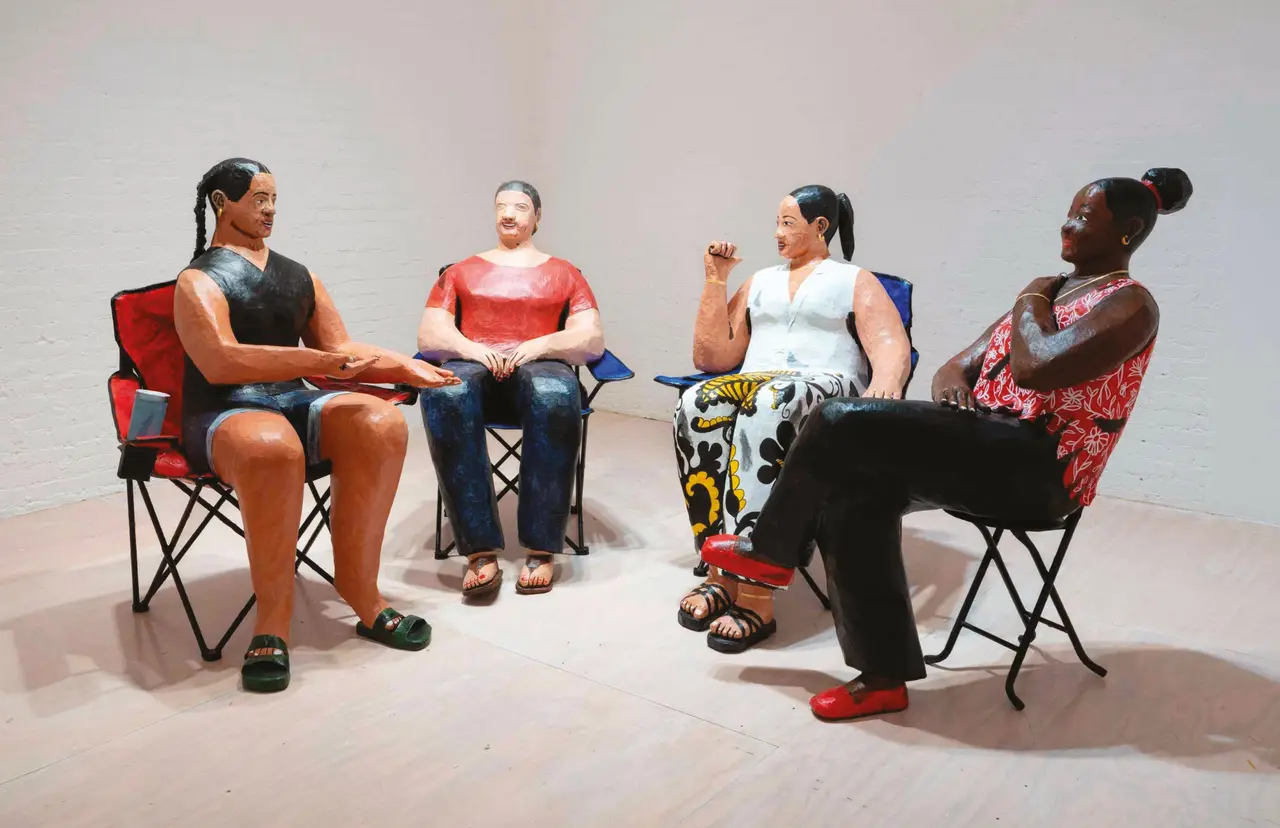
The best work on view communicates directly, in a style that reverberates with the Mamdani moment — the backdrop and referent for much of the show. The two share a celebration of everyday urban culture and collectivity, as well as a simple moral clarity. Protagonists of the exhibition reflect the Mayor’s coalition of bodega owners and halal cart operators and taxi drivers, but also deliveristas and sex workers (most of whom, of course, can’t vote). The work of Queens-born Piero Penizzotto — a disciple of John Ahearn, who beginning in the 1980s created plaster casts of Bronx neighbours displayed as sculptural reliefs of Great Men and Women and Children — is a direct product of the city. His life-size papier maché people are not cast or frozen but full-bodied and fully alive. In ‘The Council of las Tías’, which represents his fiancée’s aunts, the four women hold court as if on the sidewalk outside their building, in a semicircle of folding camping chairs. Sculptor Dean Millien’s display of cats and rats made out of aluminum foil like so many swans, creepy on close examination, could at a glance be an homage to the city’s bodega cats: collective pets and guardians of public health who keep the rodents at bay.
Another artist originating in Queens, Kenneth Tam, weaves the experiences of NYC taxi drivers into his work. An undulating cityscape composed from wooden-beaded car seat covers and blinking lights resembles the aerial approach to JFK airport. The supposedly chiropractic beads are associated with the city’s yellow cabs, whose owner-operators were the victims of a devastating municipal revenue scheme that led to crippling debt, a spate of driver suicides, and a yearslong campaign and fifteen-day hunger strike for relief. In a video projected above the beadscape, two drivers, brothers, perform movement exercises on a hard gymnasium court, a kind of bodily liberation from enslavement to their vehicles, as they speak about the system that failed them, and the disappointment of finding themselves, after 44 years in the country, right back where they started — yet still ‘staying hopeful and strong’, as the piece is entitled.
The art/activist collective Red Canary Song brings together and advocates for migrant massage workers in Queens, women isolated and criminalised twice over. At PS1, they stage a banquet overscripted with the sound of women reading love letters to their ‘sisters’ in Korean and Chinese. The city’s delivery riders, who surged in number through the pandemic and most recent wave of migration, undocumented and ignored by customers, employers and regulators, are represented by proxy. Photographed by the artist fields harrington, their electric bikes represent both critical infrastructure and a means of self-expression: enhanced with hand mitts and mud flaps, wrapped in colored tape like tennis rackets, appliquéd with decals representing the Virgin Mary or the African continent. Some of these photos are flash-bulbed, catching the bicycles in the act as they are affixed to signposts or propped against scaffolding. Others are chained to the city’s official bike docks. One of them, easily overlooked, is bolted to the gallery floorboards in front of the ‘Greater New York’ mural: a collaboration with Gustavo Achje, a rider who has led efforts to demand fair pay and safe working conditions for the city’s app-based delivery workers, including a pilot hub where they can charge batteries, fix their bikes, and rest, which was rolled out during Mamdani’s first 100 days.
A slide show of another category of ‘Men at Work’ scrolls through photographs collected by the artist Marie Angeletti over the last ten years and in various cities. The New York scenes are instantly recognisable from all the scaffolding in the frames. Sometimes labourers are photographed installing it, sometimes using it to do pull-ups. These ubiquitous supports for construction and rehabilitation have become another urban emblem, like the dollar pizza slice (now $2) and the rat, that makes a sort of virtue out of a quality-of-life conundrum. Scaffolds are central to Wang’s Night Stroll video, where he remarks that ‘the whole city seems to be falling apart at any moment, requiring these metal skeletons to hold it up.’ They also hold up Covey Gong’s sculptural red pictograms and totems, one framing a video of the Unisphere: that skeletal globe icon of the 1964 World’s Fair, held in Queens, which one realises is yet another scaffold. Omnipresent, everyday, singular, structural: scaffolds are signs of the city as a work in progress and as something we are barely holding together. A related type of art on display samples and salvages disappearing surfaces and failing infrastructures: old signs, urban fragments, panels of LED advertising light boxes stripped bare to reveal their imperfections. (There’s a little nod there to Duchamp, the object of a massive contemporaneous retrospective at MoMA; and elsewhere a sculptural homage to Klee’s Angelus Novus, who also flew to New York for the summer.)
The exhibition’s whole-city approach — we could call it ‘capacious’ — leaves room for many other strains of contemporary urban life. In the same way historians are obliged to begin any urban history with the retreat of the glaciers, some of the inclusions feel more dutiful than productive. There are gestures to celebrity and surveillance culture; water extraction and modes of pre-Columbian exchange; postapocalyptic indigenous ‘survivance’, but make it urban. And yet, perhaps the most beautiful piece in the show is a ‘Coral Dictionary’ by Chang Yuchen. At first glance, the work resembles a display case with pieces of coral, dead and bleached, collected and catalogued by the artist in exquisite graphite drawings. But rather than a melancholy scene of Anthropocene salvage, she has devised a new language, a multispecies Esperanto. In primer-like sentences spelled out in Coral and translated to English, Mandarin and Malay, she has sketched with great poetry and economy a useful phrase book for our confused times:
I can do any kind of work
People from different ethnic groups are connected through national language
They are all colonizers’s puppets
They have already noticed the intense atmosphere out there
There are many tall buildings in
downtown area
Even though I keep working, actually
I’m very tired
The darkness of the night increased the anxiety in his heart
That ancient architecher [sic] has been destroyed by dynamite
Salt can preserve food avoiding spoilage
His salary matches his capability
That the city is our work, and that the city needs work, are two truisms rarely represented. To see that reality reflected back, ennobled, embellished, is both hopeful and realist. Faced with the gap between bright dreams and brutal realities, artists, like migrants, have no choice but to keep working. Policy recommendations to support NYC’s creative economy all land on affordable housing, especially for working artists. But the reminder at PS1 was that rather than regarding artists as a special class to be protected for its economic value (just as some judge the worth of migrants based solely on the uses of their labour), we should all see ourselves as cocreators of our beautiful and vexed environment, in which everyone needs room to do their work and make their art. In this simple framing and against all odds, it almost seems possible to envision a greater New York.