
World Tribune
The Democrats and the World
Will the ‘blue tsunami’ rein in the American empire?
English (original) ·Read in Deutsch ⇄
A Democratic wave has washed over American politics. The full scale of Tuesday’s victory remains to be seen, but it appears to be a historic, extinction-level event for the MAGA coalition that has powered Republican Party politics for the last ten years. Elon Musk openly spent $445 million bolstering Republican candidates (his true expenditures almost certainly surpassed half a billion dollars), yet Republicans floundered, hemorrhaging seats in ruby-red strongholds such as Texas, Iowa, Kansas, and South Carolina. One of the most notable triumphs of the night came from Michigan’s Democratic senatorial candidate Abdul El-Sayed, who won despite tens of millions of dollars in opposition from pro-Israel donors.
It’s unquestionably a positive development, one that will loosen the Republican Party’s chokehold on domestic institutions and civil society, while establishing checks that might blunt the sharpest edges of its death-drive politics. A Democratic majority will also scrutinise the Trump administration, and introduce some threat of accountability for its runaway corruption.
An optimist might also wonder if Democratic control of the legislature will usher in an opportunity to shift fundamental tenets of foreign policy. Trump himself seems to acknowledge that Washington’s enduring commitment to an apartheid, genocidal Israeli-nation-state is a liability. Hours before the election, he floated the cancellation of $4 billion in military aid and asked a stunned Fox News anchor why Republicans should ‘suffer the slings’ from opponents like El-Sayed. And with the country mired in a war of aggression with direct consequences for the cost of living at home, Democrats have a clear mandate to end at least the most overt manifestations of American empire. With significant remit on matters of foreign policy, particularly on appropriations and budgeting, an even more radical transformation of the country’s place in the world could feel within reach.
But the newly energised base might not enjoy such fiat. The Democrats’ out-of-touch leadership and disgraced foreign policy establishment remain committed to the principle, if not execution, of the Trump administration’s wars. There’s a battle raging within the party, and the old-guard elites will do all they can to consolidate their power. For the moment, they still have the upper hand.
The Return of the Swamp Creatures
A few weeks before the election, senior American diplomat Brett McGurk released Brink: Inside the Race to Free the October 7th Hostages, a diaristic account of his time as Joe Biden’s National Security Council Coordinator for the Middle East and North Africa.
Any clear-eyed appraisal would deem McGurk’s Brink to be an unserious, self-exculpatory tract — one that doles out palace intrigue and rationalises costly missteps, while shirking from any critical engagement with the years of genocide that followed 7 October.
But in a sign of things to come, McGurk, a career bureaucrat who has worked for four presidents across both parties, received an enthusiastic co-sign from US senator Cory Booker, a Democrat from New Jersey, and a surefire 2028 presidential contender.
Booker’s nauseating praise for McGurk — calling him ‘one of our nation’s great experts on the Middle East’ and someone who has ‘spent decades working at the highest levels of diplomacy through some of the region’s most consequential moments’ — was a brazen attempt to revitalise the criminal foreign policy elite as their hold on the party appears to be weakening.
Crisis-management may well have motivated the endorsement. Two weeks before McGurk’s book came out, a more worthy account of the same topic was published by journalist Akbar Shahid Ahmed. Crossing the Red Line: Biden, His Advisors, and Israel’s War in Gaza arms readers with an actual first draft of this history, an antidote to McGurk’s gulling account. A reader of Ahmed’s work will discover a bête noire in McGurk, a man who one Biden administration official described as ‘Israel’s lawyer’ and another as ‘an unstoppable force of failing up’.
We might hope that McGurk is a swamp creature of yesteryear, a man banished from any future responsibilities of statecraft thanks to insurgent anti-war forces reshaping the Democratic foreign policy consensus. But Booker, who self-identifies as one of the more liberal Democratic senators in the caucus, is making the calculation that even though Gaza will remain a central point of contention, who is to say that anything real must change? He’s betting that the McGurks are here to stay; that this growing challenge to foreign policy orthodoxy is mere ephemera. And he’s not alone.
Trouble at the Top
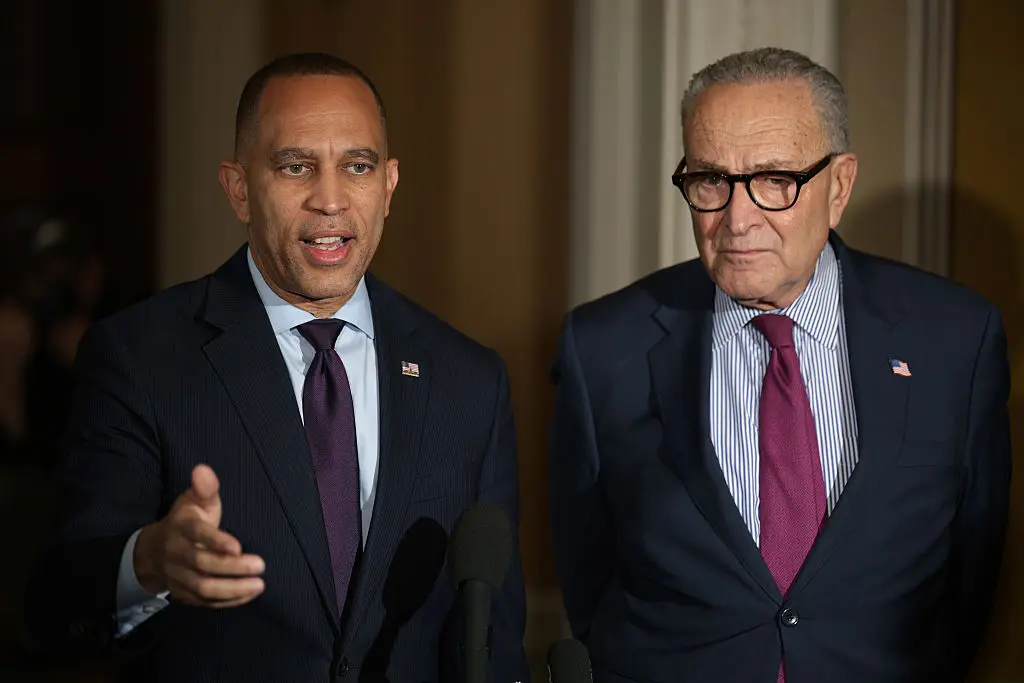
In January 2027, Hakeem Jeffries will be elected Speaker of the House of Representatives. In that role, he will wield enormous power in shaping the agenda of the House, from stocking congressional committees, to allocating chairmanships and using his perch to dictate where popular and legislative attention should be directed. And yet, despite his rise, Jeffries is painfully out of step with contemporary Democratic Party voters on a host of issues, and suffers anaemic approval ratings. One constituency, however, has remained steadfastly loyal throughout his ascent: the Israel lobby.
Jeffries’ attitude towards Israel might be best captured in his own words, taken from a pro-Israel rally in July 2014. ‘Israel today, Israel tomorrow, Israel forever’, Jeffries thundered from a podium in New York, while the IDF rained around 20,000 tons of explosives into the Gaza Strip — a chilling declaration, but one made even more bizarre by its appropriation of an infamous white supremacist governor’s declaration from the 1960s: ‘Segregation now, segregation tomorrow, segregation forever’.
Throughout his decade-and-a-half in Congress, Jeffries has proven to be a prodigious fundraiser — a skill that has catapulted this otherwise lacklustre political talent up the rungs of party leadership. He’s raised over $1.5 million in contributions from AIPAC and its allies while in office, to say nothing of the cash he’s shepherded into the coffers of other Democratic congressmembers. Jeffries has returned the favour to his donors, repeatedly whipping the Democratic Party caucus to back most hardline, pro-Israel interests over the years. ‘Hakeem Jeffries’ likely elevation set to please US pro-Israel groups’ reads a Guardian headline from November of 2022, on the eve of his ascent to House Minority Leader. The interceding four years have seen Jeffries rarely budge from his ‘Israel forever’ pledge — even as Israel has made itself a global pariah.
The tension came to a head in a July House vote, following Republican Congressman Thomas Massie’s proposed amendment to the 2027 appropriations bill, which would have slashed $3.3 billion in military aid to Israel on ‘America First’ grounds. The Massie Amendment created a quandary for Jeffries. Ahead of the vote, the then House minority leader wrote to his caucus, stating his opposition and alleging that ‘Republican leaders are desperately trying to weaponise an amendment they do not support for nakedly partisan reason’. But Jeffries also tried to negotiate the distance between his own position and recent polling indicating that over 70 percent of Democratic Party voters oppose providing military aid to Israel. In the end, he broke from custom and declined to actively whip his colleagues into support of Israel. His letter even observes that a ‘meaningful change of direction is needed,’ and that Israel ‘is capable of paying for its own sophisticated weapons’.
These words, intended as evidence of party leadership’s responsiveness to its changing base, were vapour all along — language games to provide cover for the status quo of apartheid and genocide. A little over a month after the Massie Amendment vote, the House Democrats announced four new additions to the House foreign affairs committee. Three were pro-Israel idealogues: Wesley Bell, a first-term congressman who knocked off his Israel-critical predecessor in the 2024 Democratic primaries, thanks to $8.5 million from AIPAC; Debbie Wasserman-Schultz, a longtime Israel stalwart who’s collected nearly two million dollars from pro-Israel donors; and Jared Moskowitz, one of the most pugnacious, vociferously pro-Israel Democrats in Congress. Moskowitz was also made ranking member of the congressional subcommittee for the Middle East and North Africa. With Democratic control of the House, this means that he will now ascend to the chairmanship of this important subcommittee, a body that oversees much legislation pertaining to Israel.
The Democrats’ leader in the senate, Chuck Schumer, is afflicted by the same pathologies that plague Jeffries: he’s a pathetically tepid politician, whose verve surfaces only when it’s time to defend Israel’s security interests. Over his near-decade at the helm of the Senate’s Democratic caucus, he amassed a zealously pro-Israel record, perhaps stronger than any other federal Democrat in the nation — from lavishing praise on the Trump administration’s 2018 decision to move its embassy to Jerusalem (deemed illegal by international law), to supporting round after round of military aid to Israel (even after evidence of its genocidal action and intent surfaced), Schumer’s support for Israel is iron-clad.‘My job is to keep the left pro-Israel’, he attested last year; earlier this year, he doubled-down, remarking, ‘I have many jobs as leader. . . . and one is to fight for aid to Israel, all the aid that Israel needs’.
This is not to say that movement on Israel policy is impossible. In April 2025, fifteen Democrats voted to cut military aid to Israel, a development that seemed remarkable for the time — just two years prior, this sort of measure probably would’ve won over only a few senators. This April, thirty-six of the forty-seven Democratic caucus members backed a resolution to block a $151.8 million sale of bombs to Israel. Similar measures, sure to be proposed in the forthcoming congressional session, are set to capture even more Democratic support.
That there appears to be momentum trending in the right direction is promising; its glacial pace, against the dire, existential circumstance for Palestinians, is disheartening. And now, with Democrats decisively steering both chambers of Congress, Jeffries and Schumer are unlikely to change direction. The fight over Israel policy, in particular, has become a vector of Democratic leadership’s control of the party. If leaders show pliability on Israel, they will assume that they’re ceding control of the party — and as such, they will continue to obstruct progress as much as they can, even when it comes at their own detriment.
The Clock Is Ticking
If Democrats, now armed with a popular mandate, don’t move quickly to sever existing aid to Israel and fundamentally reconfigure Middle East strategy, they risk ceding Israel-critical politics to Republicans.
Large segments of the conservative grassroots base are rumbling with anti-Israel fervour. Much of that energy stakes an ‘America First’ claim, maintaining that the United States must wind down foreign commitments, and focus on the ‘enemies’ at home (immigrants and liberals, primarily). Other corners of the right-wing, however, are experiencing what might be described as an antisemitic renaissance — their opposition to Israel grounded in a particular critique of the US-Israel commitment, one that conspiratorially alleges Jewish control of American elites. These flanks enjoy a symbiotic relationship, often blurring into one another. At the moment, they’re bursting in support, and it’s entirely possible that the Democratic presidential nominee is softer on Israel than their Republican counterpart come 2028 — a cataclysmic prospect for Democrats.
Unity will likely be the buzzword of the next few months for Democrats, as party leaders and new electeds bask in the glow of their historic victory and wait to be sworn into Congress. But this honeymoon will be short-lived. Once in power, these fundamental tensions will re-emerge. It’s difficult to imagine how any serious reassessment of Israel policy — and America’s place in the world more broadly — will take hold given these structural conditions. It will be incumbent on the progressive left’s principled, anti-war base to re-shape those conditions — or otherwise, seize and reimagine the party.