
Germany · taz · · 41m
Zionism: In the beginning there was longing
Deutsch (original) · Auto-translated to English
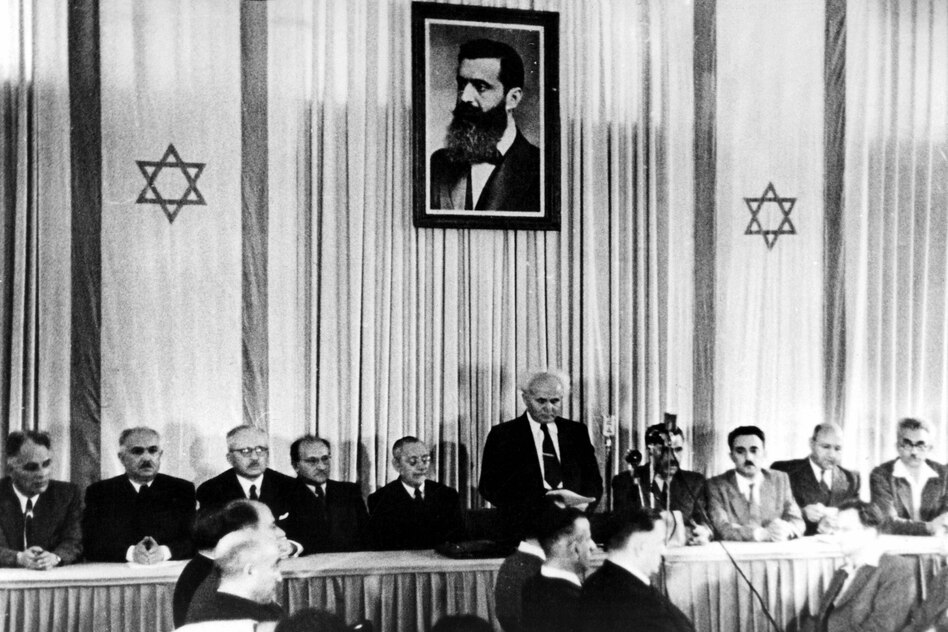
The term goes back to one of the hills of Jerusalem, Mount Zion. With the destruction of the first Jerusalem Temple in 587/586 BC. After the dispersal of Jews around the world, Zion became a symbol of the longing for home for Jews. The journalist Nathan Birnbaum then coined the term “Zionism” in his magazine “Self-Emancipation” in 1890.
The movement is primarily a reaction to rampant anti-Semitism and anti-Jewish pogroms in Eastern Europe and Russia in the 19th century. In 1897 the first Zionist World Congress took place in Basel. There Theodor Herzl, in a sense the father of Zionism, presents his plan: the establishment of a state for the Jews in Palestine who live scattered around the world. Shortly before, he had written his groundbreaking book “The Jewish State”. But the idea outlined there is still a long way from being realized at this point.
Some. The first immigration movements, called aliyah in Hebrew, occurred in the late 19th and early 20th centuries. They are primarily influenced by Eastern European Jews.
The Israel-Palestine conflict is discussed controversially, especially in left-wing circles. There are also fundamentally different positions on this in the taz. In this section you will find all comments and debate contributions on the topic of “Middle East”.
Zionism was very diverse at the time. There are Zionists who are primarily socialist and want to build a new, Jewish and socialist state. Cultural Zionists are less interested in immediately building a Jewish state and more interested in strengthening and revitalizing Jewish culture and the Hebrew language. There is also religious and civil Zionism.
No. Large parts of Jews around the world at the time viewed Zionism critically or even warned against it for various reasons. The General Jewish Workers' Union (Bund for short), an association of Jewish socialists that was founded in Vilna at the end of the 19th century, spoke out clearly against Zionism. Many simply wanted to continue living in their respective home countries and still relied on assimilation and integration. It was only the Shoah, the extermination of European Jews, that changed the structure of the Jewish population and Zionism gained significant momentum.
Within Zionism there were very different positions on this, even in the early days of the movement. Philosophers like Martin Buber focus on understanding with Arabs and on a binational model in which Jewish and Arab people live together in one country.
Others, such as the writer Zeev Jabotinsky, assumed that an “iron wall” was necessary, at least initially, between the Jewish and Arab populations and that violence could not be avoided in this process. The respective claims on the country are incompatible, and the cultural differences are also too great.
For most of the movement, writes historian Anja Siegemund, the question of coexistence with the Arab population played a subordinate role. This also included the later founder of the state, David Ben-Gurion, and the long-time president of the Zionist Organization, Chaim Weizmann. “Cooperation was seen as desirable, but not as essential as in the understanding camp,” writes Siegemund.
The group around Ben-Gurion and Weizmann set the tone. Eventually the course developed more and more towards using weapons not only defensively, but also to go on the offensive and turn a Jewish settlement into a Jewish state. Siegemund attributes this to the radicalized situation in the 1930s: to the escalation of the conflict between Jews and Arabs in Palestine, but also to the murder of European Jews in Europe.
The founding of the state is a historic turning point for Zionism. An idea becomes reality. In 1947 the UN approved a partition plan for Mandatory Palestine. The Jewish leadership accepts the plan, the Arab leadership rejects it. Shortly afterwards, a war breaks out between Jewish and Arab militias. A year later, Ben-Gurion proclaims the state of Israel.
Since then, there have been (at least) two narratives about the founding of the state: for some, the founding of the state is salvation from persecution, an existentially necessary home after the Shoah. For the Palestinians, however, the events surrounding the founding of the state are a catastrophe. They call what happened from then on the “Nakba”, the expulsion and flight of large parts of the Palestinian population.
Even in Israel, the term Zionism is hotly contested these days. A few left-wing groups in Israel describe themselves as anti-Zionist. And also many ultra-Orthodoxes there, because in the eyes of the strictly religious, only the Messiah sent by God at the end of time will establish a state that can be called Israel.
Most others struggle with the definition. On the one hand, there is the radical settlement movement, whose representatives also sit in the extreme right-wing government. In the name of a Zionism with religious and messianic connotations, they are trying to deprive the Palestinians of any basis for their existence; some of them also use violence to achieve their goals. Liberal Israelis, on the other hand, seek to reinforce a vision of Zionism in which the Israeli state can and should be both “Jewish” and “democratic.”
Critics of Zionism around the world often refer to postcolonial theories. From their perspective, Zionism is seen as a form of colonialism that has led to the displacement and oppression of the Palestinian population.
Read the full story at the source
Source: taz