
Politics · taz · · 4h
Election campaign in Mecklenburg-Western Pomerania: SPD celebrates Schwesig, CDU looks into the abyss
Deutsch (original) · Auto-translated to English
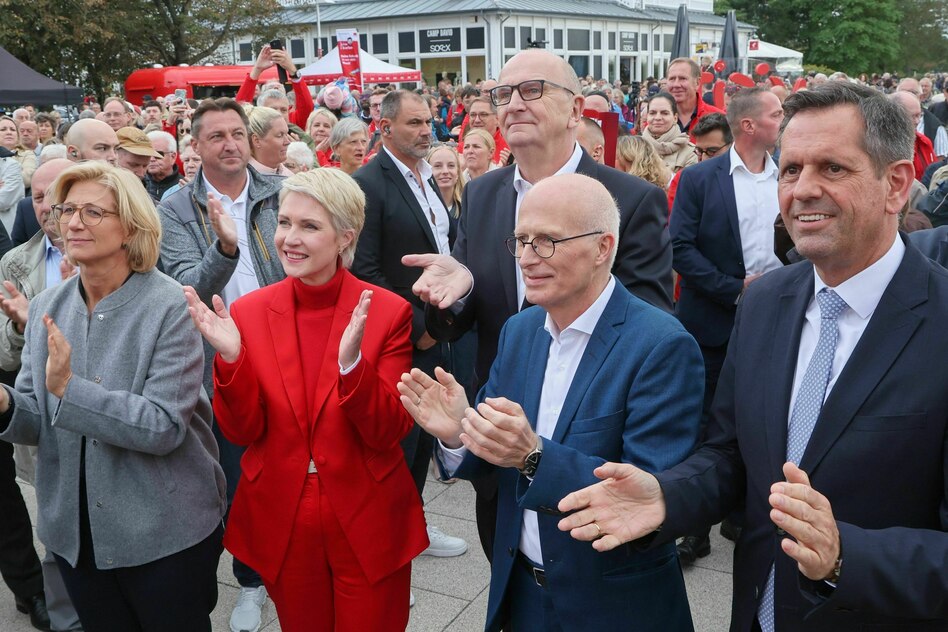
The fact that Social Democrats are largely undaunted by an election no longer happens very often. This is exceptionally the case with the SPD in Mecklenburg-Western Pomerania. At least among those comrades who applauded Prime Minister Manuela Schwesig at the end of the election campaign in Rostock-Warnemünde on Friday.
He was “rather euphoric,” said Ralf Mucha, SPD member of the Schwerin state parliament, to the taz. “Today is just the start of the final spurt,” said his parliamentary group leader Julian Barlen. In any case, the last survey before the state elections on Sunday inspired everyone, according to the head of government's close confidante.
The survey published on Thursday evening sees Schwesig's SPD at 37 percent. Not only would it have gained almost 20 points within twelve months. Above all, for the first time in over three years, the SPD is just ahead of the extreme right-wing AfD, which would therefore have 36 percent.
"What a crazy few weeks these have been? What a race to catch up!" said Schwesig herself, somewhat enthusiastically, in her speech in front of the Warnemünde lighthouse. To then warn that it is just a survey. “The situation remains very serious.” The AfD still has the chance to “take power”, perhaps together with “their friends from the BSW”, perhaps with individual rebels from the CDU. That's why the fight will continue until Sunday “for every vote”.
The SPD top candidate had previously gone through the central themes of the SPD election campaign, which was tailored entirely to her, point by point: economy, work, family, cohesion, women's rights. There was plenty of applause from the several hundred, mostly elderly, spectators.
Politicians from the sick federal SPD were deliberately left out of Schwesig's election campaign. Almost all of the other SPD heads of government were brought on stage to support this: Anke Rehlinger from Saarland, Dietmar Woidke from Brandenburg, Olaf Lies from Lower Saxony and Peter Tschentscher from Hamburg took turns praising “dear Manu”.
The message behind it, formulated by Schwesig as follows: “The Chancellor does not make decisions alone.” The prime ministers are also powerful. Schwesig in particular, she thinks: “It makes a difference whether you have a strong voice from Mecklenburg-Western Pomerania or not.”
Nothing was left to chance, not even the location of the election campaign. Schwesig said: “The lighthouse stands for confidence, orientation and hope.” So for her. And Warnemünde's landmark also provided good television pictures. There were long lines at the bratwurst stand.
Shortly before the SPD, Schwesig's left-wing coalition partner also made a big appearance in Rostock's city center on Friday afternoon. The party is currently estimated at around 10 percent. In addition to Education Minister and top candidate Simone Oldenburg, left-wing figurehead Heidi Reichinnek and the veterans Dietmar Bartsch and Bodo Ramelow campaigned for votes in front of a predominantly younger audience - bouncy castle, face painting and, as the announcement already said, “good mood” included. Energy drinks were also free.
BSW founder Sahra Wagenknecht, on the other hand, was in a particularly bad mood at the same location on Thursday. An extensive angry citizen speech was directed against “those up there”. “These are conditions that are unbearable,” Wagenknecht shouted to her now mainly older viewers.
In general, everything is getting worse and worse. There is “even more idiocy” in the black-red federal government than under the previous traffic light government, and it was already idiotic, said Wagenknecht at the end of the election campaign for her project, which was struggling with the 5 percent hurdle in Mecklenburg-Western Pomerania.
By the way, the Greens, as part of the former traffic light that was so flattered, were celebrating quite cheerfully at the same time, less than 750 meters away - despite also only 5 percent. Here, too, the party leaders Felix Banaszak and Franziska Brantner, their predecessor Ricarda Lang and several other celebrities came especially to support Mecklenburg-Western Pomerania's top candidate Claudia Müller on a big stage and with an hour-long program. There were fries.
Only the CDU is no longer interested in the traditional end-of-election campaign shenanigans. The Christian Democrats had also brought in all sorts of party grandees in the past few weeks.
The Prime Minister of North Rhine-Westphalia admired a Rheinmetall shipyard in Wolgast and his counterpart Gordon Schnieder from Rhineland-Palatinate visited the Störtebeker Braumanufaktur in Stralsund. And Chancellor Friedrich Merz ate several fish sandwiches during a rather unsuccessful and in any case very short visit to Kühlungsborn.
According to its spokesman, in the last few meters before the election, the state CDU would rather concentrate on distributing advertising material to voters. The party only got 6 percent in the last survey. According to the spokesman, these large campaign finale events were out of date anyway. “Other than there being a few TV pictures, it doesn’t help us at all.” The TV teams would also come of their own accord to accompany the election campaigners: moving images to document the view into the abyss.
The first voices from the state association are already sounding the alarm and see the party falling below the 5 percent threshold and thus rushing out of the state parliament. Even if things don't turn out so dramatically on Sunday, the CDU is threatened with the worst result at state level in its history.
Read the full story at the source
Source: taz