
Politics taz
Elections in Israel: Netanyahu in front, government bloc behind
Although Netanyahu's Likud party wins the most votes, the governing bloc itself loses massively. The Arab parties are clearly winning. more...
Deutsch (original) ·Auto-translated to English
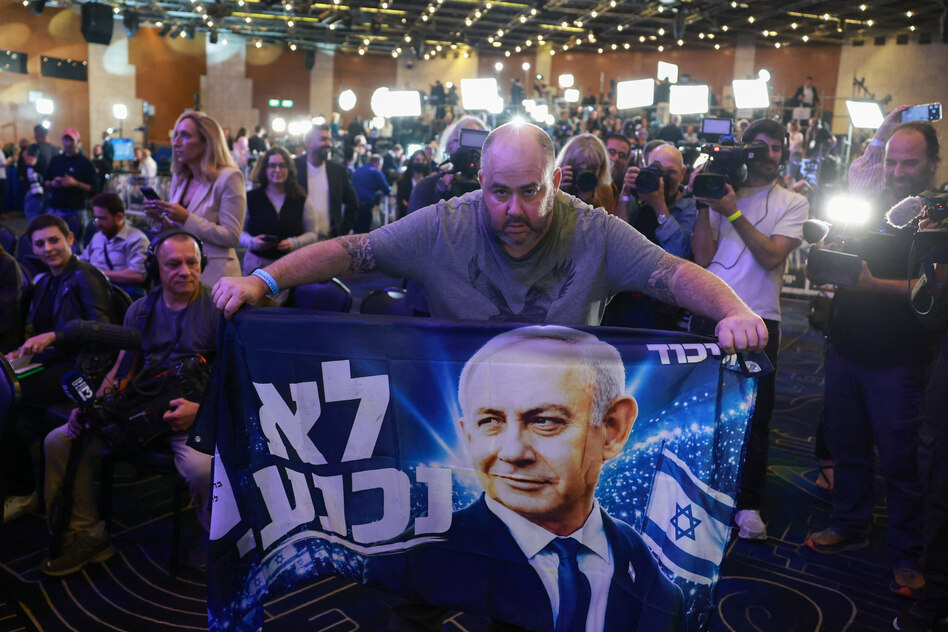
The current government's bloc in Israel has lost a massive amount of votes. This coalition of right-wing, religious and right-wing extremist parties has so far held 64 seats in the Knesset. However, according to previous calculations, Benjamin Netanyahu received the most votes. The projections published by the various TV channels in Israel sometimes differ significantly from each other; However, they agree on these two key points.
The public broadcaster Kan reports that incumbent Prime Minister Benjamin Netanyahu's Likud party won 25 seats. In second place is Gadi Eisenkot and his Jashar party, who was mostly seen in the lead in the polls before the election; it has 21 seats. Jaschar has slightly more seats on channels 12 and 13; At the station i24, the Likud is significantly further ahead with 27 seats, Eisenkot a full seven seats behind it.
The result is extremely complicated: Netanyahu and his party are ahead, but they definitely lack a coalition majority. The Zionist opposition parties also miss a majority. The blocs would need 61 of 120 seats in order to form a majority government. In the projections, the Netanyahu bloc has around 50 seats; the opposition bloc to 52 to 53 seats.
Who will now be tasked with forming a government? President Yitzchak Herzog can now decide: Will he choose the leader of the opposition bloc that left the election with more votes, i.e. Eisenkot? Or the man with the most votes, Netanyahu?
Eisenkot himself stated: The results showed an “absolute loss of confidence” in the governing coalition and a “victory for Israel’s Zionist national majority.” He will “immediately work to implement the people’s decision” and replace Netanyahu’s government.
In any case, forming a coalition will not be easy. A possibility widely discussed before the election is that the Zionist opposition bloc - contrary to the announcement of some of its party leaders - will enter into a coalition with the Arab Ra'am party. In the projections so far this comes to 7 seats - that is not enough to help the opposition parties with their 50 to 52 over the 61-seat limit.
The Arab parties are probably one of the clear winners in this election. Ra’am was able to increase from 5 to 7 seats. The other Arab electoral list, the Joint List, is estimated to win 10 to 11 seats. In the last election in 2022, the Hadash-Ta'al electoral list had just 5 seats. The Balad party, which is now part of the Joint List together with Hadash-Ta'al, was kicked out of the Knesset in 2022.
Voter turnout this year is significantly higher than in 2022: around 74 percent of those eligible to vote had cast their vote at 8 p.m. In 2022 it was around 8 percentage points less. Results broken down by voting location are not yet reliably available, but the number of Arab voters is likely to have increased.