
Politics taz
Election in Israel: Will everything remain different?
In a fateful election today, Israelis are voting for one of 36 parties. We asked six of them about their hopes and fears. more...
Deutsch (original) ·Auto-translated to English
Ben Prize, IT specialist at a start-up, 23 years old, Tel Aviv/Berlin
"I see myself as part of a movement - like me, many other people came to Israel specifically to cast their vote. The flight from Berlin to Tel Aviv cost me 500 euros, but it was worth it to me. Others came from New Zealand, Australia and the USA - so they took on a lot more. A friend of my mother came from London to vote in the morning and left again in the evening. An acquaintance only came from California for three days.
I will vote Democrat. I am a member of the party and am involved in the 'international department' in Germany. We call on Israelis living in Germany to come to the country for the election; clarify why exactly this election is so important.
When I vote for the Democrats, I don't just care about party leader Yair Golan. I vote for the entire list. There are many leaders of the protests against judicial reforms. The Democrats are the only party that will reverse judicial reform and restore the rule of law in Israel.
Polls predict between 8 and 10 seats, but I think we will get more. So many people traveled from abroad to vote and they were all left out of the polls. I hope for 15 seats. There are good candidates in places 10 to 15: I hope that Soumaya Bashir - number ten - gets into the Knesset, or Tomer Avital, who is in number 15.
I believe that an opposition coalition will emerge. The Democrats are more open to coalition partners than other opposition parties. They have not ruled out a coalition with the Arab Ra’am party. I think there is a difference between the election campaign and the post-election period, when everyone already has their promised seats. Compromises are part of it.” (Protocol: Lisa Schneider)
David, works in venture capital, 39 years old, Tel Aviv
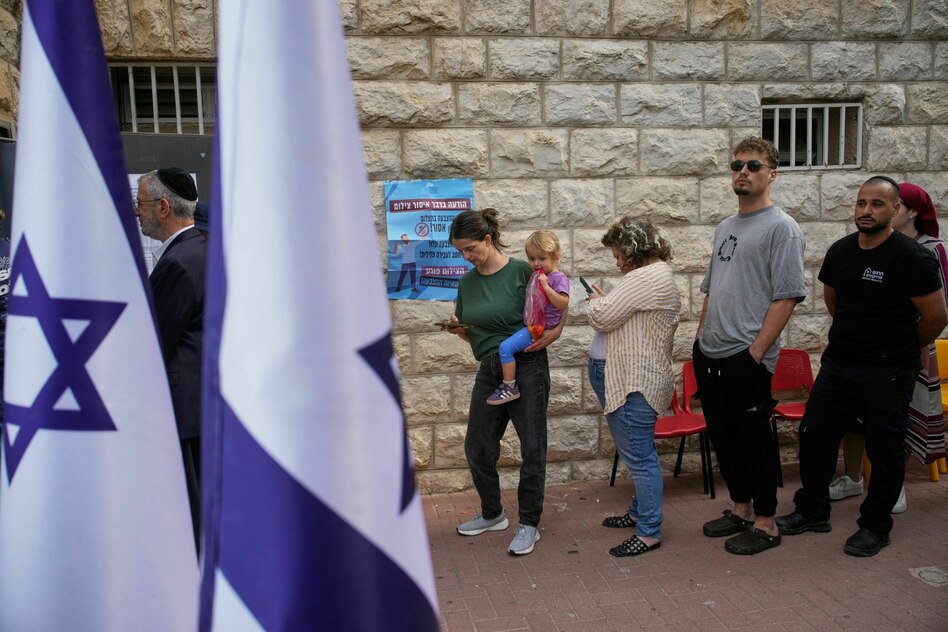
"I lined up to vote three times today: twice in the morning, but the line in front of the polling station was the longest I'd ever experienced. In the past, I've had to wait a maximum of five to ten minutes to cast my vote. And friends told me the same thing from their polling stations. That means: people are going to vote, good.
In this election I will vote for Avigdor Lieberman and his Israel Beitenu party. The Israeli political landscape is tough, and I believe Lieberman has the knowledge and experience to navigate that. I also like his political proposals best.
Voting is the duty and responsibility of every citizen. I hope for a government that will stay in power for the whole four years and give the country stability. A good election outcome would be if Benjamin Netanyahu and his Likud party formed a coalition with opposition parties such as Israel Beitenu and Yashar from Gadi Eisenkot. But I also know that that's not realistic.
It is important to me that a government does not again include the ultra-Orthodox parties or the Arab parties. Because they don't have the well-being of the entire country in mind, but rather that of their own core voters.
In the afternoon I queued again, this time there was almost no queue. The poll workers said the rush was over by 2 p.m. (Protocol: Lisa Schneider)
I will vote for the United List [consisting of the Arab parties Balad and Hadash-Ta'al, ed. Red.] agree. I have mixed feelings about the elections. My identity as a Palestinian citizen of Israel is complex. Here in Israel the Jews see us as Arabs. In the Gaza Strip and the West Bank, however, the Palestinians see us as Israelis. For us Palestinian Israelis, this choice is existential. Together with others, I am trying to encourage Palestinian citizens of Israel to vote, because some consider the elections pointless and want to boycott them. But we are trying to persuade them to participate. My father has never voted in his life, but this time he will vote - he is 87 years old.
The most serious problem that needs to be addressed at the moment is Arab criminal gangs that take control of entire communities, steal money, engage in violence and extort companies. The police under Ben-Gvir know who the criminals are, but do not take action against them. We hope that a new, different government will take action against these criminals and protect Arab communities.
The relationship with the Israeli police is complicated. On the one hand, we want the police to protect us, but on the other hand, we often feel discriminated against and oppressed by the current police. Particularly since October 7, police have aggressively targeted Arabs who have “liked” or shared anything online that expresses sympathy for the Palestinians. Some are harassed for speaking their language, Arabic, in hospitals, on buses and other places.
I would like to see a new government that will do something to counteract this discrimination. As an educator, I would also very much like the government to promote more programs for a shared Jewish-Arab life, such as the binational school [a series of Arab-Jewish schools run by the non-profit organization Hand in Hand, ed. Ed.]. In Nazareth in particular, I would like to see more safety, cleaner streets, better organized spaces for pedestrians and more investments and environmental projects. (Protocol: Tamar Ziff, translation from English: Judith Poppe)
"I was torn between two options: the Democrats, led by Yair Golan, and the Yashar Party, led by Gadi Eisenkot. I consider both men trustworthy and believe that they genuinely care about the well-being of the country. Both made great sacrifices during the war in Gaza. In the end, I chose the Democrats, mainly because I see them as a more established and politically stable party.
I am pessimistic about the elections. I can't remember a single election in the last 20 years of voting where I was truly hopeful about the outcome. It often feels as if we are trapped in a political cycle that we cannot free ourselves from. I fear that after October 7th, many people will continue to vote the same way they always have, without really considering what is best for us as a nation, as parents, and as working people trying to build a future here.
First and foremost, I hope for a government led by someone other than Bibi. In the last three years in particular, we have seen the devastating consequences of continued concentration of power. I believe preventing this is one of the basic principles of a healthy democracy. No leader should become irreplaceable.
One issue that I believe does not receive nearly enough attention in Jewish parties' election campaigns is the alarming rise in violence and organized crime within Arab communities in Israel.
Illegal weapons, shootings and murders have become normal. I also believe that it is time for Arab political parties to seriously reconsider their priorities. The Palestinian cause, the struggle for an independent Palestinian state and the rights of Palestinians, is undoubtedly important. I don't want to say that we should turn our backs on these goals. But we face an urgent crisis within the Israeli Arab communities, a crisis that is costing lives and destroying families, and that requires immediate, decisive action. Issues in these communities also include healthcare inequalities, a struggling education system, neglected infrastructure and deteriorating living conditions in many towns and villages, which require fundamental changes and long-term investments.
I want political leadership that champions the rights of all Israelis not only to equality, but also to security, opportunity, adequate healthcare, quality education and a future for our children.”
(Protocol Tamar Ziff, translation from English: Judith Poppe)
Anat Bat Ilan Amit, psychotherapist, Kibbutz Hasorea, 54
"I was born in Kibbutz Hasorea and grew up here. Today I live on the other side of the valley, where I also voted. Then I went to Hasorea to meet friends. So I was brought up in the left-wing environment of the kibbutz, which continues to shape me. I work as an art and psychotherapist, which goes well with my beliefs. Some people may think of me as a radical leftist, but I try to see all the people in the community and the needs of all of them fellow citizens should be taken into account.
I expect today's election to bring about a change that we have all been wanting for a long time, because our country has been in a very bad situation for many years. Things have gotten worse in the last four years. Since the judicial revolution a few years ago - for me it was a revolution, not a reform - I have been politically active. I joined the “Bonot alternativa”, i.e. the “Builders of the Alternative”, a feminist organization. This is one of many groups that emerged after the government's judicial revolution. Many laws passed by Parliament have targeted women.
We dress like the handmaids in Margaret Atwood's The Handmaid's Tale and take part in many demonstrations. That was my coming out as a political activist. For two years after the October 7 attack, I organized art therapy sessions for refugees from the southern kibbutzim who had been housed in my neighboring kibbutz.
It is clear that Israel had to respond to the attack on October 7th. But the reaction became more and more radical. Aggression is not a solution. In order to find a solution to the conflict, discussions must be held. This is the only way we can live together here. This also applies to the dispute with Iran. It is clear that sometimes we must use violence to ensure our survival. But after you use force, you have to sit down and negotiate agreements, like we did with Egypt decades ago.
What's also important to me about this election: Because I work with people who have difficulties, I see how the situation continues to get worse year after year. There are many families that no longer function due to external pressure and war. The need for therapists in schools, for example, is so great that we do not have enough staff for them.
Currently, those who already have power and resources are getting more from the state, while the people who need support are not getting it.
I'm going to go to a polling station in Nazareth right now to spend six hours as an election observer making sure everything is done correctly. I am a member of the Democrats, but I do not represent the party there. We received detailed information so that we knew what the correct procedures were, how the voting process was legally regulated, and how we could identify violations.” (Protocol: Ulrich Gutmair)
Yogev Tiktin, logistics manager at the oil refinery, Kibbutz Hasorea, 51
I was born here in Kibbutz Hasorea. My grandparents are not the usual Jeckes, i.e. Jews from Germany who founded the kibbutz. My family is from Eastern Europe, and my grandparents moved here from other kibbutzim in the 1960s. Here in Israel, most of the people on the left come from European, Ashkenazi families, and this also applies to the kibbutz. Jews who come from Arab countries often see themselves as conservative. I place myself on the right side of the political spectrum, where in the 1970s there was still a party that called itself liberal in the original sense. It turned against the more or less socialist consensus in Israel. She was liberal because she supported free markets and competition.
It seems to me that the left always stands up for liberal values when it benefits them. They support the rights of women and homosexuals, but when the conversation turns to Muslims, for example, these rights suddenly become less important.
To the left and the Europeans who support the two-state solution, I ask: Do you think the Arabs want that? Have you ever listened to them? Of course, our aim must always be to support the moderates on the other side. We can cooperate, for example, in economic matters; after all, we live together here. When Jews and Arabs and Muslims meet on a personal level, it works well. When you talk to them, they themselves say that they are not primarily Palestinian. That's just the political aspect of their identity.
You have to be realistic and you have to listen to them. What happened on October 7th was no surprise. They've been saying this for 40 years, you just have to read Hamas' charter and look at what they teach their children in school. 80 percent of Palestinians support Hamas. You have to respect the people, the Arabs and the Muslims. The commandment is: Don't be racist, always try to cooperate. But you shouldn't be naive. Islam as a religion is always trying to expand its rule.
We are surrounded by countries that threaten our security. In the past, we hardly noticed what was taught in the schools there, what the people there thought about us; only experts and people who spoke Arabic knew that. Today that is obvious. Many people here see the West as weak, and when I talk to Europeans, many tell me that they are worried but cannot express their concern because then they will be seen as racist.
Three years ago, the liberal, right-wing parties in the governing coalition tried to bring the justice system back into balance with parliament, the democratic representation of the people. Because thirty years ago a revolution took place in Israel. The Supreme Court has made judgments that place its own values, which tend to be left-wing values, above the decisions of Parliament. In a functioning democratic system, voters decide what to do. Anyone who generally describes politicians as corrupt delegitimizes the will of the voters. And an unelected public administration, an unelected judiciary should not be able to act against the will of the voters.
I think a two-state solution is not realistic because neither side wants it. If we imagine a situation like in Europe - the Netherlands and Germany living peacefully next to each other - most Jews in Israel will not reject it. But it's not reciprocal. The Arab population here has a different perspective on the political situation and history. Today's election will not change the fact that the majority of Jewish Israelis have now understood this. (Protocol: Ulrich Gutmair)