
Politics · taz · · 3h
Election Berlin and Mecklenburg-Western Pomerania: Who can govern there?
Deutsch (original) · Auto-translated to English
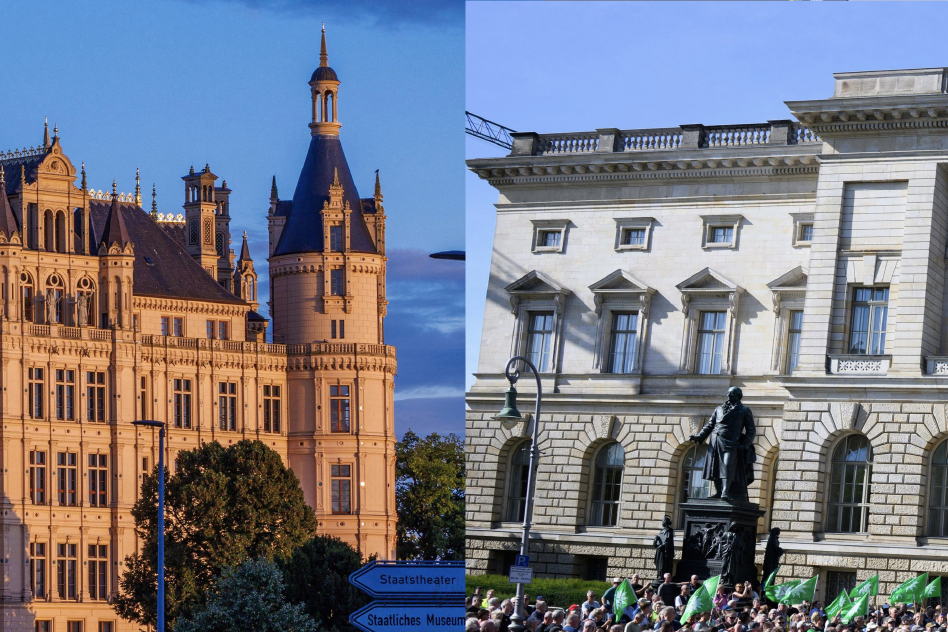
dpa | The Berlin police are securing the elections in Berlin with around 1,100 additional emergency services. The police officers are on the move throughout the city to ensure everything runs smoothly, as the authority announced on the X platform.
It's about protecting the more than 2,500 polling stations, the House of Representatives and the government buildings, as a spokesman said. Police officers also ensured that there was no undue influence around polling stations. According to the state election law, for example, no large rallies are permitted in front of polling stations within a radius of 30 meters.
It is also important to prevent disruptive actions, according to the police. So far, there is no evidence that the election should be hindered by actions. The police are also in close contact with the state election authorities.
Around 2.5 million people are called to vote for the Berlin House of Representatives. There are a good 2.7 million eligible voters for the election of the twelve district council assemblies, in which citizens of other EU countries can also take part. The more than 2,500 polling stations are open from 8 a.m. to 6 p.m.
taz | Here we go: The polling stations in Berlin and Mecklenburg-Western Pomerania have been open since 8 a.m. Citizens can cast their votes until 6 p.m. In Mecklenburg-Western Pomerania, around 1.3 million people are eligible to vote. In both federal states, 16 and 17 year olds are allowed to vote for the first time.
taz | It could be close. According to surveys, the SPD has caught up enormously in the last few months. Recently it was only 2 to 3 percentage points behind the AfD. The ZDF political barometer even saw the SPD narrowly ahead of the AfD on Thursday. A year ago things looked completely different. The right-wing extremists were similarly strong today at 38 percent, but they were far ahead of the SPD, which was only seen at 19 percent.
The SPD probably has its prominent Prime Minister Manuela Schwesig to thank for its catch-up. Conversely, the CDU in particular is suffering from the soaring, as it has fallen sharply. At 6 to 7 percent, it was only just above the five percent threshold. This is exactly where the Greens are seen. The BSW just below.
It is therefore certain that none of the three small parties will ultimately be in parliament. With neither of the two big ones, who comes out on top in the end. Because, as we all know, surveys are by no means election results. The deviations can be enormous, as the state elections in Saxony-Anhalt recently showed. It could be close.
taz | It could be tight, even in Berlin. According to surveys, the SPD has had to say goodbye to the race for first place in recent weeks. Of the four remaining parties, each could end up being the strongest. The Left and the CDU can have the highest hopes. The right-wing extremist AfD has no chance of participating in government in Berlin, but is only slightly behind the CDU and the Left. The Greens are in fourth place.
The distances are so close that everything can change on election evening. It is also unclear whether the BSW will become the sixth party to enter the House of Representatives. It was seen at 3 to 5 percent in the polls. As I said: it could be close.
In the state parliament in Schwerin, 71 seats are to be allocated without overhang and compensatory mandates. Each voter has two votes. The first vote for the candidates of the respective constituency, the second votes for the state lists of the parties, which is crucial for the size of the parliamentary groups in the new state parliament.
At least 36 seats would be necessary for a majority. If the Greens get into parliament, it could be enough for a red-red-green coalition - if the BSW stays out. Otherwise it will be tight here too.
The SPD wants to keep its Prime Minister Manuela Schwesig in office. The AfD wants to replace her with its top candidate Leif-Erik Holm.
In Berlin, in addition to the House of Representatives, the district council assemblies of the 13 districts are also elected. Therefore, the voters there have three votes. One for the district parliament, the first vote for the constituency candidates and the second vote for the state lists of the parties.
According to surveys, a three-party alliance is definitely needed for a coalition in the new House of Representatives. A red-green-red alliance with Elif Eralp (Left) as governing mayor would be conceivable. Or a black-green-red alliance with Stefan Evers (CDU) at the top. It is unlikely, but not impossible, that Werner Graf (Greens) will emerge as a surprise if his party ends up ahead of the CDU or the Left. The decisive factor is which party becomes the strongest in a three-party alliance. That doesn't necessarily have to be the strongest in the House of Representatives. Because in extreme cases that could even become the AfD.
Governing Mayor Kai Wegner (CDU) is no longer running. As is well known, he lost his temper at tennis.
Read the full story at the source
Source: taz