
Politics · taz · · 1h
Election Berlin and Mecklenburg-Western Pomerania: High voter turnout in Mecklenburg-Western Pomerania
Deutsch (original) · Auto-translated to English
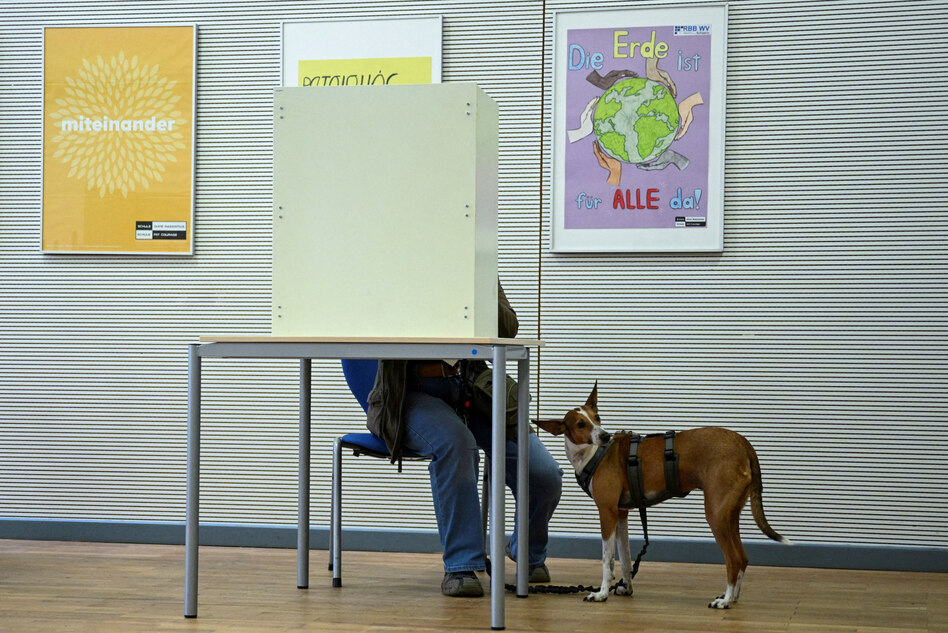
A good hour before the polls close, the sky over Berlin is pouring out. “No blue sky” over Berlin, says a taz editor, which is a good sign. Well, now. Let's see who ends up out in the cold.
taz/ap | Elections are not as free everywhere as in Germany. In Russia, for example, the Duma is still being re-elected today. But not everyone is allowed to compete.
The leader of the anti-war party Yabloko, which was excluded from Russia's parliamentary elections, has demonstratively invalidated his ballot. When he cast his vote in St. Petersburg on Sunday, Nikolai Rybakov labeled the ballot paper in bright green letters with the words “For Freedom,” “For Peace” and “Yabloko.”
He had previously called on the party's supporters to also invalidate their ballot papers.
taz | There are signs of significantly higher voter turnout in Mecklenburg-Western Pomerania. According to the state returning officer, 40.7 percent of eligible voters had already cast their votes at the polling stations by 2 p.m. In the 2021 state election, voter turnout at the same time was only 32.5 percent. The final voter turnout at that time was 70.8 percent.
In Berlin, voter turnout up to 12 p.m. was also higher than in the last election. The state returning officer has not yet announced more recent figures.
ap/taz | A few hours before the polls closed, a whale appeared! A humpback whale like “Timmy”. But this time not off the Baltic Sea coast of Mecklenburg-Western Pomerania, but on the Sacramento River in the US state of California. There it was caught in front of an angler about 100 kilometers from the Pacific... okay, sorry, irrelevant. Continue with election news.
taz | Dilan (16) and Albert (17) are on the way to the polling station in Berlin-Lichtenberg. For both of them, this is the first election in which they are eligible to vote. You have previously found out more about the Wahl-O-Mat and social media. There was also a panel discussion at her school with the local top candidates from the CDU, SPD, Left, Greens and AfD. For Dilan, the most important issues are the fight against high rent prices and the expansion of local public transport, and he will only vote for a party that does not exclude migrants.
Albert thinks climate protection, the expansion of cycle paths and the creation of affordable housing are most important, and politicians should also make more money available for education and youth work. Both parties found the social media election campaign unconvincing. (ale)
taz | Around a quarter of residents over the age of 16 in Berlin are not entitled to vote at all. Where they would like to have a say – if only they were allowed to. Sunny Riedel and Uta Schleiermacher report on this in their report for the taz.
taz | Giulia Cialé and Giaccomo Ruisi are also allowed to vote in Berlin for the first time today at the age of 28. You have lived in Germany for five years and are allowed to vote for the district council even without a German passport. “That’s a good feeling.” They plan to live here longer. They also want to begin the naturalization process soon. “Then we can take part in even more elections.”
They both voted for the left today because, for Cialé, they make policies “that are aimed at the normal people who get up every day and go to work.” They found out more on social media, through party advertising flyers, and on YouTube.
Their friends choose their families similarly, but differently: Ruisi says his father chooses completely differently. “But my grandpa is more like me!” (ads)
taz | At Kleistpark, a photo is taken in front of the polling station with the daughter, who is allowed to vote for the first time. The polling station itself, which is set up in the foyer of the University of the Arts, is very relaxed: you could hear the buzzing of flies as they buzz around the room in boredom. Since the chaos in the 2021 election, which led to the election being repeated, more polling stations have been set up in Berlin and more election workers have been hired, and this is noticeable. The few people eligible to vote give each other the handle, and a ZDF employee stands at the exit and carries out random surveys for the forecast. The daughter provides friendly information.
There is a Sunday atmosphere in the Akazienkiez, the cafés are well attended and many people are already sitting in front of the Apostle Paul Church with drinks in the late summer sun and chatting. At the burger joint you meet the neighbors and their children, who also voted for the first time, and talk about the election – and football. The forecast is clear: the fact that Hertha has won six games in a row could benefit the ruling party. In the case of Berlin that would be the CDU. The daughter says that the CDU candidate scored points at an election talk at her school by saying that his party would support Hertha BSC. At least some of the guys liked it. Maybe they make the difference. (bax)
dpa | Sportily dressed and in a good mood, CDU top candidate Stefan Evers cast his vote for the election to the Berlin House of Representatives. He was “extremely relaxed and relaxed,” the 46-year-old told journalists present on the sidelines of his vote in the gymnasium of the Emanuel Lasker School in Berlin-Friedrichshain.
“I finally got a good night’s sleep,” explained Evers. After breakfast together, he and his husband went for a walk. In the evening we go to the House of Representatives to watch the results of the election. “Things are perfect in Berlin,” says Evers. “We’ll all know more at 6 p.m.”
Voter turnout in Berlin appears to be significantly higher than the meager turnout in the most recent election in February 2023 - at that time only 62.9 percent of eligible voters voted, less than two thirds. According to figures from state returning officer Stephan Bröchler, turnout by 12 p.m. was 27.9 percent - four and a half percentage points more than at the same time in 2023, when it was 23.4 percent. So far it is weakest in the Mitte district. (sta)
taz | In many polling stations you can, so to speak, vote twice: For the ARD election forecast at 6 p.m., you mark your own vote again on a survey ballot paper and throw it into a blue paper urn.
Werner Mengel now works as a correspondent for infratest dimap, which is commissioned by ARD. The 69-year-old earns a small fee. “It’s fun, the people are really nice.” In the morning there was more willingness, at midday it waned and the voters were in a hurry. “It’s dragging on a bit now.” Did he have some kind of briefing for this job? “This is my training!” – he digs out a stack of A4 pages, an official announcement about the election. (ads)
dpa | During the state elections in Mecklenburg-Western Pomerania, some voters in a Rostock district had a special voting experience. Because access to a polling station in Rostock-Kassebohm was not possible in the morning, the electoral authority arranged for a Rostocker Straßenbahn AG bus to be used as a polling station, a spokesman for the Hanseatic city said. The “Ostsee-Zeitung” had previously reported.
The temporary solution only took about half an hour, said the spokesman. Afterwards, you could use the actual voting room, which is located in a private school building. There are a total of 134 polling stations in the city for the state elections.
dpa | AfD top candidate Kristin Brinker has cast her vote in the House of Representatives election. She appeared in a good mood at the polling station at a school in Steglitz. Smiling, she threw her ballot into the ballot box.
taz | Nadine Özdemir usually votes for the AfD. But given what the AfD has planned for Berlin, the 40-year-old will “unfortunately” have to give her vote to the left. “I hope that they will change something, including when it comes to rents and food prices.” A publicly exciting election for the woman from Lichtenberg.
Her 10-year-old daughter came with me to the polling station. She also voted for them because of the situation at school. “They don’t even have a computer room at school.” The daughter corrects: “Yes, there is a computer room,” but she is missing another special media room. Özdemir has two daughters, the older one also has to come vote, “but she’s still in bed!”
Before the election, there were many discussions in Nadine Özdemir's family. Her family chooses “half-half”, between the AfD and the Left. “My parents came here as guest workers and helped build the country.” Everyone in her family works a lot: in nursing, with the police, or like her in the fashion retail sector, where she manages a branch in double shifts. “We don’t want to be compared to other foreigners.” It’s not “okay for her to just sit at home.” She was born in Stuttgart, where she has always voted AfD to this day. (ads)
dpa | In Berlin-Pankow, some voters voted in the House of Representatives election on the grounds of a mosque. “Churches and other religious institutions have long been active as polling stations, and in that sense it is a kind of democratic neutrality or democratic normality that the mosque now also functions as a polling station,” said Sharjil Khalid, imam and Islamic theologian at the Khadija Mosque, on election day. The polling station on the mosque grounds is a sign that Islam and Muslims belong to Berlin and Germany. The day is one of the most important days of democracy, said Khalid.
But the polling station in the mosque's community room was also criticized, particularly on social media, as Khalid reported. Critics called for a clear separation of state and religion. The imam countered that churches and other Christian spaces were also used as polling stations.
The head of the responsible Pankow district electoral office, Marc Albrecht, also said before the election: “It’s all part of our society.” In addition to Muslim spaces, elections are also held in Christian and Jewish community spaces. "We need a lot of polling stations. We represent a diverse district and therefore also have polling stations in a variety of properties," said Albrecht.
Initial projections show red at the forefront – at least in Weinbergspark in Berlin-Mitte. Neighbors there collect the garbage on World Clean Up Day and place flags wherever they find it. Red stands for cigarette butts. (ga)
dpa | Prime Minister and SPD top candidate Manuela Schwesig has cast her vote for the state elections in Mecklenburg-Western Pomerania. Schwesig appeared with her husband Stefan to vote.
In the last survey before the election, according to the elections research group, the SPD received 37 percent, putting it one percentage point ahead of the AfD. Schwesig is running for a direct mandate in the same constituency in Schwerin as AfD prime minister candidate Leif-Erik Holm.
taz | It's sunny election Sunday, and some voters are hanging out in the schoolyard in front of the Marcana School after the vote.
Marzahner Liza Haegerf is voting today at the Marcana School. “I live around the corner.” For the 22-year-old, voting is not a spontaneous decision: she even read through the election manifestos of the parties that are suitable for her, she says with a smile. And watched television, as did her partner (25 years old): “I watched some debates on BerlinTV.” She is also a native of Marzahn, where they live together.
The Marcana School in Marzahn houses four polling stations, which are staffed by around 42 volunteer election workers. An experienced election worker says at lunchtime that you don't notice the younger voters yet: "I think they won't come until four." (ads)
Something has grown in the northeast over the years: places where people come together who rarely see each other anymore. An AfD victory would threaten them. Ulrika Rinke reports on this for the taz.
dpa | According to state returning officer Stephan Bröchler, voting operations got off to a good start. “So far things have been going very quietly,” Bröchler told the German Press Agency a good two hours after the polling stations opened. The state returning officer visited some election workers in the city.
According to his information, there were initially no major incidents. A caretaker was late in Steglitz. The problem was resolved before the polling station opened at 8 a.m.
According to Bröchler, graffiti or graffiti calling against the AfD was discovered at some polling stations. These were removed where possible. The state returning officer initially named two cases in Steglitz. A dpa reporter reported on corresponding lettering that was defaced in front of a polling station in a primary school in the Kladow district.
afp | The first top candidates cast their votes in the election for the Berlin House of Representatives. Werner Graf from the Greens and Steffen Krach from the SPD voted on Sunday in the Tempelhof-Schöneberg district. CDU top candidate Stefan Evers wanted to cast his vote in Friedrichshain around midday and not publicly vote for the left-wing candidate Elif Eralp.
According to the state returning officer, there are signs of a high proportion of postal voters. According to information from Saturday, the district election offices issued over 800,000 voting slips for the election to the House of Representatives, covering around a third of those eligible to vote.
afp | The AfD prime minister candidate Leif-Erik Holm cast his vote in the state elections in Mecklenburg-Western Pomerania. He voted on Sunday in Schwerin accompanied by his wife Wenke. Surveys predict a close race between the AfD and Prime Minister Manuela Schwesig's SPD for election victory; both parties were recently only a few percentage points apart in the surveys.
dpa | Voters have two votes for the election to the House of Representatives. For the first time, you can cast these on one ballot paper instead of two. With the first vote you choose your direct candidate in one of the 78 constituencies. With the second vote, they choose a state or district list of a party. The second vote is crucial for the distribution of seats between the parliamentary groups. This normally consists of 130 members. Currently there are 159 due to overhang and compensatory mandates. Voters have one vote for the district assembly.
dpa | The Berlin police are securing the elections in Berlin with around 1,100 additional emergency services. The police officers are on the move throughout the city to ensure everything runs smoothly, as the authority announced on the X platform.
It's about protecting the more than 2,500 polling stations, the House of Representatives and the government buildings, as a spokesman said. Police officers also ensured that there was no undue influence around polling stations. According to the state election law, for example, no large rallies are permitted in front of polling stations within a radius of 30 meters.
It is also important to prevent disruptive actions, according to the police. So far, there is no evidence that the election should be hindered by actions. The police are also in close contact with the state election authorities.
Around 2.5 million people are called to vote for the Berlin House of Representatives. There are a good 2.7 million eligible voters for the election of the twelve district council assemblies, in which citizens of other EU countries can also take part. The more than 2,500 polling stations are open from 8 a.m. to 6 p.m.
taz | It's actually clear what has to happen if the AfD wins the race again: just ban it. Only if things turn out differently does it get complicated, comments Page 1 editor Lukas Wallraff.
taz | Nowhere in Germany do lifestyles collide as harshly as in Berlin. What should remain? What will change? Six comments from the taz editorial team.
taz | Here we go: The polling stations in Berlin and Mecklenburg-Western Pomerania have been open since 8 a.m. Citizens can cast their votes until 6 p.m. In Mecklenburg-Western Pomerania, around 1.3 million people are eligible to vote. In both federal states, 16 and 17 year olds are allowed to vote for the first time. (ga)
taz | It could be close. According to surveys, the SPD has caught up enormously in the last few months. Recently it was only 2 to 3 percentage points behind the AfD. The ZDF political barometer even saw the SPD narrowly ahead of the AfD on Thursday. A year ago things looked completely different. The right-wing extremists were similarly strong today at 38 percent, but they were far ahead of the SPD, which was only seen at 19 percent.
The SPD probably has its prominent Prime Minister Manuela Schwesig to thank for its catch-up. Conversely, the CDU in particular is suffering from the soaring, as it has fallen sharply. At 6 to 7 percent, it was only just above the five percent threshold. This is exactly where the Greens are seen. The BSW just below.
It is therefore certain that none of the three small parties will ultimately be in parliament. With neither of the two big ones, who comes out on top in the end. Because, as we all know, surveys are by no means election results. The deviations can be enormous, as the state elections in Saxony-Anhalt recently showed. It could be close. (ga)
taz | It could be tight, even in Berlin. According to surveys, the SPD has had to say goodbye to the race for first place in recent weeks. Of the four remaining parties, each could end up being the strongest. The Left and the CDU can have the highest hopes. The right-wing extremist AfD has no chance of participating in government in Berlin, but is only slightly behind the CDU and the Left. The Greens are in fourth place.
The distances are so close that everything can change on election evening. It is also unclear whether the BSW will become the sixth party to enter the House of Representatives. It was seen at 3 to 5 percent in the polls. As I said: it could be close. (ga)
taz | In the state parliament in Schwerin, 71 seats are to be allocated without overhang and compensatory mandates. Each voter has two votes. The first vote for the candidates of the respective constituency, the second votes for the state lists of the parties, which is crucial for the size of the parliamentary groups in the new state parliament.
At least 36 seats would be necessary for a majority. If the Greens get into parliament, it could be enough for a red-red-green coalition - if the BSW stays out. Otherwise it will be tight here too.
The SPD wants to keep its Prime Minister Manuela Schwesig in office. The AfD wants to replace her with its top candidate Leif-Erik Holm. (ga)
taz | In Berlin, in addition to the House of Representatives, the district council assemblies of the 13 districts are also elected. Therefore, the voters there have three votes. One for the district parliament, the first vote for the constituency candidates and the second vote for the state lists of the parties.
According to surveys, a three-party alliance is definitely needed for a coalition in the new House of Representatives. A red-green-red alliance with Elif Eralp (Left) as governing mayor would be conceivable. Or a black-green-red alliance with Stefan Evers (CDU) at the top. It is unlikely, but not impossible, that Werner Graf (Greens) will emerge as a surprise if his party ends up ahead of the CDU or the Left. The decisive factor is which party becomes the strongest in a three-party alliance. That doesn't necessarily have to be the strongest in the House of Representatives. Because in extreme cases that could even become the AfD.
Governing Mayor Kai Wegner (CDU) is no longer running. As is well known, he lost his temper at tennis. (ga)
Read the full story at the source
Source: taz