
World · taz · · 1h
Before the elections in Brazil: God, help us!
Deutsch (original) · Auto-translated to English
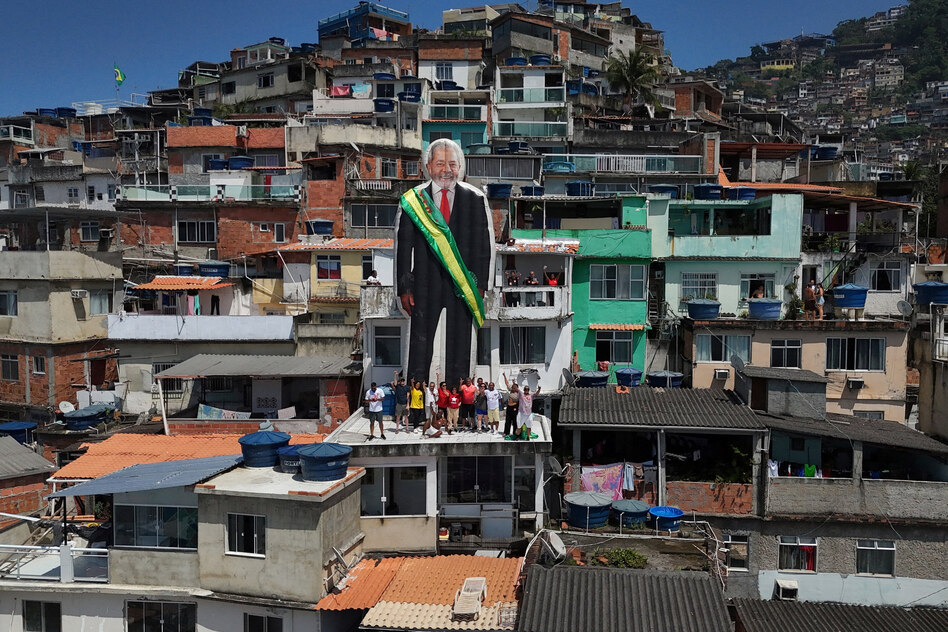
There is no way around God before the presidential elections in Brazil. Flávio Bolsonaro, the most promising challenger to incumbent Luiz Inácio “Lula” da Silva, styles himself as a fighter in a “spiritual war”. He regularly announces that God has given him a mission.
The 45-year-old senator almost pretends to be a priest himself, practicing reverent poses, opening his hands to receive heavenly blessings, bowing his head humbly or praying in front of crowds of evangelical believers to save the country “from the spirit of evil”. What is unmistakably meant is the political opponent.
And if he wins the election, the extreme right candidate announced, he would have to talk to those who don't believe in God. As one of his first acts of state, he would decree by decree that the land belonged to “the Lord Jesus Christ”. The qualified lawyer fails to mention that this would violate the constitution.
The vying for the favor of believers is strategically motivated: the votes of evangelicals - around 30 percent of those eligible to vote - could be decisive in the head-to-head race between the son of the convicted coup leader Jair Bolsonaro and the current President Lula. A current survey sees Lula just ahead of Flávio Bolsonaro in the first round with 35 percent of the vote.
This Sunday Brazilians will elect a new head of state. 13 candidates are up for election. But only Bolsonaro and incumbent Lula have any real chances. If neither of the two achieves an absolute majority in the first round of voting, they will have to go to the runoff election on October 25th. In this scenario, pollsters see them even closer together. The fight for the 21 percent of voters who have not yet made up their minds, including many supporters of Pentecostal churches and evangelicals, is correspondingly bitter.
Flávio Bolsonaro takes such an offensive approach that some of the church services he attends seem like an election campaign event. For example, the one on September 7th, the Igreja Mundial do Poder de Deus, in São Paulo. The 12,000 listeners cheered at a prayer recited by self-proclaimed apostle Valdemiro Santiago, his voice shaking with emotion. The fact that the federal police are investigating Bolsonaro on suspicion of corruption, money laundering and illegal foreign currency exports seemed irrelevant. Likewise, Apostle Valdemiro sold bean seeds as a miracle cure for the disease during the Covid pandemic.
Not all believers like the fact that churches are being turned into political stages. “They are tired of political messages being forced on them at every service,” says political scientist Ana Carolina Evangelista from the Brazilian religious research institute ISER.
However, it is important to 86 percent of Brazilians that their president believes in God. This probably explains why Lula uttered the word “God” eleven times in his opening speech of the election campaign in August. According to CNN Brasil, the previously relatively discreet Catholic used the G-word at least three times in subsequent election campaign appearances.
The head of state does not present himself as God-sent like his political opponent. However, he interprets his life, especially his rise from a poor refugee from the northeast to the highest state office, as evidence of God's goodness. Wife Janja Lula da Silva even recorded a jingle about the rise of the common man in a duet with gospel star Kleber Lucas.
So while Bolsonaro presents himself as extremely religious but moderately right-wing, Lula tries to score points as extremely social and moderately religious. The political veteran has never visited churches or services to convince religious voters and categorically rejects this. "If someone asks me to campaign in a church, I won't go! I do politics and campaigning in the streets," Lula said recently in Brazil's capital Brasília. First Lady Janja facilitated a meeting between the president and evangelical pastors from across the country.
Representatives of the organization Frente de Evangélicos para o Estado de Direito (German: Front of Evangelicals for the Rule of Law), an association of progressive evangelicals that had already supported Lula in the runoff election against Jair Bolsonaro in 2022, were also on site.
This year they are also on Lula's side and are trying to win voters for him. "We discuss with people on the street, listen to why they don't want to vote for our candidate and present our arguments. Then we listen to their arguments," explains Frente leader Nilza Valéria. Sometimes it is possible to win the vote this way. But sometimes not.
Personal encounters are central to the election campaign of Lula's ruling party, the Partido dos Trabalhadores (PT, German: Workers' Party), alongside social media and TV appearances. In the last days before the vote, the PT wants to distribute more than ten million flyers. The government's past measures should be linked to Bible quotations to show that its program is in accordance with Holy Scripture. Many evangelical believers today hardly see government programs as a possible cause of growing prosperity. According to the prosperity theology widely held among them, they tend to interpret individual financial success as a direct result of the believer's connection with God.
By the 2006 elections, more than 60 percent of evangelicals had supported the PT. But then issues came into the political spotlight, particularly gender and reproductive issues, that did not fit with the conservative stance of many evangelical churches. Jair Bolsonaro cleverly took advantage of this and positioned himself in 2018 as the one who took the needs, values and problems of Pentecostals seriously.
“Something like a firewall emerged between the left and the Bolsonaro family within the evangelicals,” says political scientist Ana Carolina Evangelista. “Whoever from the Bolsonaro family ran since then had Jair’s legacy secure.” Jair's wife Michelle, herself an active Pentecostal church member and therefore religiously credible, would certainly have inherited this inheritance particularly effectively. But Jair Bolsonaro appointed his son, who was loyal to him, as his successor from prison.
Brazil is voting, and leftist Lula and opponent Flávio Bolsonaro are fighting bitterly for votes. Is there a threat of the next shift to the right in Latin America? Here's the episode
His approval ratings among the population initially rose sharply, but fell after he first alienated his popular stepmother and then lied several times about his relationship with the imprisoned banker Daniel Vorcaro. Bolsonaro Junior has been experiencing an upswing again since mid-September. The reason for this is the current crisis at the Supremo Tribunal Federal (STF), the country's highest court. [Link to post 8734913]
A few weeks ago, Chief Justice Alexandre de Morães came under suspicion of corruption. This shocked many Brazilians because Morães had established himself as a moral authority for years due to his unyielding stance on corruption issues. He was also significantly involved in the conviction of Jair Bolsonaro and has since been considered “Lula-friendly” among Brazilians.
This text first appeared in wochentaz, our weekly newspaper from the left!
Every week, wochentaz is about the world as it is – and as it could be. A left-wing weekly newspaper with a voice, attitude and the special taz view of the world. New every Saturday at the kiosk and of course by subscription.
The investigation against Morães was commissioned by the evangelical pastor André Mendonça, appointed to the STF by Jair Bolsonaro. Now the man who describes himself as a “terrible evangelical” is trying to present himself as some kind of religious bulwark against corruption.
The PT, meanwhile, is trying to steer the public debate away from questions of morality and towards concrete, everyday issues such as wages, public health care, food security and work. All topics that should also interest many evangelicals. The members of Pentecostal churches are predominantly black people from the periphery, including many women.
Nevertheless, according to current polls, only 28 percent of them want to vote for Lula, while Bolsonaro can expect 51 percent of their votes. For Nilza Valéria it remains a contradiction. "How can it be that Lula is ahead among poor people, women and blacks, but not among evangelicals? There is a contradiction somewhere." Your organization is now relying on a song. On social media they are spreading a jingle that says: “It is not a sin to vote for Lula!”
Read the full story at the source
Source: taz