
World taz
Hungarian Popular Uprising: How the Kremlin is using the Hungarian Uprising for propaganda
70 years after the suppression of the Budapest protests, the Kremlin is recycling Soviet propaganda - and in doing so is again stoking fear of the West. more...
Deutsch (original) ·Auto-translated to English
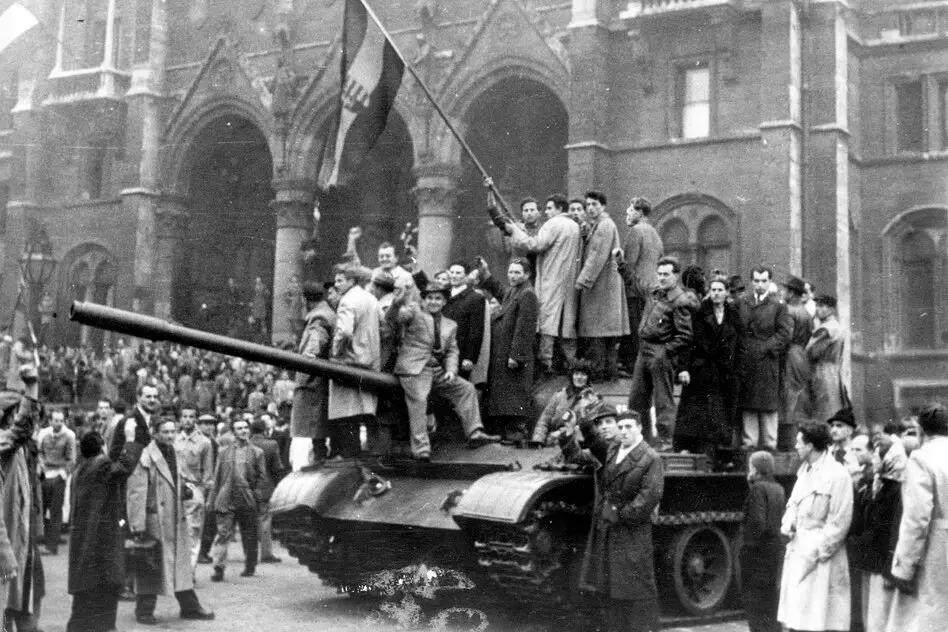
70 years ago, in the fall of 1956, the crisis in Hungary came to a head. After Khrushchev's speech at the 20th Party congress, in which he condemned Stalin for mass repression, hopes for reforms arose. Things began to boil in the countries of the socialist bloc - first in Poland, then in Hungary. Public discussions took place in Budapest, attracting thousands of participants.
Although Rákosi, the executor of Stalinist policies in Hungary and responsible for the mass repressions, had been deposed, de-Stalinization was extremely slow. On October 23, thousands of Budapest residents took to the streets demanding reforms, free elections and the withdrawal of Soviet troops. The Stalin monument was toppled and a popular uprising began.
The Soviet leadership hesitated, but Khrushchev's position prevailed: if we leave Hungary, it will embolden the American, British and French imperialists. This would show the weakness of our position.
Moscow decided to suppress the uprising militarily. The plan called for the capture of Budapest and other major cities, the disarmament of the Hungarian army and control of state institutions.
The offensive began on November 4th. The representatives of the Hungarian leadership were arrested, the army was disarmed, but the fighters continued to resist in Budapest for a few days. Around 2,500 Hungarians died and thousands were injured. Prime Minister Imre Nagy was arrested and executed with his colleagues in 1958. Moscow announced the formation of a new Hungarian government under János Kádár.
Although the Western states supported the Hungarian uprising, they did not enter into a military conflict with Moscow. After the uprising was suppressed, over 200,000 people left Hungary. Soviet propaganda portrayed the Hungarian uprising as a counter-revolutionary coup attempt that had been prepared by Western secret services. The newspapers were full of reports of massacres of communists.
But the events in Hungary did not leave Soviet society unscathed. Sympathy for the Hungarian uprising and the fight against Stalinism emerged among students and intellectuals. The contemporary witnesses remember: “The events in Hungary captivated us... we exchanged news, were excited and hoped.” – “I began to plan an escape to get to Budapest… I dreamed of a great anti-Stalinist revolution of spirit…”
The example of Hungary caused great concern among the Soviet leadership. The student circles that emerged in the Soviet Union were broken up, their organizers arrested and sent to camps.
Only during perestroika was the suppression of the Hungarian uprising reassessed and historical justice restored.
But today, 70 years later, Putin's “historians” are once again repeating the formulas of Soviet propaganda. They claim that the events in Hungary were “the result of a large-scale operation carefully prepared by Western intelligence services” and that the “events in Hungary of 1956” were a “color revolution” of the Cold War. In doing so, they make direct connections between the events in Hungary and the Ukrainian Maidan, which they hate.
This return to the formulas of Soviet propaganda is now taught to Russian students and schoolchildren in rewritten textbooks.