
Climate taz
UN climate conference in Turkey: Erdoğan is happy about new oil fields
Turkey is hosting the ongoing UN climate conference. But at the same time, Erdoğan is announcing the exploitation of new fossil energy reserves. more...
Deutsch (original) ·Auto-translated to English
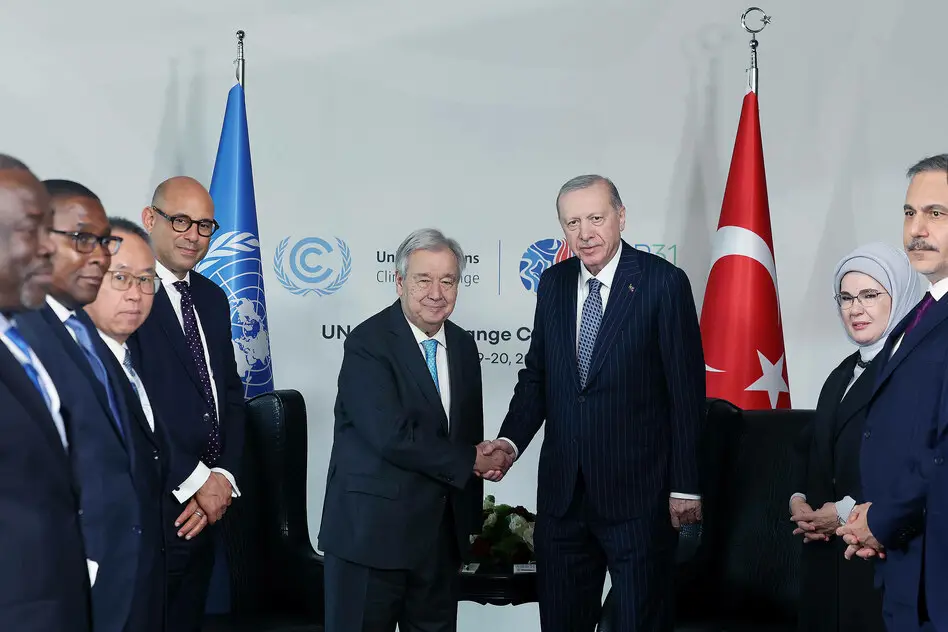
Just in time for the start of the UN Climate Change Conference, Turkish President Recep Tayyip Erdoğan is celebrating the development of two new oil fields in the southeast of the country. While UN Secretary General António Guterres demanded at the climate conference in Antalya that the world must finally get serious about phasing out fossil energies, i.e. coal, gas and oil, the host country Turkey announced that it would increase domestic oil production by 30 percent next year.
“We can then produce around 100,000 barrels a day in the second half of 2027,” Erdoğan said on social media on Monday evening. This could save around $4 billion a year because less oil would have to be imported.
Although Turkey has also invested in renewable energies in recent years, so that around 40 percent of electricity generation now comes from sun, wind and hydropower, coal, oil and gas still provide the lion's share of energy production. There is no contradiction when the Turkish Environment Minister Murat Kurum proposes that the goal of the conference is to increase the share of electricity in the energy mix from around 20 percent worldwide to 35 percent by 2035, and at the same time Erdoğan makes it clear that Turkey wants to continue to rely entirely on fossil energy. Finally, electricity can also be produced using coal and gas power plants.
So far, Turkey has to import around 90 percent of its fossil energy needs. This is one of the largest expenditure items in the budget and regularly means that Turkey has to spend significantly more money on imports than it earns from exports. Turkey wants to get out of this dilemma. The country's energy consumption has risen sharply in recent years, which is why the government doubts whether the expansion of renewable energies alone will be enough to reduce dependence on oil and gas imports.
So far, the expansion of renewables has only been sufficient to cover the annual additional energy requirements. According to experts, Turkey has the potential to at least end particularly harmful coal burning through a consistent expansion of wind and solar energy, but lignite is the fossil fuel most commonly found in the country.
In addition to oil production, Erdoğan is focusing on producing his own natural gas. Turkey began exploiting a gas field in the Black Sea a few years ago and is increasing production there from year to year. At the same time, Turkish research ships are searching for new gas fields in the Mediterranean and the Red Sea, especially off the coast of Somalia.
While the search for gas fields in the Red and Black Seas is relatively conflict-free, there have been serious conflicts with Greece and Greek Cyprus in the Mediterranean. The definition of the respective special economic zones in which a country is allowed to exploit the seabed alone is highly controversial. That's why Greece joined forces with Israel and Cyprus. Meanwhile, Turkey has concluded a corresponding agreement with Libya on the exploitation of gas reserves. The conflict over the exploitation of the gas fields almost led to an armed conflict between Turkey and Greece a few years ago.