
Climate Pressenza
Us, the Civil Society and them, the Parties at the Climate Conference COP31: Same Targets?
“People don’t expect words from us. They expect action, they expect results.”, Murat Kurum, COP31 President. Two new oil fields on Mount Gabar. Daily output will pass 100,000 barrels in 2027. , Recep
English (original) ·Read in Deutsch ⇄

“People don’t expect words from us. They expect action, they expect results.”, Murat Kurum, COP31 President.
“Two new oil fields on Mount Gabar. Daily output will pass 100,000 barrels in 2027.”, Recep Tayyip Erdoğan, President of Türkiye, after a cabinet meeting on opening day.
This was the “welcome” on the very first day at the 31st Climate Conference (COP31) in Antalya, Turkey. The world will learn about the official debates and results, while thousands of civil society observers have no say in it, but are present with actions, informative events, press conferences, interventions by their respective constituencies and thousands of talks with whoever of the representatives of governments is willing to listen to them for a few moments. Meanwhile business, industry and in particular fossil fuel companies can afford visible presentation and lobby.
Climate Action Network (with about 3000 non-governmental organization members worldwide) held a press conference on the first day (9 November 2026). Tasneem Essop, Executive Director, spoke about the urgency of going beyond talking to delivery. The world is burning and wars, conflict and genocide are afflicting people who want justice now. Inspiration comes from the streets as people notice that funding wars to trillions of public money are not spent on public service and least at grant based public finance for mitigation, adaptation, loss and damage, that is a just climate transition.
In a remarkable speech, Shady Khalil, Senior Policy Strategist of Oil Change International told the audience: “We are living in a moment marked by geopolitical wars, genocides, climate disasters, inflation and the volatility of fossil fuel markets. A world where almost 700 million people still lack access to electricity, while millions more struggle to afford the energy they need to live with dignity.
We can no longer speak about climate change as something abstract. It is shaping people’s lives, deepening poverty and forcing people to grieve, lose their homes and watch their loved ones suffer.
And while communities pay the price, fossil fuel corporations and weapons manufacturers continue to profit from extraction, pollution and destruction, accumulating enormous wealth and power.”
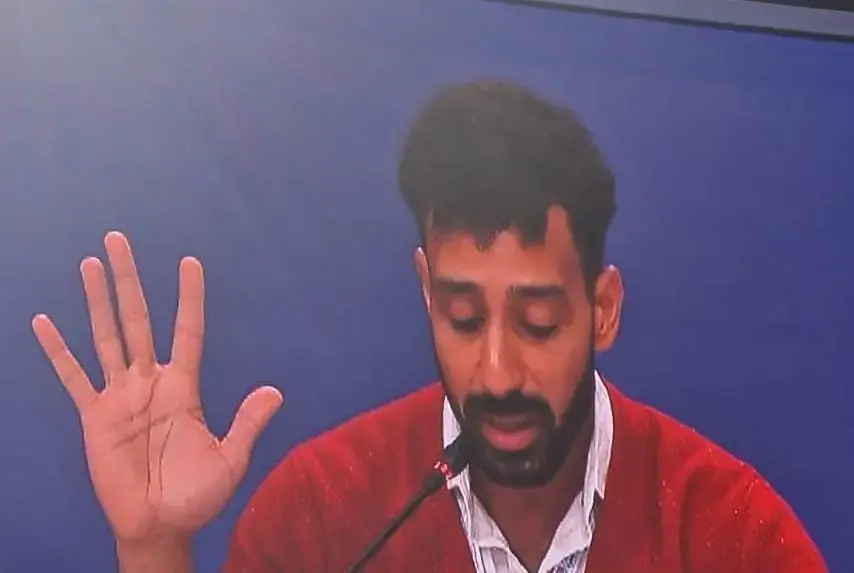 Shady Khalil indicating the 5 largest oil companies made $500+ million every day in the second quarter of 2026. Credit: Helga Merkelbach
Khalil continued: “The five largest oil companies made $48 billion in profit in the second quarter of 2026 alone, equivalent to $500+ million every day. Global military expenditure reached a record $2.9 trillion in 2025, while public climate finance from developed countries declined.
This is not a question of whether resources exist. It is a question of political priorities. There is no excuse for continuing to expand the business of killing people while failing to invest in the business of saving lives.
We need to move resources away from financing destruction and towards financing life: just transition, renewable energy, adaptation and loss and damage.
That is why we are here. We are calling for a Justice Package.
A package that recognizes that mitigation cannot be separated from adaptation, just transition, loss and damage and finance. These are interconnected pillars of climate justice, and they must advance together.
We need a Just Transition Mechanism that ensures the transformation of our economies serves people, workers and communities, rather than corporate greed or new forms of economic dependency.
We need climate finance that meets the scale of the crisis, in both quality and quantity. Finance that comes as grants, not loans that deepen debt. We need public resources mobilized through progressive taxation, including taxing extreme wealth and polluting corporations.
And we must recognize that adaptation is not separate from mitigation.
When countries are denied the means to adapt and recover, they are also left with increasingly limited choices about the quality, speed and ambition of their mitigation pathways. We cannot demand ambitious transitions while denying countries the financial space to make them possible.
We also need national and regional roadmaps that put countries in the driving seat of their own transitions, protect their energy sovereignty and security, and enable them to plan their development without being held hostage by fossil fuel markets and geopolitical interests. These must be whole-economy roadmaps, rooted in equity, with an end to fossil fuel expansion everywhere and developed countries leading and providing the necessary finance and technology transfer.
Fair Electrification must be a floor, not a ceiling, for ambition. Access to energy must mean access to affordable, reliable and renewable energy, not another generation of fossil fuel dependency. 100% renewables!
Finally, we need a strengthened Mitigation Work Program connected to the Second Global Stocktake, with equity and enabling conditions at its core. We do not need another talk shop. We need a space for implementation that addresses not only emissions reductions, but also the finance, technology transfer and obligations that make an equitable transition possible.
And I want to close with this. By calling on the world leaders.
Look at what is happening in the world today. Look at the people paying the price, but also look at the movements rising everywhere.
The forces of oppression, division and corporate greed may appear powerful, but they do not own the future.
We are seeing glimpse of hope just in past two months all over the world of what people coming together can do.
Its a reminder to all of us and to our leaders The future belongs to the global majority: to workers, communities, young people, women and the movements demanding a different world. We have seen a glimpse of hope all over the world in just the past couple of months.
We are here, hand in hand and shoulder to shoulder, refusing to surrender our futures to those who profit from destruction.
We are not asking for isolated commitments. We are demanding the resources, the conditions and the political decisions that make justice possible.
We are calling for a future that finances life, not destruction.
We are calling for a Justice Package.
And we will not compromise on the justice in the package.“
You can watch the complete press conference online.