
Germany · taz · · 1h
Play about Simson mopeds: metal shakes, pressure becomes movement
Deutsch (original) · Auto-translated to English
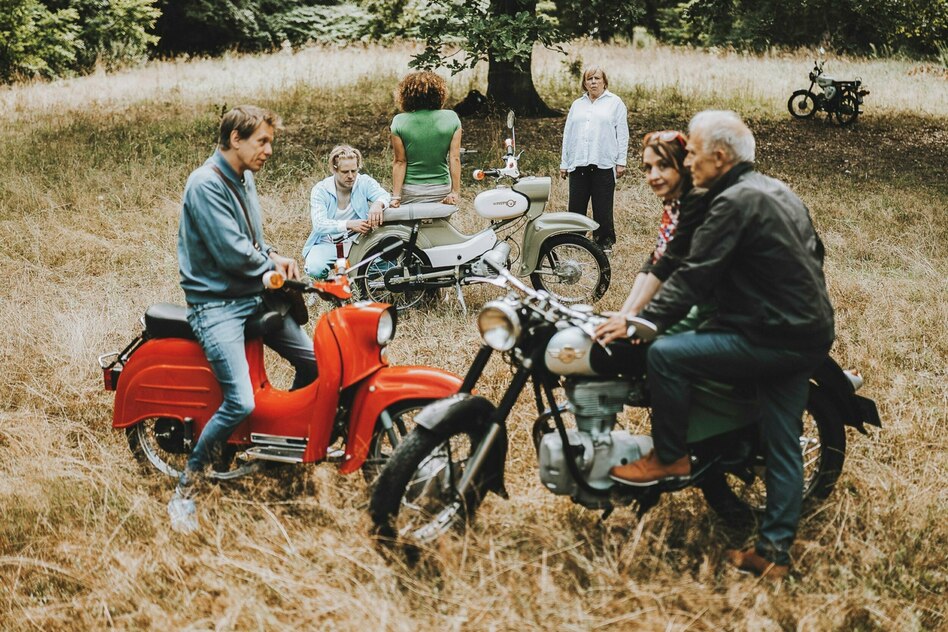
Paul heads over to the West on the Simson Schwalbe sometime in the 1970s - or maybe not. You don't really find out about it in Charlotte Gneuss's novel "Gittersee". A few years ago, Gneuss's debut about a young person targeted by the Stasi sparked a literary-critical debate. Whether Gneuss, born in West Germany after 1990, could actually report authentically about life in the GDR. Will the East become a West German invention? asked the FAZ.
Let's take a closer look at the GDR moped brand Simson. It produced that rattling, roaring product of everyday life in the GDR that is still tangible today. It's not an invention, but this object brings together all sorts of projections on the East: Ulrich Siegmund campaigned in Saxony-Anhalt on an AfD blue Simson Schwalbe, Björn Höcke conjured up the East German "way of life" with the sporty Simson S50 in Thuringia.
In the materiality of these retro-Simsons, which have long since been discontinued and with which people once traveled to the Baltic Sea or fled the Republic, one seems to find the essence of a life that lies in the past of a state that no longer exists. The right knows how to use this for their propaganda.
"A spark hits the confines of the combustion chamber (...) The mixture tears itself apart, presses, hammers, drives down the piston. Everything is closed, everything concentrates on this one downward push. Metal trembles. Pressure becomes movement." The play “Freiheit:Simson” begins with this erotic, brutal hymn to the moped. It is a text montage made up of original sounds, excerpts from files from the Stasi, the Treuhand, TV recordings, and archive documents. And it is an attempt to shed light on the glorified Samsons.
“Freiheit:Simson” was written by Aron Boks, writer and taz author, and the theater director Janek Liebetruth. There are Simson fans who just want to ride a moped and don't want to know anything about his political instrumentalization, factory workers who still produced Simsons during the GDR era, and a contract worker from Mozambique too - "I was once in the discotheque and met a girl. Then three or five teenagers came. Then the N-words were said," actress Chenoa North-Harder quotes him as saying during rehearsals for the play, it's about the late 1980s.
Dennis Baum also met Aron Boks for “Freiheit:Simson”. The descendant of the Jewish Simson family living in the USA, who today defends himself against the AfD misusing his family name for its right-wing propaganda. “Freiheit:Simson” describes the whole crazy company history of Simson. And that in turn tells a lot about the shattered German-German 20th century. Boks and Liebetruth are bringing the piece to the stage in the Thuringian city of Suhl, with its premiere on the evening before German Unity Day, Friday, October 2nd.
Suhl is the place where the Jewish entrepreneurs Löb and Moses Simson founded their company in 1856, which initially manufactured hunting and military weapons and later cars, bicycles and strollers. Simson was the only company in the Weimar Republic that was able to supply the shrunken Reichswehr with small arms. This is how the company survived the economic crisis and even grew into a kilometer-long manufacturing plant on the outskirts of Suhl in the 1930s. During GDR times, this became the “VEB vehicle and hunting weapon factory Ernst Thälmann Suhl”.
Today, between the monumental concrete steles of the Hasetal valley bridge and an almost anarchic collection of GDR garages, highly polished half-timbered houses with trimmed boxwoods in the front yard and junk properties, the former Simson works are owned by the Gesellschaft zur Entwicklung und Sanierung von Altstätten mbH, or GESA for short. It goes back to the early 1990s and the Treuhandanstalt.
Boks and Liebetruth show the Treuhand as an overwhelmed resolution authority. In fact, she stopped operations on the Simson site in 1991, and after a few rescue attempts it closed completely in 2003. Today the old Simson works are an industrial park, as was invented in the Federal Republic of Germany. For a hoped-for service industry that was still to come, the site was remodeled and made inviting with a few event architectures - wide canopies made of brightly colored coated steel, information boards. You often see something like this in Suhl.
In front of the huge prefabricated buildings, for example. Or at the Congress Hall in the city center, the former Friendship City Hall. In the mid-1970s, after the SED declared Suhl the district capital, the prominent GDR architect Hermann Henselmann had the historic city center completely redesigned according to socialist ideals: high-rise windows, a department store center, a large parade ground and the circular town hall, almost reminiscent of New York's Guggenheim Museum.
Today, such architecture would be valued again as an Eastern modern cultural heritage, but unfortunately Henselmann had planned it in the service of a regime that they wanted to quickly leave behind in the 90s. Suhl soon transformed its socialist modernism with the cheerful “everything is possible” architecture of the reunification period, plastered the concrete over in colorful colors, put a postmodern, funny glass cone on the town hall and added a jagged foyer made of steel struts in front of it. All of this is now getting old. The architectural layers in Suhl are also layers of dusty social promises.
At least to date, the hoped-for service companies of the new pan-German market economy have not really wanted to move into the GESA business park; instead, moped fans now meet there and zoom along the production halls with their Simsons. Exclusively Simson, as a young person who is present at the rehearsals for “Freiheit:Simson” emphasizes. Kawasaki or Vespa? – Nope.
The brand's retro mopeds now cost many thousands on the used market. Thanks to GESA, Boks and Liebetruth can perform their piece in the Simson-Werke cultural hall. The GDR air still hangs in its wood paneling, heavy red curtains and people's palace-like bronze chandeliers.
"A Jewish weapons factory that is the largest employer in the region? That was a real thorn in the side of the Nazis," writes historian Ulrike Schulz about the Simson company. In 1935 the Simsons were expropriated by the Nazis. Fritz Sauckel, Gauleiter of Thuringia and Reich Governor, “party and state in one person,” as he appears in the play, had brought the Simsons to court and had them expropriated. In 1936 the family fled into exile. The Nazis took over the factories and switched production completely to weapons during the Second World War.
After the surrender, the Soviets first dismantled the armaments factories. And they gave an order: a motorcycle with a 250 cc four-stroke engine that could be used on a sidecar should be built. Consequently, the AWO 425 rolled out of the Simson works in 1950. It was also called the “steam hammer”. The aerodynamic tank, the circular headlights, the chrome handlebars spread far forward - an AI today would hallucinate James Dean on exactly such a vehicle for the American fifties.
In 1953, Ewald Meyer, who was now living in the USA and had been forced to own the Simson factory by the Nazis in 1935, received a call from Suhl: The now state-owned company wanted to use the Simson brand name free of charge for all mopeds manufactured in Suhl. And so the Simson logo ended up not only on the “Steam Hammer”, but on all stylish mopeds until the factory closed in 2003. It was also on the S50 model, now in thick, colored, sans serif letters. It was launched in 1975, looked particularly motorcycle-like and was popular with young people in the GDR.
Just a few weeks ago, the AfD submitted a motion in the Bundestag to make TÜV approval easier for this model. “Protecting the technical and cultural heritage of reunified Germany” is what she called for in the title of her application. In the play, the S50 marks a time of confinement – a shortage of materials, a planned economy. The works were examined by the Stasi. It was also an open secret that parts of the Kalashnikov were manufactured there.
Dennis Baum, the now 80-year-old Simson descendant, tried to negotiate with the Treuhandanstalt after the fall of the Wall about a possible rescue of the Simson companies in the market economy. That didn't happen - after many years the process resulted in a major restitution. But at that time, Baum was primarily interested in the production of sporting and hunting weapons. "To try to revive the motorcycle business, or the vehicle business, that would be crazy. Doomed to failure," he is quoted as saying in the play. – In the 90s, no one wanted the old machines and newly designed successor models. Who would have thought that the Samsons could become a myth?
Read the full story at the source
Source: taz