
Germany · taz · · 2h
Part 8 of the 100th birthday series: Foucault and Baldwin, two parallel lives
Deutsch (original) · Auto-translated to English
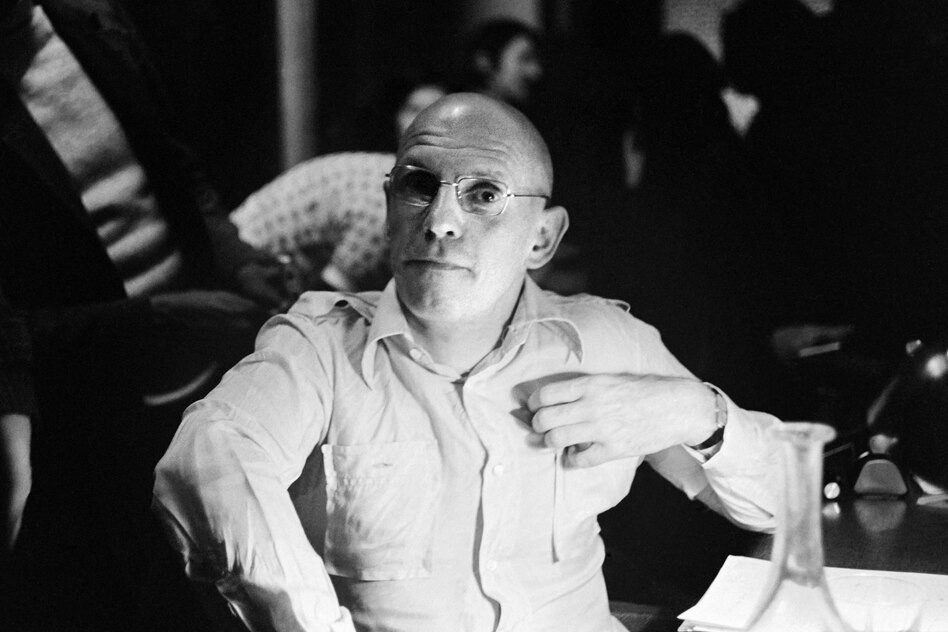
It could have been an evening in January 1950. The bar La Reine Blanche, not far from Boulevard Saint-Germain, is packed. The guests: mostly men - younger, older, married, unmarried, some openly, others secretly gay - many of them looking for a flirt, sex or even love. The landlady sits enthroned at the bar. At the table in the corner, a thin black American man is making speeches, speaking French with a strong accent, surrounded by people, including his new lover, a young Swiss man. James Baldwin is 25 and only he and his friends know that he is a writer.
On that winter evening in post-war Paris, he tells the bar crowd the story of how he ended up in prison shortly before Christmas because of a stolen bed sheet - an experience from which he would form one of his brilliant essays: "Equal in Paris". It is not impossible that a student named Michel Foucault also drank a drink in this bar that same evening.
If Foucault, then 23 years old, did not seek refuge in the bar La Reine Blanche, then in similar establishments in the same area on the left bank of the Seine. Foucault's regular excursions "to gay bars or promenades" at the time are as well documented as the depression and shame that haunted him afterwards. This is what Didier Eribon reported in 1989 in the first version of his biography of the philosopher. In 2011 he expanded it, and "Michel Foucault. A Biography" is now being published in German, on the centenary of the philosopher's birth this year.
Michel Foucault would have been 100 years old on October 15, 2026. To mark this occasion, the cultural editorial team of the taz will publish an article every month on an aspect of the work of this influential philosopher. The following texts have been published so far:
Cord Riechelmann on Foucault's intellectual program that combined theory and activism
Philipp Sarasin on Foucault and the Left
Julian Nicolai Hofmann on Foucault and the “coldest of all cold monsters”
Petra Gehring on Foucault and the power of compulsory confession
Georg Simmerl on Foucault's theses on fascisation
Andreas Fanizadeh on Foucault's engagement with the Iranian revolution of 1979
The scene in the bar can be imagined by reading Nicholas Boggs' monumental biography "Baldwin. A Love Story" (2025). There is no Foucault there, and conversely no Baldwin appears in Foucault biographies, of course not. These two lives, as well as the works and the lines of tradition and reception of the two authors, are too different. There is no evidence of an actual meeting between the two. And yet it is quite possible that James Baldwin and Michel Foucault occasionally visited the same places in Paris's nightlife around 1950.
One later became a best-selling author and a sought-after activist in the black protest movement in the USA; the other a philosopher read worldwide, whose influence far exceeds the boundaries of the academic world. To this day, they are both icons - for an analysis of society that pushes for fundamental change. The fact that Foucault and Baldwin frequented the same neighborhoods for a while, at least at night, sets a series of associations in motion. For example: For Baldwin, the escape to Paris played a similar role as the escape from Paris for Foucault.
When James Baldwin told his mother and eight younger siblings that he was leaving New York and emigrating to Europe in November 1948, he got on a plane that same day. Later, he repeatedly spoke about how much he could no longer tolerate the life-threatening racism in the USA. His biographer reports what he didn't tell so often: Baldwin also experienced anti-gay violence, even in the socially mixed Greenwich Village. Given these circumstances, the change of location brought relative relief for Baldwin.
Not that Paris was free of racism or homophobia; and his money was still tight. But in France he experienced himself primarily as an American. Racism there found its primary objects in the immigrants from North Africa. The milieu of bohemians, expats, cafés and hotels in which he moved provided an infrastructure for loving, writing and surviving - and the material for the setting of his novel "Giovanni's Room" (1956).
In an essay about the writer André Gide, Baldwin notes about the situation of non-heterosexual life: "The truly terrible thing about the phenomenon of contemporary homosexuality [...] is that the unfortunate person with deviant sexuality of today can only save himself by the most violent use of all his powers from falling into a netherworld [...] in which it is impossible to have a lover or a friend, in which the possibility of real relationships has completely disappeared."
Michel Foucault moved to Paris in the fall of 1945, shortly after graduating from high school, from a wealthy middle-class background in the provincial town of Poitiers. For him and his peers, post-war normality consisted of the relentlessness of the marathon of examinations, as is traditional for the most educated of the French classes: preparatory class at one of the most prestigious high schools in the country, admission to one of the most prestigious universities, the École Normale Supérieure.
His achievements, first in philosophy and then psychology, were above average - but he led a "life that he would only endure with difficulty," as Eribon writes. He was unable to fit into the community of normaliens; He started fights or threatened classmates with a dagger. The sad highlight of his behavioral problems were various suicide attempts. His doctor confirmed that he had a bad homosexuality. But the young Foucault was not only a student and patient, he also worked as an intern in the Sainte-Anne psychiatric hospital - and from 1950 in the Fresnes prison. In the very same prison, a few kilometers south of the capital, where James Baldwin was held at Christmas 1949.
After ten years in Paris, Foucault took the chance to leave the country. He takes over the management of the French Cultural Institute in Uppsala. There is no doubt that by moving to liberal Sweden he also hopes to escape the restrictions of his love life. “In any case, I suffered from some aspects of social and cultural life in France,” he said in 1982. “That is the reason why I left France in 1955.” But homosexuality is hardly accepted more generously in Protestant Uppsala than in Paris. However, the codes of coexistence are different, and this at least opens up different scope than in France.
So neither Baldwin in Paris nor Foucault in Uppsala find complete freedom. It is more likely to be said, says Foucault in retrospect: "the feeling of freedom we feel is often greater in a foreign country than in our own country. As foreigners, we can spurn all the implicit obligations that are not written into the law, but are written into the general mode of behavior."
The parallel lives of Michel Foucault and James Baldwin can be further questioned as to where they might have almost met each other: in San Francisco in the 1970s, for example? A look at their works and attitudes seems even more interesting, and it reveals some points of contact.
Above all, there is the matter of power. The longer Baldwin writes about Black America and white supremacy, the clearer it becomes that his criticism of racism is a criticism of power that sees power in institutions but does not fix it there; which she still detects in the most subtle interpersonal relationships; a criticism that sees power as, in principle, reversible. All of these points are an essential part of how Foucault expanded his idea of power into a whole analysis during the 1970s.
The prison and the police are the institutions that Baldwin and Foucault each analyze and attack in their own way, with implications that continue to this day. In his criticism of the police, Baldwin draws primarily on his own experiences with the cops since his childhood, even though he knows that racism in the US law enforcement agencies can be statistically proven. He writes as a “witness,” as he says again and again.
Foucault goes further, for professional reasons. The “Great Incarceration” is the title in “Madness and Society” (1961) for the European 17th century project of rounding up not only the “mad” but also other socially undesirable people, such as criminals, beggars, the sick, tramps, prostitutes or people with deviant sexual practices. He follows this investigation when he later analyzes prison as the central method of punishment in European modernity - on the basis of historical sources, with the ambition to extract philosophical insights from them. “The soul: prison of the body” is just one of the resonating sentences in “Monitoring and Punishing”.
When the book was published in 1975, Foucault had already been fighting for years against the conditions in French prisons and demonstrating against anti-migrant police operations. For a few years, his own apartment served as the headquarters of the activist network Groupe d’information sur les prisons. It is the same time in which he sympathizes with the Black Panther Party, which translates criticism of racism into “copwatching” and self-organized social work in various US cities. It is obvious that James Baldwin supports the Black Panthers - although at second glance his love for the Panthers definitely needs to be explained, because some of them insult him in homophobic ways.
Political stakes like these point to perhaps the greatest similarity between the two: a vibrant relationship between authorship and activism. On the one hand, Baldwin, the novelist, insists on the stubbornness of artistic creation. And Foucault, the philosopher, takes the opportunity to prevent the audience from making a connection between his academic work and his political commitment. On the other hand, Baldwin puts immense energy into a fight against white supremacy, the connection to his literature is obvious.
And Foucault himself, on other occasions, does not characterize his thinking as an isolated science. His desire for his books to function as a “tool box” or “Molotov cocktail” has become almost proverbial. He makes no secret of the fact that these books have their starting point in the life of their author. As he explained in a conversation with Didier Eribon in 1981, they form “fragments of an autobiography, so to speak.”
Seen from today, the most astonishing point of contact between these works, which are created side by side without knowing about each other, can be found in two interviews from the 80s. Baldwin has long since moved the center of his life to the south of France and commutes to the USA for teaching positions. Foucault teaches as a professor with the responsibility for the “history of thought systems” at the Collège de France and researches his major project “Sexuality and Truth”. The public repeatedly seeks advice from the two intellectuals - including the young gay rights movement.
Baldwin was 59 years old when The Village Voice asked him questions about the gay situation. He sees himself as a witness to the gay experience - but he is unfamiliar with the vocabulary of the younger generation: What exactly does “coming out” mean and what does “gay” mean? His generation only had the word “homosexual” available. And then the sentence comes: “‘Homosexual’ is not a noun.” What other part of speech? “Maybe a verb,” Baldwin replies. "I loved some people and they loved me. It had nothing to do with those labels."
Foucault was 54 when the gay magazine Gai Pied asked him questions about his views on sexuality. Right at the beginning of the conversation, Foucault is happy about the existence of the fairly new magazine. But he is confused by the fact that people his age can hardly see themselves in it: that here, as in general society, homosexuality is equated with youth. And then the sentence comes: “So we have to work hard to become homosexual and not insist on admitting that we are so.”
Gay as a word denoting an activity; and becoming rather than being homosexual: Both Baldwin and Foucault resist turning sexual orientation into a fixed identity category. Both see processes and practices at work here, not pigeonholes. One person substantiates his view with his own experience – “love is where you find it”. The other wants to escape sexuality as, as he calls it, a device, for example the attributions that go along with a particular sexual identity; wants to use the deviation from the norm to invent new relationships: “friendship as a way of life”.
In a present where the culture wars are raging, not least over gender, sentences like these sound a bit like they come from another time, almost naive. It would be hoped that they would still be heard. Sentences from a tradition that knows that gender and sexuality have nothing to do with reality and everything to do with social practice. That practical exploration could be a form of lived enlightenment that rejects the will to know that prevails everywhere. By the way, James Baldwin's Village Voice interview appears on June 26, 1984. That is the same day that the Paris newspapers reported the death of Michel Foucault.
René Aguigah heads the literature department of DLF and DLF Culture. “James Baldwin: The Witness” was published by C. H. Beck in 2024.
Read the full story at the source
Source: taz