
Germany taz
Sophie Calle exhibition in Berlin: Could it be better?
To mark the house's 30th anniversary, the Hamburger Bahnhof in Berlin is showing a show by Sophie Calle. The curation turns out to be cerebral. more...
Deutsch (original) ·Auto-translated to English
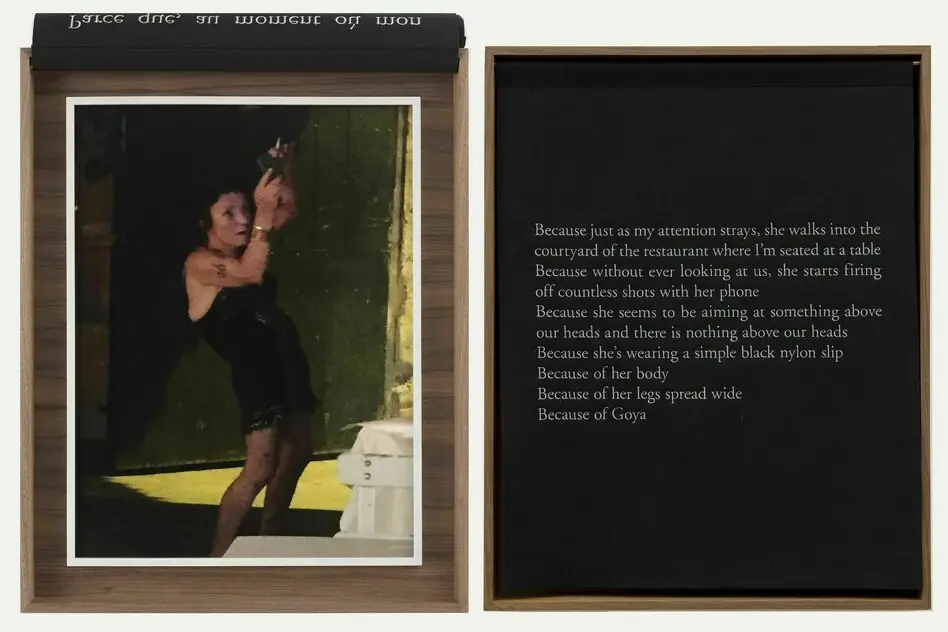
In the end she does appear: the daring, funny and voyeuristic Sophie Calle. "Because I wouldn't want anyone squatting in my zygomatic arch. Because I wonder whether T and K still love each other or whether their love has died. Because one day only the padlock will remain." (“Because I don’t want anyone to get stuck in the arch of my cheekbone. Because I wonder if T and K still love each other or if their love has expired. Because one day only the padlock will remain.”) is embroidered in white on purple felt. Attached to the frame, it covers a photo. Visitors are allowed to ventilate it, as the artist has written on the wall in fine French cursive with a pencil.
If you lift the thick curtain, a dark gray colored collection of human bones appears. All sorts of bones and skulls. One immediately hopes that it is a collection of some sort of religious nature and not the remains of a mass grave. In the skull depicted in the center, someone has placed a padlock in the cheekbone. “T+K” is written on it in thick white Edding. A gesture of supposedly eternal love that has spread rapidly on bridges and supposedly romantic places around the world in recent decades.
You swallow helplessly for a moment, caught between piety, humor and curiosity. Death and longing and love and hopelessness and the radicalism of going irritatingly far beyond boundaries for the sake of the experiment or the result, as well as the combination of text and photography lie in this small work - and it is exemplary of everything for which Sophie Calle became known.
“Is it Better” is the name of the exhibition by the French artist, who was born in 1953, and which Hamburger Bahnhof is opening in Berlin on Friday to mark its 30th anniversary. While in the main hall noisy school classes are still building and tearing down Lina Lapelytė's towers amid the building blocks sponsored by Chanel, to marvel at Calle's work you have to climb to the first floor of the former train station building, where the wooden construction noise immediately falls silent. And yet here too you are immediately caught between demolition and reconstruction.
In 1996, the year the Hamburger Bahnhof – National Gallery of the Present opened, Sophie Calle also began her relationship with Berlin, as curator Lisa Hörstmann describes it, and created the series “The Distance” in the post-reunification city. The conceptual artist photographed places in public space where monuments and insignia of the GDR were removed and showed the images of the empty spaces visible to people who shared their memories of those same places with Calle.
The resulting book – one of dozens in her oeuvre – documents photographs, the removed objects and the short texts. It is a pleasure to discover the fuzziness and indifference as well as the interweaving of the individual with the political in the twelve-part series, which is otherwise only available to parliamentarians on loan from the art collection of the German Bundestag.
Berlin understood early on how to market its dysfunctions, conniving and bad decisions for self-promotion. With the drama surrounding the Rieckhallen and the controversy surrounding the withdrawal of the Friedrich Christian Flick Collection, the Hamburger Bahnhof itself was also a frequent example of the country's failed cultural and real estate policy. Perhaps there are also touches of courage and self-irony in the curation of the museum director Sam Bardaouil and Lisa Hörstmann in showing Calle's clearly Berlin works on the occasion of the anniversary.
So does “Is it Better?” the eponymous works, which follow a very similar principle. The artist made them twice. Once in 2012 and now in 2026, especially for the show. “Is it better?” Calle asked for the two-part series City Dwellers, first referring to the former Palace of the Republic, where a lawn covered the floor area after it was demolished from 2006 to 2012, and later to the newly built Berlin Palace, which was built on the same lawn from 2013.
The quotes appear anonymously on text images next to photos of the location, and postcards show the situation before the change. Calle takes the respondents seriously; the opinions seem to be exemplary of the debates in the city. However, great poetry is unlikely to emerge here. And if you ask Hörstmann how his colleagues from the Humboldt Forum, which is located in the Berlin Palace, reacted to the work, he dismisses it: The debate is really old.
Sophie Calle. “Is It Better?”, Hamburger Bahnhof – National Gallery for Contemporary Berlin, until April 4, 2027
The work of the self-taught Calle, who, among other things, represented France at the Venice Biennale in 2007 and whose largest audience consists of young women, as she recently revealed in an interview with Die Zeit, is particularly fascinating because of the illusion of radical self-exposure and the artist's submission to the project.
As a young woman, she began to pursue a strange man, followed him all the way to Venice and documented this in detective photos. She regularly anonymously sent a stranger clothes for his birthday that she thought would look good on him, copied a private address book she found, contacted the people in it, created a portrait of the owner, and filmed her mother's death.
The works almost always revolve around the ghostly, a gap or memory. These are often accompanied by projections noted by the artist, with self-revelations and longings, with sensuality, with passion and willingness to suffer. What is actually autobiographical and what is fiction remains unclear, which makes the artist even more of a symbol of her work: the viewers fill the voids of her private life with her projection, just as Calle fills the longings in her work itself. In the age of the autofictional boom, it can be surprising that her work has not been comprehensively presented in Germany for more than 20 years.
The exhibition at Hamburger Bahnhof, on the other hand, is more in the name of the artist's works, which are more distanced from the self. The show also presents the series “The Ghosts of Orsay” from 2022, in which the artist deals with her years in the abandoned Hotel d’Orsay, a grand hotel in the Paris train station of the same name, which has housed the Musée d’Orsay since the 1980s and in which the artist stayed unnoticed in the late 1970s until the renovation work began and documents and objects collected, but this is far less self-revealing than her early work.
For this work, which she created for an exhibition at the Musée d'Orsay, the artist had guest cards from the 1930s, room numbers and technical objects interpreted by an archaeologist; the accompanying texts are carefully framed.
From the museum in the train station to the museum in the train station, this has now moved to Berlin, and another work that was originally made for the Musée national Picasso-Paris and shows photos of master hams covered during the Corona lockdown can also be seen, at least in part.
After so many institutional references, it is good to visit the last two rooms of the exhibition. For the almost painfully touching video work “Voir la mer” (Seeing the Sea) shown there, Calle filmed people living in Istanbul seeing the sea for the first time. (The back view that appears first is of course also referred to in the text here as Caspar David Friedrich, who is in the Berlin collections, but this can safely be ignored.).
A few steps further you can finally snuggle under the felt curtains and discover T's and K's morbid love. Embroidered into the textile, the artist wrote down why she photographed the motifs. Below you discover a cloud like intestines. Or a woman photographing nothing, her body hunched over in a black dress. Or shirt, tie and final bills, the words on the curtain: “Because of the Pangs of Sadness.” And suddenly you can feel it very clearly.