
Germany taz
Dilapidated Köhlbrand Bridge: Hamburg's port is threatened with a heart attack
Doubts are increasing as to how long Hamburg's Köhlbrand Bridge will last. Stability is at risk. more...
Deutsch (original) ·Auto-translated to English
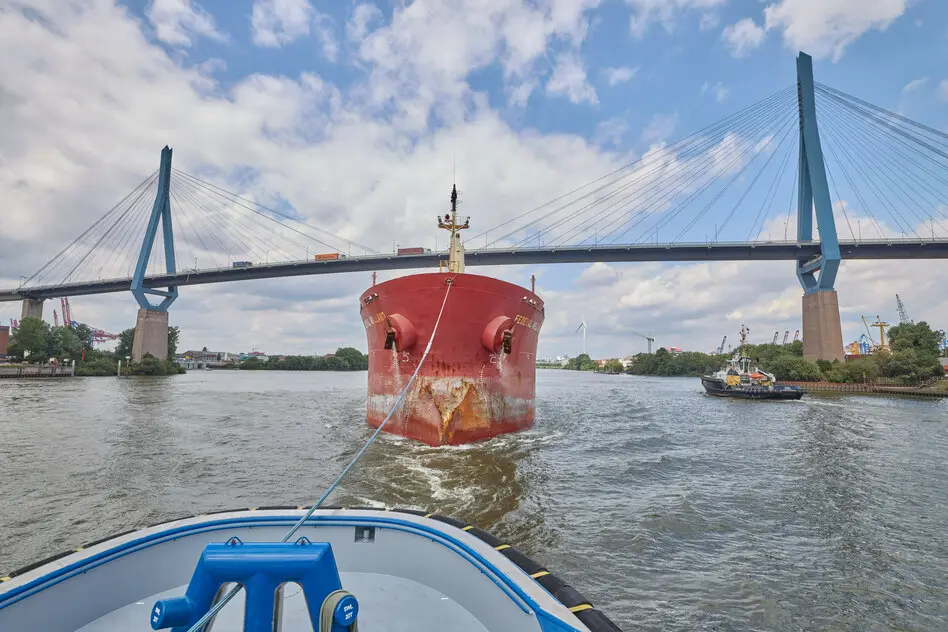
It is a Hamburg landmark and at the same time one of the most important connections in the port of Hamburg: the Köhlbrand Bridge. It has now emerged that their condition has further deteriorated in recent years and has exceeded a critical threshold: the stability is at risk.
30,000 motor vehicles travel on the Köhlbrand Bridge every day, including 11,000 trucks. The load today is many times higher - both in terms of the number and weight of the vehicles - than the engineers imagined when it opened in 1974. As early as 2012, the then mayor Olaf Scholz (SPD) announced that the bridge would have to be replaced.
The fact that the bridge was fundamentally repaired between 2014 and 2016 for 60 million euros did not change this development. The total number of damages discovered and repaired each year rose from 25 in 2016 to 158 in 2025.
Nevertheless, the grades in the most recent regular main inspection from the beginning of 2025 to April 2026 were devastating: the power bridge, which consists of a hollow steel body, received a grade of 3.4, the two elevated ramps made of reinforced concrete each received a grade of 3.5. The condition grades for bridges in Germany only range from 1 to 4.
3.0 to 3.4 means “insufficient” and is considered an “indicator that a repair measure needs to be planned in the near future”. According to a note from the Federal Highway Research Institute (Bast), 3.5 and worse describes an “inadequate structural condition” with the definition: “Stability and/or traffic safety are significantly impaired or no longer exist.”
Such a judgment raises the question of whether the bridge will even last until the planned completion of a new building at the end of the 1930s. As early as 2017, the HPA port administration began planning a new Köhlbrand crossing. She planned a tunnel for years until it became clear that it would be prohibitively expensive due to unexpected difficulties in the subsoil.
Critics doubt that the bridge needs to be as high as Leonhard announced, hoping that a simple replacement would be cheaper and easier to accomplish. After all, only one of the many container terminals is behind the bridge and the growth in ship sizes must come to an end. Leonhard contradicted this in the citizens' economic committee at the beginning of October.
“We don’t have the situation where all the ships that exist today can fit under the Köhlbrand Bridge and only some of the predicted ship types can’t,” she said. Even an average ship with 14,500 standard containers (TEU) is over. In addition, the Senate is planning a transfer point for renewable energies behind the bridge and the expected gas tankers will have to fit under the bridge with a certain amount of flexibility.
In September, the CDU and the Chamber of Commerce called for the construction of a relief bridge to be examined in order to prevent the risk of a bridge collapse. It quickly became apparent that such a temporary solution would be no easier or quicker to implement than a new replacement building. The Hamburg Freight Forwarders Association (VHSp) criticized the discussion as an expression of years of political stalemate.
“The real news is that after around 14 years of discussion about tunnels, bridges, tunnels and bridges again, no new crossing has yet been built,” says VHSp chairman Axel Plaß. Hamburg and the federal government must now declare the German pace for new construction.
Of course, it's not that easy. The Senate points out that it has already shortened the completion period by a good two years to the end of the 1930s - by optimizing the planning and construction process. The HPA promises that further acceleration potential will be developed during the planning phase.
Leonhard reminded the committee that a high level of planning must be achieved before a permit application can be considered and must meet a variety of requirements, such as water rights or the rights of companies in the area. She considers a project acceleration of five years thrown into the discussion to be “daring”.
Your State Councilor Christopher Schwieger contradicted the hopes that the Köhlbrand Bridge could be accelerated as a project with the existing relaxations in planning law. The Senate has brought an initiative for a Lex Köhlbrand through the Federal Council, with which the bridge could be built as a replacement structure with the same function and therefore fewer approval requirements. However, a planning approval decision also has its advantages.
If the replacement bridge is not completed on time, contrary to what the HPA promised, the semi-trailers with their containers would have to find alternative routes through the port area and along the edge of the Wilhelmsburg district. This already applies to heavy goods traffic today. The roads are already being upgraded for this.
A more clever use of the terminals would also provide relief, which would make it unnecessary to transport containers back and forth with trucks. It would also help to bring the containers to the right place on the water. Engineer Ulrich Malchow has been peddling his concept of a self-loading port feeder barge for years.