
Climate taz
Solidarity at COP31: The most important climate fighters need support
The World Climate Conference is taking place in Türkiye: but queers are faced with a repressive state. How can this work well? more...
Deutsch (original) ·Auto-translated to English
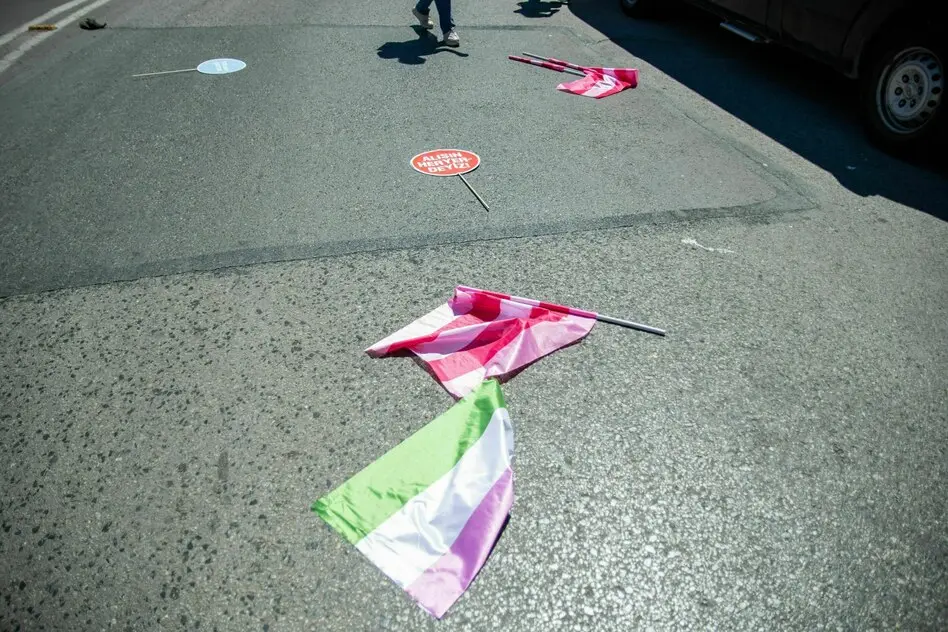
A bus goes directly from Tirana to Istanbul. When I was in Albania at the end of September, I had planned to continue driving and walk around Istanbul for a few days. In the end the bus left without me. Shortly before my trip, the police searched queer clubs, bars and apartments in 15 Turkish provinces. 162 people are being investigated, all under an operation called “My Family is Safe.” Aha!
In Ankara, board members of the Kaos GL association were arrested; according to Human Rights Watch, photos of kissing men were cited as evidence. In several cities, however, people took to the streets, and the police arrested 106 of them in front of the Istanbul Palace of Justice alone. Homosexuality is not forbidden in Turkey. Queers are still persecuted, for example because of “obscenity”. As a queer person, I had no desire to explore this experience myself.
But that's precisely why I'm more interested in COP31 this year than just the latest dystopian degree forecast - which, to be honest, doesn't mobilize anyone anymore. This year's World Climate Conference begins in Antalya on November 9th. The host's carbon footprint alone is remarkable: Turkey generates more coal-fired electricity than any EU country, and there is no phase-out date. The approval process for a new 1,050 megawatt coal block began in June.
There is no question that Turkey is completely in line with the trend that is leading us back into the age of fossil fuel technology. The COP31 negotiations are led by Australia, whose coal exports are booming. And then there is the USA, which is now leaving the UN Framework Convention on Climate Change after the Paris Agreement - the first country ever to do so. It is almost logical that an exit from coal, oil and gas is not even officially on the agenda in Antalya.
Physics has nothing to say here. According to Copernicus, the global temperature in August was 1.65 degrees above pre-industrial levels; no other month was warmer. An exceptionally strong El Niño continues to heat up. In its new report, the UN Environment Program writes: The 1.5 degrees will be exceeded and it can no longer be prevented. In order to have around a 5 percent chance of getting back below that by 2100, emissions would have to fall 45 percent below the 2025 level by 2035.
You are reading a text from our future department. If you're interested in more positive perspectives, subscribe to TEAM FUTURE, the constructive newsletter on climate, knowledge, utopias. Every Thursday you will receive an email from us with strong thoughts for you and the planet.
🐾 Sign up now for the TEAM FUTURE newsletter – free of charge
With current policies there is a risk of warming of 2.8 degrees. Keeping the 1.5 degrees alive means hope, says negotiator Chris Bowen at the preliminary conference in Fiji. However, it seems that only a few countries that are not themselves under existential threat like the Pacific states are still interested in this goal.
For me, climate has always been about justice. After Egypt, the Emirates and Azerbaijan, the COP is once again meeting in a country that keeps its civil society small. But who drives climate policy if not activists, indigenous people, feminists and queers? A conference at which these very people have to be afraid cannot deliver fair results.
That's why I hope for two things from the federal government: It should work with everyone willing on a roadmap out of fossil fuels, regardless of whether it's on the agenda. In addition, I hope she talks in Antalya not only about gigatons of CO2, but also about Kaos GL. We will break the 1.5 degrees. We must not also abandon the people who fight for them.