
Germany · taz · · 58m
Sci-fi action horror comedy “Hope”: brutally measuring the space
Deutsch (original) · Auto-translated to English
The plot can be summarized in one sentence. But you shouldn't make it that easy. In general, you can make things relatively easy with this film, for better or for worse. When “Hope,” the fourth feature film by South Korean director Na Hong-jin, was presented in competition at Cannes in May, the verdict was quite mixed. The spectrum ranged from basically benevolent, at the same time relativized with a clear “Yes, but…”, to “nonsense”. There was no price.
Which says nothing about the quality of a film. The genre mix of “Hope” alone, in which action, science fiction, horror films, westerns and black comedy form a dirty alliance, may seem off-putting to some on principle. You should therefore be warned. It's unlikely that they would be taught otherwise by seeing the film.
So to the beautiful aspects of “Hope”. Because you can find a lot of love for film art in it. Na Hong-jin has already demonstrated style and stubbornness in films such as “The Chaser” (2008) and “The Wailing” (2016). And even behind all the doomsday spectacle of his most recent contribution, he reveals a very subtle understanding of his medium.
“Hope.” Director: Na Hong-jin. With Hwang Jung-min, Zo In-sung and others South Korea 2026, 160 min.
The first images from “Hope” introduce what the next two and a half hours will be primarily about: space and the movement within it. The camera initially flies towards two mountain peaks that are close together, passes between them, and then reveals a view of a wide plain off the coast.
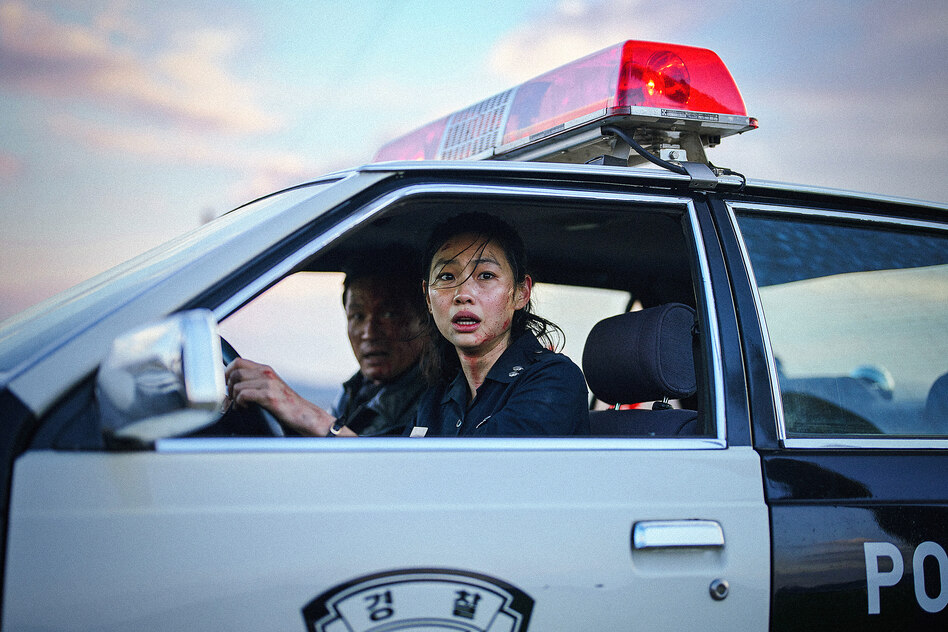
The story begins very slowly. At the edge of the plain, just before the water, a police car drives along a country road. A police officer and a man in casual clothing are sitting in the car. Their target is an animal carcass that hunters had recently found on a dirt road. The animal's injuries are strange. They look like the marks of huge claws. The hunters speak of a tiger that could have made its way through the area from North Korea. You live near the DMZ, the Demilitarized Zone that separates the two countries. Hope Harbor is the name of the fishing village.
The local police chief Bum-seok (Hwang Jung-min), who came to the site with his cousin Sung-ki (Zo In-sung), who is one of the hunters, initially doesn't know what to do with the case. He is particularly amazed at the condition of the animal, which the camera sometimes shows from an angle from below, as if to signal that something has slipped.
Shortly afterwards, the supposed calm also collapses. Bum-seok receives a radio message from his colleague Sung-ae (Jung Ho-yeon) that there are several emergency calls in town. On the way back, the police chief sees signs of destruction on the side of the road. There are considerable holes in the facade of buildings, objects are lying around, and occasionally he discovers traces of blood and corpses. Bum-seok still doesn't know what's happening to him.
From there, Na Hong-jin increases the pace in a way that amazes. Explosions can be heard, cars fly through the air and kill people on the street, and an animalistic growl can be heard. The cause of the chaos remains invisible and unknown. Until Bum-seok spots an armed resident hiding under a bridge. He saw something. For the life of him he doesn't know what.
Little by little the film zooms in on the horror, revealing more and more victims. The view also changes. Bum-seok and his companion constantly come across new holes in buildings through which something has cut real paths. A little later they are running down narrow side streets, much like in a shooting computer game, the men seem to be rushing through a labyrinth, looking for something that they cannot name but that they have reason to believe is reliably fatal.
Na Hong-jin only reveals that there is a superhumanly large monster behind all the destruction and annihilation after the men have repeatedly come dangerously close to this creature without it appearing in the picture. From then on, the film literally shifts up a gear, because just before the monster racing after the escaping Bum-seok catches him, Sung-ae shows up in the police car and saves her superior.
They continue to flee together, the monster always on their backs. It doesn't seem to be significantly injured by weapons, but at some point Sung-ae hits the green creature with a grenade so badly that it loses a leg and is now hunted by the police. It's a frenzy in which fun and horror are almost equal parts.
So far, so pointless, one could say. At the same time, it could be countered that the plot of the film may not be the main thing. With Na Hong-jin, on the other hand, you get a very direct understanding of what the term κίνημα (kínēma) is all about: The ancient Greek word means “movement,” and, as already mentioned above, there is plenty of that in “Hope.” So much that you can feel physically “worn out”. This includes the frequent change from narrow corridors or streets to open squares and areas. It is one of the elements that gives the film structure and rhythm.
Parallel to the action in town, the hunters, who have not learned anything about the events in Hope Harbor due to a disruption in the telephone network, search the forest. They suspect the tiger is there, or something that has left its not particularly tiger-like tracks in the forest floor. It probably doesn't give too much away that there is more than one monster in this story and that the hunters soon find themselves the hunted as well.
Before the horror in the forest begins, in which horses will play an important role for the people on the run, Na Hong-jin allows the audience to take a break. Without monster rage, but with some pretty rude jokes. The survivors can nurse their wounds and the police are trying to get an overview of the situation. An eyewitness reports what he observed in the forest.
On the horizon of this narrative are questions such as: What can humanity do in the face of a seemingly overwhelming threat? In the absence of more creative solutions, is it ultimately relying on blunt weapons? Since signs and posters repeatedly appear in the picture indicating ongoing inter-Korean tensions, fears of aggression from the North Korean side likely play into this catastrophe plot.
Na Hong-jin tells all of this with crude ease, without one being able to say that he exposes the topics in the background to ridicule. Whether he completely trusts people is another question.
There won't be a film like this again this year. The joy belongs to the brave. It's worth waiting for the end credits.
Read the full story at the source
Source: taz