
Germany · taz · · 35m
German Book Prize for Shida Bazyar: History of a Hometown
Deutsch (original) · Auto-translated to English
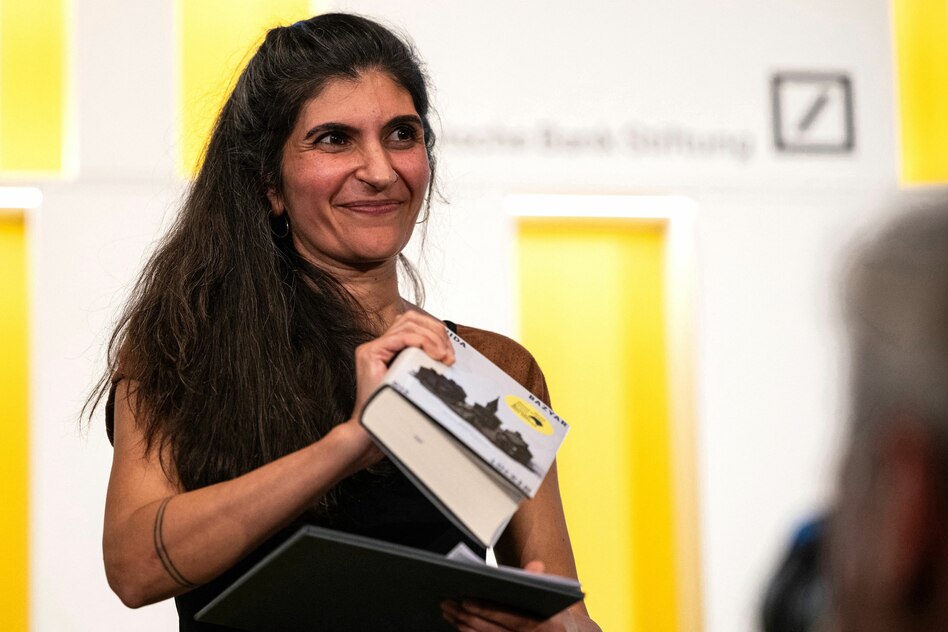
She was considered the favorite, so now Shida Bazyar has won the German Book Prize: with “The Gaps,” a book that will do everything right in Germany in 2026. Bazyar has redefined the homeland novel, said juror Maha El Hissy in her short laudatory speech shown at the award ceremony on Monday evening, and “The Gaps” actually reveals a variety of Federal Republic life.
In her third novel, Bazyar travels deep into lower-middle-class western Germany, the Hunsrück, and follows the fortunes of the residents of Heimesbach, which is based on Bazyar's birthplace of Hermeskeil. She describes how Jewish life in the town is disappearing, how the Holocaust is discussed or not discussed in post-war Germany and continues the thread up to the present day, where refugee families now meet the Nazi descendants.
One can believe that the author followed the history of her hometown to the point of obsession. The feeling that some people might have when they find out that their beloved grandfather was a National Socialist is something she experienced while studying her hometown, Bazyar said in the video about the shortlist nominees.
100 years of German history is, above all, inevitably a history of violence. Bazyar makes it clear that something like this happens by looking at the behavior of the children in Heimesbach, who mirror the adults. “And because fear had no place in this time and in the world of these children, she chose resentment,” it says at one point. “Her parents showed her that, she knew him well.”
Bazyar reacted calmly to the recording, speaking long after she received the certificate. The remarks she made in the Imperial Hall of Frankfurt's Römer could hardly be called a happy prize speech; that didn't seem right to her, said Bazyar, after all, "The Gaps" was awarded to a novel that was about the persecuted and killed.
The author drew attention to the bleak political situation in Germany, to the fact that anti-Semitic and racist crimes are at a new high, and that there is no minority group that is not currently threatened in this country. Bazyar did not leave out who this threat came from; he referred to the deportations, which are now being talked about publicly for the first time since 1945, even if they are not called deportations, but he did not locate the danger primarily in parliament. The problem, she said, quoting Hannah Arendt, the problem in 1933 was not “what our enemies did, but what our friends did.”
The link back to literature, to the now and back to the award ceremony, because despite the gloomy note, she was beaten. She found it very pleasant to be able to endure the ambivalence together with the nominees on the long and short lists of wanting to receive prizes but actually having no interest in competing with each other.
The event was moderated by ZDF man Jo Schück, who carried it off confidently, with a bit of a literary zeal and with a bit of flair. Literature is a nice antidote to all demands for clarity, he said, introducing a theme that ran through all the greetings in the Frankfurter Römer: literature as a way to counteract the current difficulties. Ina Hartwig, the head of the Frankfurt cultural department (SPD), differentiated it was important. She clearly rejected a purely national, German-national literary perspective and focused on the aspect of exchange. “Exclusion means narrowing, ultimately destruction,” she said.
Sebastian Guggolz, who was a strong counterpart to Federal Minister of State for Culture Wolfram Weimer at the Leipzig Book Fair in the spring and exuded intellectual curiosity before his first Frankfurt Book Fair, quoted Franz Fühmann. The author, who died in 1984, was concerned with the literary task of: How do I share my experiences so that they become the experience of others? Also in this greeting: exchange, communication as a means against the hardening of time. Guggolz described the entire book fair as a “counter-event to the polarization of the times”. All in all, a worthy, pleasantly unembarrassing evening that showed the literary world's strong self-confidence.
In addition to Shida Bazyar, the nominees this year were Franziska Gänsler with “Orca”, Valeria Gordeev with “The cicada escapes from its shiny gold shell”, Elias Hirschl with “Schleifen”, Peggy Mädler with “Self-regulation of the Heart” and Dana Vowinckel with “Anton and Alma”. This was a thematically wide-ranging list of candidates - from the subculture in the GDR to the German-Jewish relationship dispute, from provincial life in small towns to climate protests.
The award ceremony traditionally took place on the evening before the Frankfurt Book Fair. In a redesigned trade fair architecture this year - the trade publishers can now only be found on the ground floors of the trade fair halls - you will be able to meet many of these authors and many more until Sunday. Most often, of course, the winner; it will be omnipresent for the next few days.
Last year, Dorothee Elmiger received the award for her novel “The Dutch Women”. It guarantees a high circulation and international attention, which is reflected in many translations.
This year the jury included the bookseller Theresa Donner, the book critic Jan Ehlert, the literary critic Maha El Hissy, the literary director of the Berliner Zeitung Cornelia Geißler, the head of the NRW literary offices Emily Grunert, the literary scholar Stefanie Kreuzer and the Zeit literary director Adam Soboczynski.
Read the full story at the source
Source: taz