
Germany taz
Dwindling sand on Norderney: coming and going
The popular beach at the White Dune on Norderney has been washed away. Some people think it's best to just let nature take its course. more...
Deutsch (original) ·Auto-translated to English
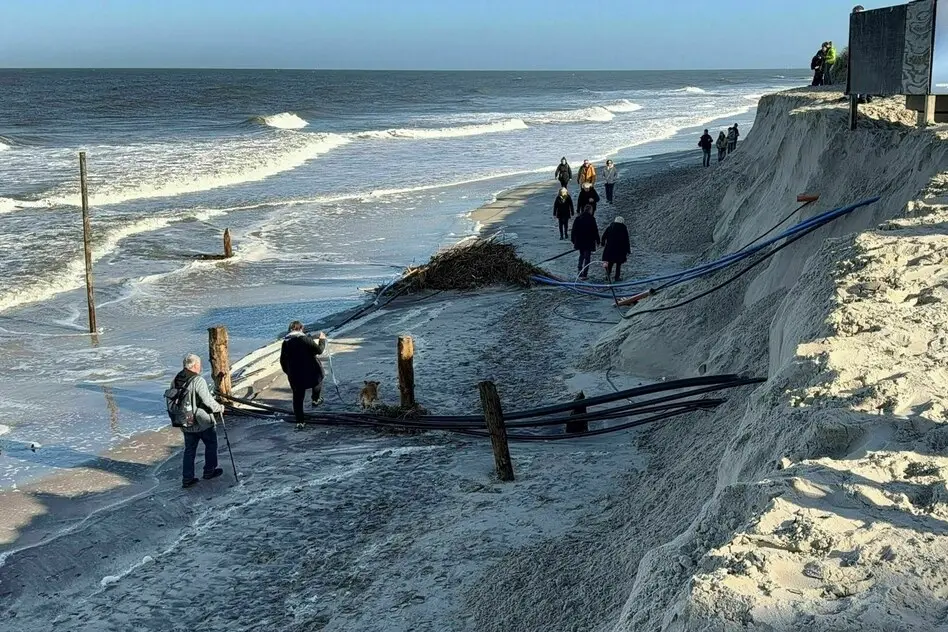
There is the sea, and here is the sand. Still damp and pleasantly firm under your steps. There are a few broken shells lying around, and closer to the water there are also a few that are still whole. People are walking around, a Labrador is let loose, he rushes towards the water, 20, 30 meters. This is a beach, a real North Sea island beach. Or?
The White Dune is gone, destroyed and on the verge of extinction, according to daily newspapers and news portals. A storm surge hit the beach on the north side of Norderney at the end of October, washing away the sand and breaking off the dune. This time the edge of the dune has receded by more than six meters, according to the Lower Saxony State Office for Water Management, Coastal and Nature Conservation.
At low tide you can still walk over a fairly large area of sand. But what can now be seen and looks like a beach is swallowed up by the waves at high tide, and the sea then hits the broken dunes. This is not a danger: the outer dune is around 100 meters wide at this point, which is enough to protect it from the sea.
But until two weeks ago there were still several thousand cubic meters of sand, an elevated beach area that can be reached from the dunes. After all: the authorities have now piled up a ramp made of sand; Anyone who comes here from the “Weisse Düne” restaurant no longer stands helplessly on the edge, but can walk down a good five meters.
A large wooden platform stands impressively on stilts in the middle of nowhere, with people walking underneath it. It protrudes about five, maybe six meters from the sand - it used to be at ground level to the beach, and toilets and changing rooms were located here. That was a few years ago now: the storm surge in October was not the first to hit the beach cold.
In the spring of 2022, a large section of beach was damaged, the wooden platform was exposed, and the coastal protection was no longer secured. As a countermeasure, 125,000 cubic meters of sand were artificially washed up, primarily to stabilize the outer dune. The effort was successful: the dune is now considered safe again for coastal protection purposes.
For the beach, the effect was not as lasting. Every autumn it is removed, every spring sand is added, but not nearly enough to compensate for the loss. Every year the restored section of beach becomes smaller; As recently as 2014, there was around 150 meters of beach at high tide. This summer only a small area of the hull was filled up for 60 beach chairs. After a few days the sand was washed away and had to be added again and again.
“Yes, that’s how it is now,” says a woman on the beach, half to her companion, half to me. I haven't spoken to her, but we're standing not far apart, looking at the edge. The two friends come from Essen and go to Norderney every year, always in November. The woman has noticed how the beach has shrunk from year to year. “There’s nothing you can do about it now,” she says. “It’s climate change.”
Climate change - that's what I thought at first, and in fact it is often mentioned as an explanation here, including by locals. But for once it's not his fault.
There are currently no more or stronger storm surges in the North Sea, says Frank Thorenz from the State Office for Coastal Protection. “Dune erosion when water levels are elevated is a completely natural phenomenon.” Huge sand banks migrate under the sea from the neighboring island of Juist to Norderney - when they are there, they change the way the waves hit the land. And when they are missing, like now, “the sea takes the sand from the dunes,” says Thorenz.
People have been working against this natural process on Norderney for years. But this time they wonder whether it was the last time. Whether we should give it up as a bathing beach, the White Dune. “We can’t keep working against nature,” says Olivia Meiners-Hagen from Staatsbad Norderney, the island’s official tourism organization, which has more say in some areas than the town hall.
A dpa report spread the ideas, and a whole range of media picked up on them. People are already rowing back at the Norderney state swimming pool and also in the city's town hall. They never said anything like that, they just wait until the winter season and nothing has been decided yet.
In reality, considerations and statements have been around for a long time. Spa director Wilhelm Loth had already chosen the wording that one cannot “throw money out the window forever” in a statement to the Norderneyer Morgenpost after the autumn storms a year ago.
But such decisions are not that easy. “You can see the excitement,” it is said from the state spa. Of all things, the White Dune! The name has a ring to it, it is one of the most famous bathing beaches in Lower Saxony. Because the sand here was almost white not so long ago, and because the beach was so wide, so beautiful. “It was probably our most beautiful beach,” says the young man from the bike rental shop. “It’s a little sad when you see it now.”
But the excitement isn't really at home on the island itself. Many people haven't even thought about it, the tourists are understanding. Even on Facebook, Norderney fans remain calm about the topic, posting a few comparison pictures from before - but tempers tend to heat up over the question of whether the island should set up a luggage collection facility.
One person who shouldn't care because he has shares here is Matthias Möckel, the operator of the Weisse Düne - the restaurant. He's been on the mainland for a few days right now, we can only talk on the phone - but he's happy to do that. “The beach is being abandoned – that sounds terrible at first,” he says. "And that's it. Tears run down my eyes when I compare the sight with before."
But: He has noticed the sand heaps of the last few years. Last year the community spent 150,000 euros to create at least a small beach, which only lasted a few days.
"The drop is sucked. Nature does the rest," says Möckel. He is the only real resident. “And if I keep my mouth shut, I don’t think there’s anyone else who should demand the beach.”
He can afford it: the restaurant is an institution; guests don't just come for the beach. The restaurant is busier than the beach today, “although it’s very relaxed today,” says a waiter. I think a young couple with an SLR camera are adventure seekers who want to see the edge - but no, the goal was the restaurant. They haven't even been to the beach yet, the restaurant and the dessert are photographed: He associates chocolatey memories from his childhood with the restaurant.
The good thing: As the sandbanks go, they come back. Such a cycle lasts 10 or 15 years, says coastal protector Thorenz. It is not possible to predict exactly when the phase will change again. But if the experience of the 10 or 15 years is correct this time too, then the people who love the island won't have to wait that long until the sand comes back on its own.
To fill up or not is primarily an economic decision, says Thorenz. It costs six figures to amass a hull beach. And with a bit of bad luck, the result only lasts days or weeks.
This text first appeared in wochentaz, our weekly newspaper from the left!
Every week, wochentaz is about the world as it is – and as it could be. A left-wing weekly newspaper with a voice, attitude and the special taz view of the world. New every Saturday at the kiosk and of course by subscription.
But if you do it, then you have a beach, one where the beach chairs don't get washed away with every tide. You can offer something to the tourists who visit Norderney every year and who are the life insurance of the islanders.
On the way from the White Dune I take the main road by bike, I have to get back to the ferry on time. An old woman with her walker walks down the street - definitely a Norderney native, which tourist would choose this path?
And so it is: Selma Harms is 96 years old, “born here and always lived here,” she says. “The White Dune, yes… it was gone before.” Then when? Harms thinks. "I don't know. Multiple times, I think." That's how it is. It's coming. And it works.