
Germany taz
Hambacher Forst: Stayed on the tree
People still live scattered in tree houses in the Hambach Forest. But the occupiers and those leaving will probably have to go: the country wants to turn it into wilderness. more...
Deutsch (original) ·Auto-translated to English
He stands between the living and the dead. The signs of the living say: I am a maple tree. I am a mountain ash. I am a red oak. The dead trees have human names. Standing next to the Elisa oak tree on this July afternoon is Robert Borsch-Laaks, 78, wearing orange horn-rimmed glasses, three-day beard, and hiking boots. Elisa fell over because the energy company RWE is dredging closer and closer to the forest, drying out its edges. Now it lies on the forest floor, its dried branches sticking out over a ditch. Borsch-Laaks wants to teach people something here in the Hambi Oasis, a mixture of tree nature trail and rest area in a famous, occupied forest between Cologne and Aachen. Walkers and cyclists often pass by, and sometimes school classes and students too. Robert Borsch-Laaks says of himself that he has a teacher's soul. He wants to bring people closer to the forest.
The so-called oasis is barely a minute's walk from the Hambach opencast mine, more than 40 square kilometers of brown wasteland. A narrow path leads north, lined with information boards with texts about the tree species that grow here. To the south a path leads to a memorial site for the student Steffen Meyn, who fell and died in the forest in 2018. Borsch-Laaks has the oasis with his club, the Drei Rosen e. V., whose members are committed to opposing coal and nuclear power. The energy transition is something like a life issue for him. As a working student at Rheinbraun in the 1970s, he saw on a model how big the pit would one day be. He knew then: That couldn't be the solution.
Today, like no other place in Germany, the Hambach Forest represents a historic victory for the climate movement. The first occupations in 2012 were followed by others, with repeated evictions and new occupations. The rest of the forest was scheduled to be cleared in 2018. But occupiers, environmental associations and citizens from all over the republic were ultimately able to save around 550 hectares of forest from RWE excavators. The original area was around eight times larger.
Occupation The Hambacher Forest is a forest in North Rhine-Westphalia that is approximately 550 hectares in size. It lies between Cologne and Aachen, mainly in the area of the city of Kerpen. The energy company RWE wanted to cut it down to mine brown coal. For years it was occupied to prevent deforestation. Environmental activists, who also call it the Hambach Forest or “Hambi”, built the first tree houses in 2012.
Tragic death In 2018, filmmaker and activist Steffen Meyn fell from a tree and died. In the same year, the treehouses were evacuated after a fierce battle. In 2020, the federal government made a promise to preserve the remaining forests with its coal exit plan.
Deforestation continues In 2025, activists occupied the nearby Manheim Sin Forest, once part of the now-milled Hambach Forest, which RWE wanted to cut down for lucrative gravel mining. In November 2025 this occupation was also vacated.
This is thanks to Robert Borsch-Laaks, among many others. When the situation around the Hambach Forest worsened, he and the Three Roses got satellite images so that they could always see where the RWE excavators were devastating the landscape and how they could best resist. They protested, sometimes side by side with the occupiers. Borsch-Laaks sometimes travels here, to the Hambi Oasis, several times a week. Here he built a small climbing frame for his granddaughters. This is where the first attack on the club took place: a red A. Someone smeared it with a felt-tip pen on an information board, big and wide, with a circle around it. Borsch-Laaks says: “These were people from the forest,” meaning the activists who live here in tree houses and huts. “What do they actually want here other than to live a free life?”
The common enemy RWE once united the many groups in the resistance, but today the disunity could hardly be greater. Instead of solidarity and unity, there is now a lack of understanding, mistrust and arguments.
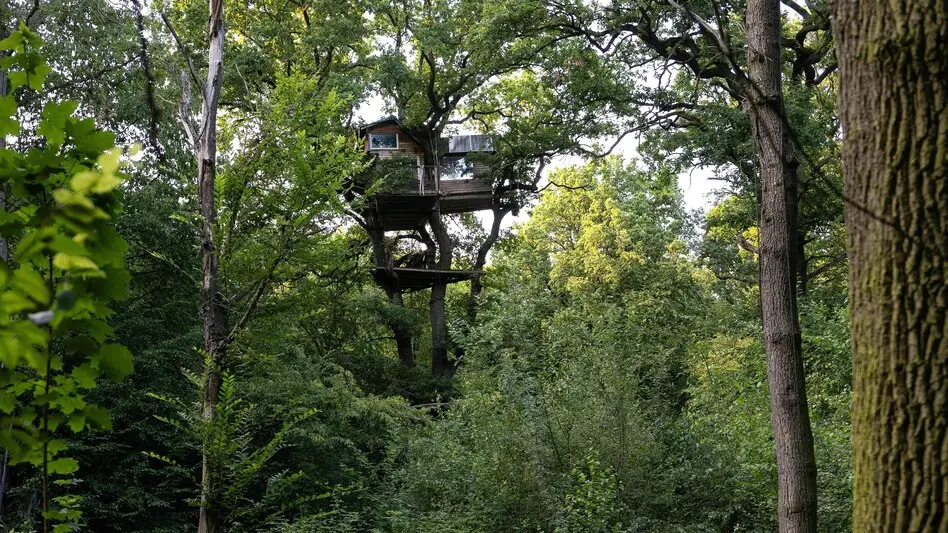
Traces of the protest can be found in many places in the forest: construction fences that the activists once used for barricades, signs, ovens. The gravel roads that RWE cut into the forest so that large machines could clear the trees have become narrow paths because bushes and trees can grow freely. It's not easy for someone coming from outside to find out who actually lives here today, and the area is confusing. There were once more than 70 treehouses and cabins, but in July there were at least 12 left, and more could be hiding in the forest. Some hang more than 20 meters above the ground. They are made from scraps of wood, some decorated with branches.
Sayings are written on benches, tables and huts: “Chaos never goes away,” “Better polytox than monogamous” and “Dead Cops for future.”
The people who still live in the Hambach Forest today almost all walk around outside their homes covered up, leaving only a slit for their eyes. Some are open to conversation but remain silent as soon as they see a recorder or notepad. They give themselves fantasy names like Tortilla or Butterfly. Their huts and treehouses are called Avalon, Hash Mountain, Yggdrasil or Old Black Socks. When they talk about someone, they usually just say “the person”. The person went to Cologne. Man is hungry. People ask questions. Other residents react with open hostility. Metal fences rise around two meters around a tree house, branches, leaves and camouflage nets hang from them, and a bicycle lock locks the entrance. A treehouse like a fortress. There's a small person in a tank top standing behind the fence. She stares and is silent. Then she says: “I don’t speak German,” and disappears. A few days later she walks through the forest, this time covered with a dark cloth. She whispers: “Some people don’t like to have journalists around.”
What may seem like pure madness today seems less strange in the shadow of the years of protest. There had been repeated escalations of violence in the forest, for example in confrontations with the police. But also with security employees who guarded the pit for RWE. One of them, who was employed by a subcontractor at the time, now tells how he had the task of keeping an eye on all the surveillance cameras during a shift. He saw colleagues taking brutal action against an activist who had broken into the pit. The four of them threw him into one of the white pickup trucks. That was “inhumane”. He himself had instructions to turn away the surveillance cameras in such cases so that no evidence would emerge. He did that and resigned shortly afterwards. Said security company is now bankrupt. A request from the taz remains unanswered.
The fight for the forest is a complicated story of evictions, compromises, court rulings and a closeness between politics and RWE, which has been criticized from many sides. The first tree houses were built here in 2012. In 2018, the Hambach Forest became a nationwide symbol of the climate movement. The “fire protection” that served as the justification for an evacuation in the same year was presumably a pretext, as WDR revealed a year later. In 2020 it was finally clear: the forest should stay. At least the remaining 550 hectares. The decision was sealed with the so-called coal compromise, in which the Hambach Forest was a symbolic sideshow to the big decision that Germany would phase out coal by 2038.
This year, the black-green state government, some nature conservation associations such as BUND and RWE have drawn up a plan for the future of the forest: by 2035 it is to become a so-called wilderness area and become the property of a public foundation. The plan is expected to be sealed with a public contract this year. Wilderness means: the forest is left to its own devices. Humans should only be allowed to intervene to remove non-native species. In addition, a cycle path is to be built around the opencast mine and partly through the forest. If the forest becomes wilderness, the occupiers have to leave it - at least that's how BUND representatives see it. In a statement from the Nature Conservation Association it is said that people should only be “guests” in the forest “temporarily” if it becomes a wilderness area.
A man who is supposed to be called Milo here is one of the forest occupiers - and yet not. He hasn't masked up for years, he says. Milo is slim and has a gray beard and doesn't want to be photographed. He lives in a small hut, the foundation is made of Euro pallets, the walls are made of leftover wood, and there are solar panels on the roof. He earns a little money by collecting deposit bottles in the neighboring town; he makes two euros a day, he says. He gets baked goods from a gas station trash can that are too old to sell but still good enough to eat. When Milo talks about the other forest occupiers, he says “them” and not “we”. He got out twice. Once from the so-called system and once from the forest community.
The first exit was in 2017. He was frustrated by the harassment in a temporary employment agency and turned his back on the world of work “for completely selfish reasons”. Where he worked, what his real name is, his exact age, he doesn't want to give any of these details. He says he liked the idea of anarchism, yes, the idea of real justice for everyone, when he was young. So he looked for a “rebel nest” and someone recommended the Hambach Forest to him.
He moved into the forest, lived first in a tent and then in a hut. Back then, nine years ago, says Milo, the committed people were still there. Back then the mood was still good. Then the coal compromise came in 2020 and it was clear: the forest would not be cleared. A triumph – you might think. But that's where the mood got worse, says Milo. The committed people left and those who wanted to have fun came. And then gangs of youth went through the forest and threw firecrackers.
Milo got out for the second time. The reason was a personal dispute between two forest dwellers. He was not involved at all, but he was asked to take a position in this dispute. Because he didn't want that, he was suddenly left out. This is how he tells the story. He does not want to name the names of those he blames. A few months after the fight, he came home from collecting pawns and was greeted by flames. “Lights ablaze,” his hut burned. Nothing left to save. He doesn't know who started the fire. The youth gangs, forest squatters – he thinks both are possible. As if to spite himself, he built his new hut exactly where the old one had stood.
When walkers come by today, they sometimes ask him what he wants to do here now that the forest has been saved. He then answers: As long as the forest belongs to RWE, it will stay. After all, owners could do whatever they want with their property, including clearing the trees if in doubt. The forest is better protected if activists live in it. He does not mention that RWE would be violating various decisions of the federal and state governments by clearing the land. Milo says he is still in the resistance. Even if he had previously imagined this resistance to be more intelligent, both from himself and from others. “Somehow more strategic, less impulsive,” he says. "I wanted to rebel and after a few years I realized that the great world revolution would definitely not start from the West. Everyone here is far too fed up."
Over the almost ten years that he has lived in the forest, he has gotten used to the winters. Today the cold doesn't bother him anymore. It's ironic that right now, shortly before next winter, eviction is being discussed again, says Milo, referring to BUND's statement that people should only be “temporary guests” in the forest. Milo calls the forest his home. He doesn't worry about where he would go if the forest became wilderness. In any case, the path back to a middle-class life would be difficult for him because he had cut off all connections. He has been living without health insurance or ID card for years. He says: “If they want to evict me, then they can.”
A Tuesday in July, 2:30 p.m. Robert Borsch-Laaks is standing in a parking lot, on the left is a broken road that used to be the A4. He, representatives from BUND and the Green state parliament member Antje Grothus want to walk through the forest and inform about the wilderness plan. Around 30 citizens are also there, including veterans from the anti-coal movement, Green Party members and local residents.
They actually wanted to leave a long time ago, but instead they are now discussing things. Because someone spray-painted “Stop Greenwashing” in big green letters on the car of Borsch-Laaks, the teacher’s soul. Attack number two. Should you call the police to keep an eye on the other cars? The police of all people? Finally, one of the walkers agrees to stay at the parking lot and guard the cars.
Everyone else walks to a narrow path that leads into the forest and looks into a sea of white signs. They are everywhere, on the side of the road, in the bushes, in the trees. The forest occupiers put them here specifically for the walk. It says: Dear green Party, your opinion is as flexible as my climbing rope. Hambi stays wild. Your perspective 2035?! – Coal phase-out now. Politics kills, anarchy lives. NGOs should not cooperate with politicians and corporations.
Some walkers grin, others grimace. Borsch-Laaks looks down and shakes his head as he tells a friend about the red A on his information board in the oasis. State parliament member Grothus says how much she was affected by the graffiti attack on his car. The forest is there for everyone. Arnoldus, a saint from the Middle Ages, already had the idea of a common forest that all citizens could use. “He would probably be turning in his grave now.”
The walkers reach the Hambi oasis. They walk past a pavilion that Borsch-Laaks had actually wanted to bring to the memorial site for the deceased student Steffen Meyn for a long time so that the photos and flowers didn't have to lie in the dirt. He actually wanted to ask the occupiers in an email for help with carrying it. The walkers take a few more steps and then stop. Robert Borsch-Laaks holds up self-made signs and lists which “trees of the year” grow here. “Ash, aspen, sycamore, …” he says and raises his index finger.
A man comes towards him. He says someone knocked down the pavilion at the entrance to the oasis and then fled. “Such a hooded person.” It rattled. Borsch-Laaks groans. Someone says this must be an attack from “camp two,” the “aggressive” and “separatist” splinter group among the forest occupiers. Borsch-Laaks lists a few tree species in a shaky voice, then most of the walkers head off to the oasis circular path. He himself goes in the opposite direction, to the pavilion, a walker accompanies him. The massive wooden structure lies on the ground on its side between bushes and leaves.
They are trying to put the pavilion back up. No chance, too difficult. He was stunned, says Borsch-Laaks. The fact that all the tons of coal remained in the ground was only achieved because everyone pulled together. "But now everything is falling apart! They say the BUND is greenwashing, the Greens are shit anyway..." He hardly dares to hope that the forest occupiers will actually help him, as planned, to bring the pavilion to the Steffen Meyn memorial site. Nevertheless, yes, despite this, he finally wanted to write them an email in the next few days and ask them to do so.
Borsch-Laaks turns around and walks back to the other walkers, past a sign that says: Danni is alive. Next to it is a small tree that was donated by a forest occupier from the Dannenröder Forest, the forest in Hesse that was first occupied by environmentalists and finally cleared in 2020 to expand the A49. A nature guide placed water canisters in front of the forest dwellers and asked them to water the Danni tree. Now it's dried up.