
Germany · taz · · 1h
Safe Abortion Day: Safe abortions under pressure
Deutsch (original) · Auto-translated to English
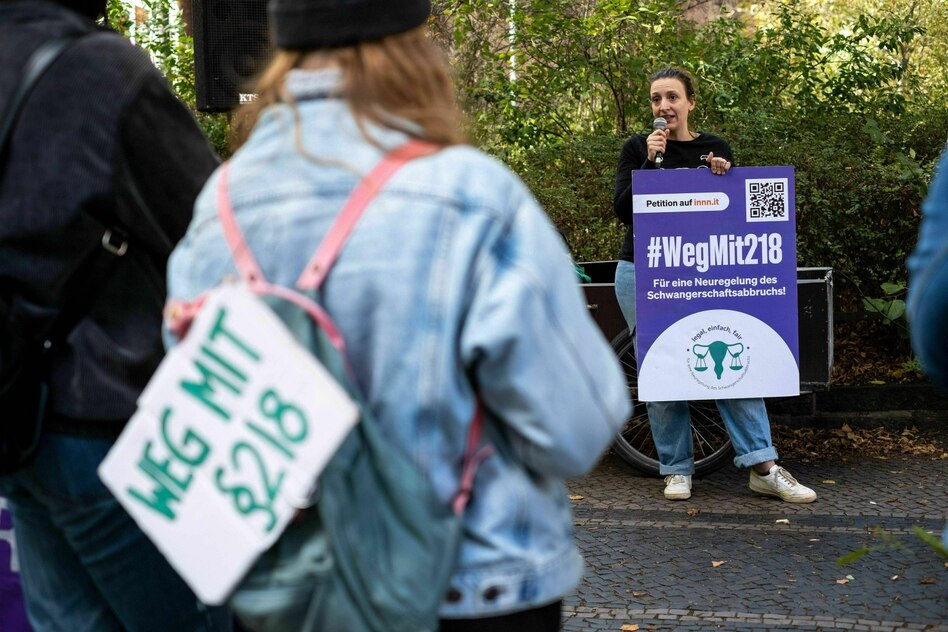
Safe, accessible, legal abortions – that’s what feminists around the world are demanding on Monday when they take to the streets for the annual “Safe Abortion Day”. Access to abortions is not a given in Germany either. With a growing Alternative for Germany (AfD) like in Saxony-Anhalt, there is a risk that the situation for unwanted pregnant women in the federal states will deteriorate further.
“In times of political shift to the right, sexual and reproductive rights are usually the first to be restricted,” says Hannah Spallek from “Doctors for Choice Germany”. The organization is part of an international network that advocates for the decriminalization of abortion. “We now urgently need political courage and political action to decriminalize abortion in Germany,” says Spallek.
Although more than 80 percent of the population supports decriminalization - this was the result of a representative survey from 2024 - abortion is prohibited under Section 218 of the Criminal Code. Only after prior consultation and a three-day “consideration period” is an abortion up to the 12th week exempt from punishment.
Reproductive rights are on the defensive in Germany - despite a social majority for the decriminalization of abortions. And despite an expert commission on reproductive self-determination that unanimously recommended that abortion be legalized in the early stages of pregnancy. In February 2025, a joint bill by MPs from the SPD, the Greens and the Left to abolish Paragraph 218 failed.
Under the current black-red federal government, the deletion of paragraph 218 is unlikely. The Union rejects any new regulation of abortion outside of the criminal code. The coalition agreement only addresses the supply situation for abortions: “We want to enable women in conflict situations to have access to medically safe care close to home,” it says.
But even the question of what the supply situation actually is is a political point of contention. “Travel times of several hours, waiting times, uncertainty – that is the reality of women who want to have a self-determined abortion,” says Bundestag member Kirsten Kappert-Gonther (Greens) to the taz. In addition to the already endangered supply situation, there are doctors for whom there are no successors and denominational operators of clinics who prohibit abortions.
“Access to abortion must be secured,” demands Kappert-Gonther. In February, she and other Green MPs submitted an application to the Health Committee. Reference is made to the results of the Elsa study from 2025.
The 999-page study is the first in Germany to comprehensively and qualitatively and quantitatively address the living conditions and care of unintentionally pregnant women. The finding: Especially in rural regions, unintentionally pregnant women have problems finding doctors in the immediate vicinity. Long journeys add costs and time pressure.
However, politicians from the Union parliamentary group questioned the regional undersupply identified in the study. “The system was and is stable and resilient,” said Union MP Maria-Lena Weiss in the plenary debate on the proposal. Since the study is not representative, the “data is not suitable to prove a structural supply problem”.
The Elsa study has shown something else: in particular, it identifies stigmatization as a “central factor” that has a “many number of negative effects” on the care situation and the psychological state of unintentionally pregnant women. Mandy Mangler, chief physician at the Auguste Viktoria Clinic in Berlin, also confirms this to the taz. For Mangler it is clear: abortion needs to be decriminalized. The gynecologist is annoyed that a medical service that is performed 100,000 times a year is also listed in the criminal code. “Abortions are a completely normal medical service and we should treat them that way.”
A normal medical service would include the abortion being covered by the health insurance companies under the advisory regulation. At the moment this is only possible if there is a medical or criminological indication. Black-red had announced an expansion in the coalition agreement: “We are expanding the coverage of costs by statutory health insurance beyond the current regulations.” That hasn't happened yet.
In addition, more public clinics should offer abortion, according to the Doctors for Choice network. According to research by “Correctiv”, only 60 percent of public clinics with a gynecology department offer abortions.
The care situation for unintentionally pregnant women is significantly more precarious in some federal states than in others. In Bavaria, for example, there are far fewer contact points than in large cities like Berlin; Hamburg or in the eastern German states. And: In Saxony-Anhalt, for example, there is currently great uncertainty in many pregnancy counseling centers. After the AfD emerged as the strongest force in the state elections with 44 percent, the financial future of many non-profit organizations offering advice is threatened.
The AfD program states: “Abortion must remain in criminal law!” The party in Saxony-Anhalt wants unintentionally pregnant women to have an ultrasound scan carried out in addition to advice. The party wants to withdraw funding from undesirable providers of advice centers who, in the AfD's view, propagate a “perverse left-wing, radical feminist and individualistic evil spirit”.
The many hurdles in Germany already mean that around 1,000 women every year go to the Netherlands for an abortion. An abortion is possible there up to the 24th week. This reduces the time pressure, but is associated with higher costs for travel and accommodation.
Such cases may have been what the “My Voice, my Choice” initiative had in mind when it launched its European Citizens’ Initiative in 2024. To enable safe abortions across Europe, the initiative has collected 1.1 million signatures in the past two years. So with success.
The EU Commission has thus achieved that member states can apply for money from the European Social Fund to cover treatment and travel costs for safe abortions.
Nevertheless, people are disappointed with the initiative. Each member state must individually express its interest in the fund to the Commission, but no member state has yet joined. One would have expected that the Commission would be “more proactive” in explaining the “My Voice, my Choice” mechanism to the member states, according to the initiative in response to a taz query. The initiative is now planning campaigns in individual countries. This should help ensure that the “historic decision is not just on paper”.
Read the full story at the source
Source: taz